
We’re always up for a good crossover between video games and other media, and Bridge Command, the latest theatre production from Parabolic Theatre that is currently playing in London, is something special indeed. Instead of a regular theatre, the production actively involves the audience in an experience that puts them at the center of their own interactive journey through space. Featuring gaming mechanics, ‘replayability’ and live actors even when they appear on the starship bridge’s monitor, it’s certainly unique. We got in touch with Artistic Director Owen Kingston to learn more, and you can catch Bridge Command until January 31st if you’re interested.
What inspired the fusion of live action theatre with gaming mechanics and interactive storytelling that we see in Bridge Command?
We just really wanted to play at being the bridge crew of a starship! We are huge sci-fi fans and grew up on a diet of Star Trek, Babylon 5, Stargate and Star Wars. When I was a kid I used to turn my parent’s extension into a starship bridge with my little friends, and this is in some ways just an extension of that same idea – super-advanced den building! In all seriousness, science fiction has long been fertile ground for interactive storytelling in computer games – in making a live-action immersive experience, a starship-based show is great as the physical boundary of the space is very clearly defined by the ship itself – we can then use the interactive gaming and video elements to expand the world of the show beyond the confines of the ship and take the audience literally anywhere. Science fiction also allows us to explore culturally relevant ideas and storylines without being too ‘on the nose’. It’s a great vehicle for storytelling.
Developing a project like Bridge Command seems like an ambitious undertaking. What were some of the biggest challenges you faced during its development, and how did you overcome them?
Increasing the audience capacity from 6 participants in our R&D test to 14 participants for the actual show was a big step up. Not only do you need to make sure that everyone has enough to do, but you also need to figure out the most optimal way of ensuring everyone understands fully their role on the ship. Designing a method of training all 14 people to collaboratively fly the ship within a tight time frame has probably been the most challenging part of making Bridge Command, and involved a lot of trial and error with our early test-audiences. It was also a huge challenge finding a venue to build our starships in. Finding a space that was the right size and shape took a long time with several false starts.

The episodic format of Bridge Command is intriguing. How did you approach designing the experience to be both engaging for standalone visits and rewarding for repeat attendees?
The key has been to find a reliable method of recording important moments in a show and decisions that participants have made, and then finding ways to build on those moments or feed back the consequences of those decisions. It’s all very well giving participants the opportunity to make decisions that affect the world of the show, but if they never get to see how those decisions play out – if it’s never clear to them how what they’ve done has affected the story – then they may as well have not done it. All of our missions are highly adaptable. They have a default set of events and characters, but they all have the flexibility to switch out elements for other elements that may have greater meaning for your specific group.
For example, you might play a rescue mission the first time you attend and rescue a specific character. In a later show, we could then reintroduce that character in a different context, replacing the ‘default’ character for that story. This person is someone you now have history with, and they’ll remember you because we recorded everything your crew did last time in our bespoke database. In a similar way your crew might find themselves with a Nemesis character who is out to get them, or information that you recovered from a wrecked ship in a previous mission might become critically important to the success of your next mission. If it’s your first mission, however, there is still a fun and engaging story there that doesn’t rely on past experiences to be interesting.

The integration of gaming technology with live performance is a unique aspect of Bridge Command. Could you elaborate on how the interactive elements were incorporated into the show’s design?
Everything is designed around the core idea of the audience being the bridge crew of the starship, and collaboratively flying the ship to complete a mission. All the elements have to support that core idea, and that puts the audience at the centre of the story – they are the protagonists and their decisions must meaningfully shape what happens. The gaming technology is the main engine for delivering that experience. The show is powered by the starship bridge simulator Empty Epsilon which is an open-source game that we have heavily modified to create enough meaningful points of input for a crew of up to 14. Each participant takes on a different role on the ship and has a way of affecting the ship through the Empty Epsilon game engine. We also adapted Empty Epsilon to send and receive triggers to different pieces of the physical set – if the manoeuvring thrusters sustain damage in the game world, then their physical components in the set can be triggered to break, meaning that one of the participants needs to go and make a physical repair before that system will work again in the game world. Everything works together to make you feel like you’re really flying a starship.
The set design for Bridge Command was designed to be incredibly immersive. How did you go about creating a physical environment that seamlessly blends with the virtual and live action elements of the experience?
We started with a 3d design of our ship interiors in Blender – our designer was Tadeo D’Oria, a 3d artist from Argentina who specialises in designing starship interiors. Once we had a look and feel that we liked, the next step was to take it to the scenic design company Illusion Design and Construct who had the difficult job of turning those 3d renders into plans for a buildable set. No expense was spared on the materials and finishes – we wanted the ship to feel real to the touch as well as look real. At a very early stage we involved escape room technology specialists Clockwork Dog to help us design physical systems that could interact with the game engine to link the physical and virtual environments together as seamlessly as possible. Using an open-source game engine proved critical to this – Clockwork Dog’s software engineers wrote bridging code to enable Empty Epsilon to communicate with their show control software COGS. Attention to detail was key. Everything needed to support that core idea of the audience being a bridge crew in command of their own starship. There are no false buttons – every control that you see can be touched and will do something.
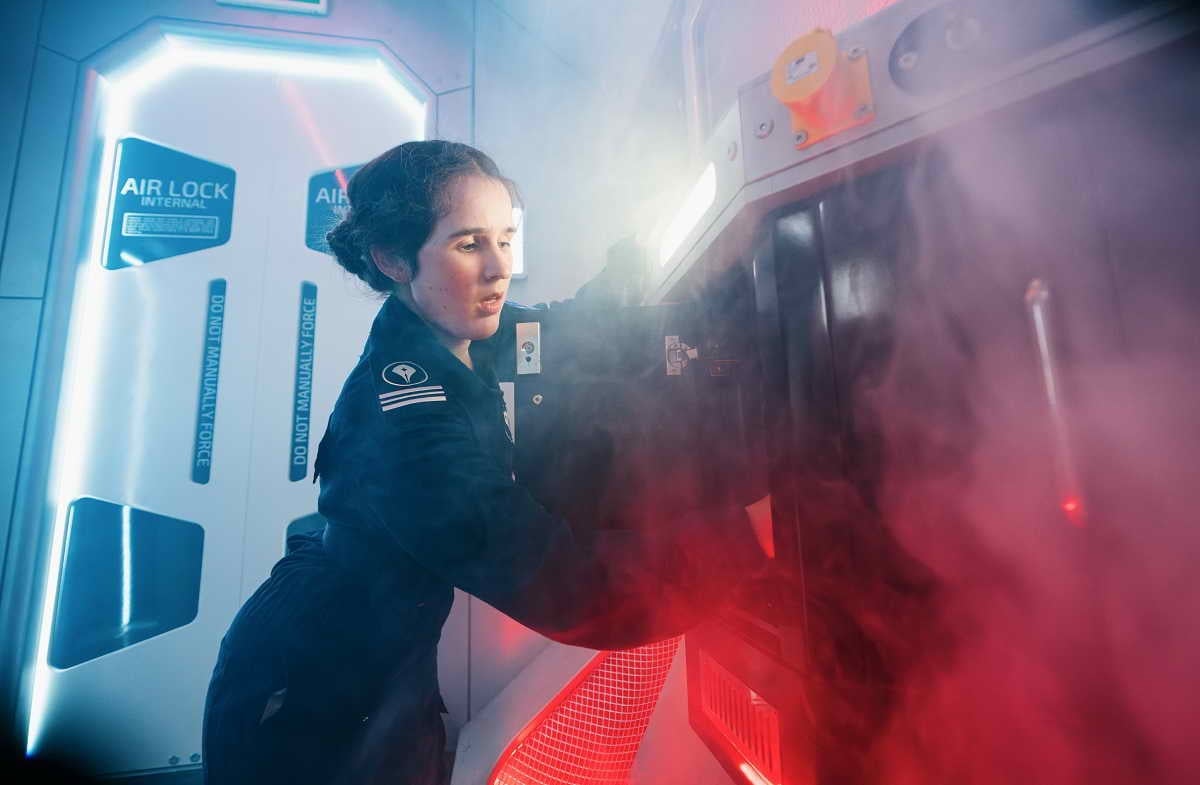
Where there are porthole windows in the sides of the ships, the angles match precisely where they would be on the hull, so you can look out and see the part of the game world it would be logical to see from that angle. We were also keen to build everything that would be logical to have on the ships – even if they didn’t have an immediate use in a show. That’s why the ships have bunks – even though our shows are only two hours long – it’s logical there would be places to sleep on board for a crew going on an extended mission. And of course, each ship needs its own toilet! Some experience designers would say we were crazy for building full starships when most of the action happens on the bridge. Why not build just the bridge? But ultimately a huge part of being immersed in the world of the show is it feeling plausible. Where we draw the boundary of the physical space can aid or hinder that sense of immersion. Everytime you encounter the ‘edge’ of the world in a show, it can jolt you out of feeling immersed if that ‘edge’ doesn’t fall in a logical place – so to have only a bridge with no ship to explore undermines that core idea of being the bridge crew in command of your own ship. If you have a ship, you want to be able to explore all of it! Drawing the boundary of the physical space at the edge of the ship feels much more logical for the participant – there’s a very real in-world reason why you can’t just walk out of the airlock – it’s called the vacuum of space! By contrast, if you’re in command on the bridge there is no adequate in-world reason why you shouldn’t be able to explore the rest of your starship if you wanted to.
Audience agency is a central aspect of Parabolic Theatre’s philosophy. How did you ensure that participants feel empowered to actively shape the narrative and engage with the world of Bridge Command?
We bring people into the world of the show slowly and carefully. When participants sign into our database at the start of a session they are creating their character in our universe. We don’t expect people to be anything other than a version of themselves, in space, in the future, but some people use that opportunity to create a different name or a whole character for themselves, and that works fine as well.
A lot of immersive shows feel more like a tightly scripted ‘ride’ where the show happens to you, and you passively observe, so it’s important to make sure that early on the audience understand that their actions are important and they have consequences – this hinges on those consequences being fed back so that participants understand how they’ve affected something. For the most part the game engine itself handles this beautifully and it makes that feedback loop super obvious from the moment you start learning how to use the ship’s systems. If you fire a missile and see something blow up, or go to warp speed and see the starfield zip past then you know your actions are doing something meaningful. We work hard to extend this to character interactions also.
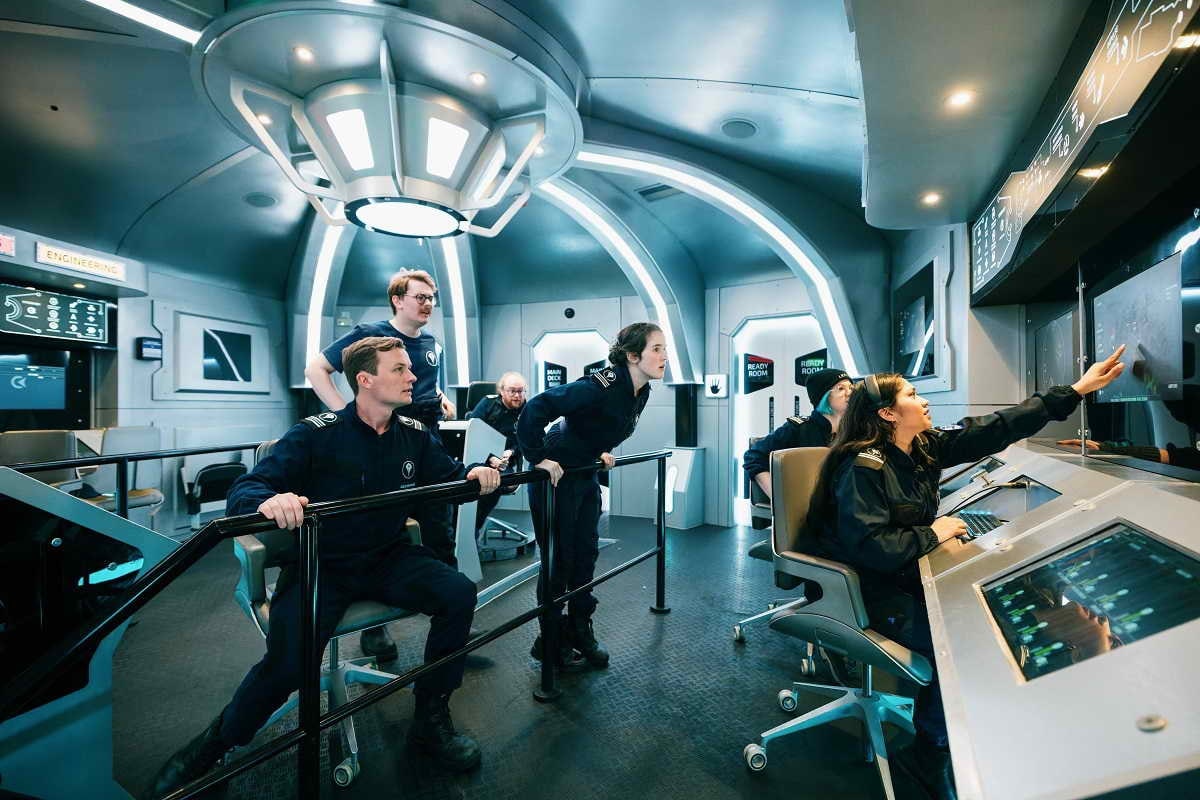
There is no AI generated or recorded content used in the show – if you hail another ship it’s a real actor that will appear on screen and talk to you live. When you open text-based communications with another ship you’re not talking to a chatbot – it’s a real actor writing a live response. If your mission is to hold diplomatic negotiations then what you say and how you say it really matters. We use very little in the way of scripted content, as scripted content tends to shut down audience responsiveness – as a participant you are acutely aware that you can’t match the verbal dexterity of someone who has had their lines written for them! Instead our performers are empowered to improvise and respond to the audience in the way that seems most logical in-world and in-character to them. This helps to maintain the feeling of a genuine conversation, which encourages the participants to actively engage.
Behind the scenes we have a Games Master who coordinates the efforts of the actors and the events in the game world to shape a meaningful story around the actions of the audience. In that way it is a lot like a tabletop roleplaying game, but as a theatre company we feel a great responsibility to deliver a satisfying story. The gaming elements are important, but so is the theatre element of delivering a good story, well told. For this reason, each of our missions has a strong narrative structure which has just enough flexibility to meaningfully incorporate the audience’s ideas and decisions, but simultaneously has enough internal integrity to reliably deliver an interesting and coherent story. Nevertheless, sometimes our audiences do things that are very unexpected! Our rule is that this is not a problem to be fixed but an opportunity to do something cool and unique. Provided the audience’s actions and decisions make sense in-world, we run with them – honestly those are the most exciting moments in shows for us, and have resulted in some of our most memorable moments in Bridge Command.
 Press Play Media