
Free League’s Over Hill and Under Hill starter set for The One Ring is a tightly packaged invitation to Middle-earth that gets a surprising amount right for its modest price, and the latest add-on that is Realms of the Three Rings expands the tone and scope in a way that rewards groups who want to press deeper into Tolkien’s quieter, melancholy corners. The starter box offers a complete, coherent introductory campaign that begins in Bree and pushes a fellowship into the lonely wilds of northern Eriador; it deliberately trades blockbuster spectacle for slow-burn dread and fellowship-focused play, and the result is a game that feels faithful to the source text even when it exposes some practical omissions and design compromises. Realms of the Three Rings, by contrast, leans into lore and atmosphere – mapping Rivendell, Lórien and Lindon in useful detail, giving the Loremaster Sauron-adjacent schemes to run, and offering rules for Playable High Elves and Elf-lords that widen the game’s emotional register and tactical palette.
Mechanically the starter set is a clever distillation of The One Ring’s latest edition: action resolution still pivots on the distinctive Feat d12 and Success d6 pool, with runes on the Feat die that swing scenes toward triumph or failure, and the set retains the game’s emphasis on journeys, councils and the toll that travel takes on characters. Free League’s condensed rules keep the core drama of Hope, Shadow, and Fatigue while simplifying examples and trimming some of the peripheral systems so groups can get running without buying the full corebook. That makes the box an effective gateway, but the condensation is not a panacea; new Loremasters and players unfamiliar with narrative TTRPG conventions will still find parts of the book dense and will benefit from a patient, experienced GM to shepherd play and bring them into the experience.
Where the starter set truly shines is in how it scaffolds cooperative storytelling. The adventure’s structure and the Journey-role mechanic encourage the fellowship to function as a unit, with encounters written to require interdependence rather than individual spotlight play. The campaign’s scenes – inns with local color, ruined halls and goblin-strewn tunnels – evoke the right mood; stakes are real and character wear-and-tear matters. However, that design choice means the box presumes a particular group size and pacing. The adventure works best with a full fellowship of five, each filling a Journey role; with fewer players, the Loremaster needs to double roles or scale enemy numbers, and the manual offers little practical guidance for smooth downscaling. The set also assumes players will commit to multiple sessions – the starter campaign runs long compared to a pick-up-and-play one-shot – so it’s not aimed at casual drop-in gaming.
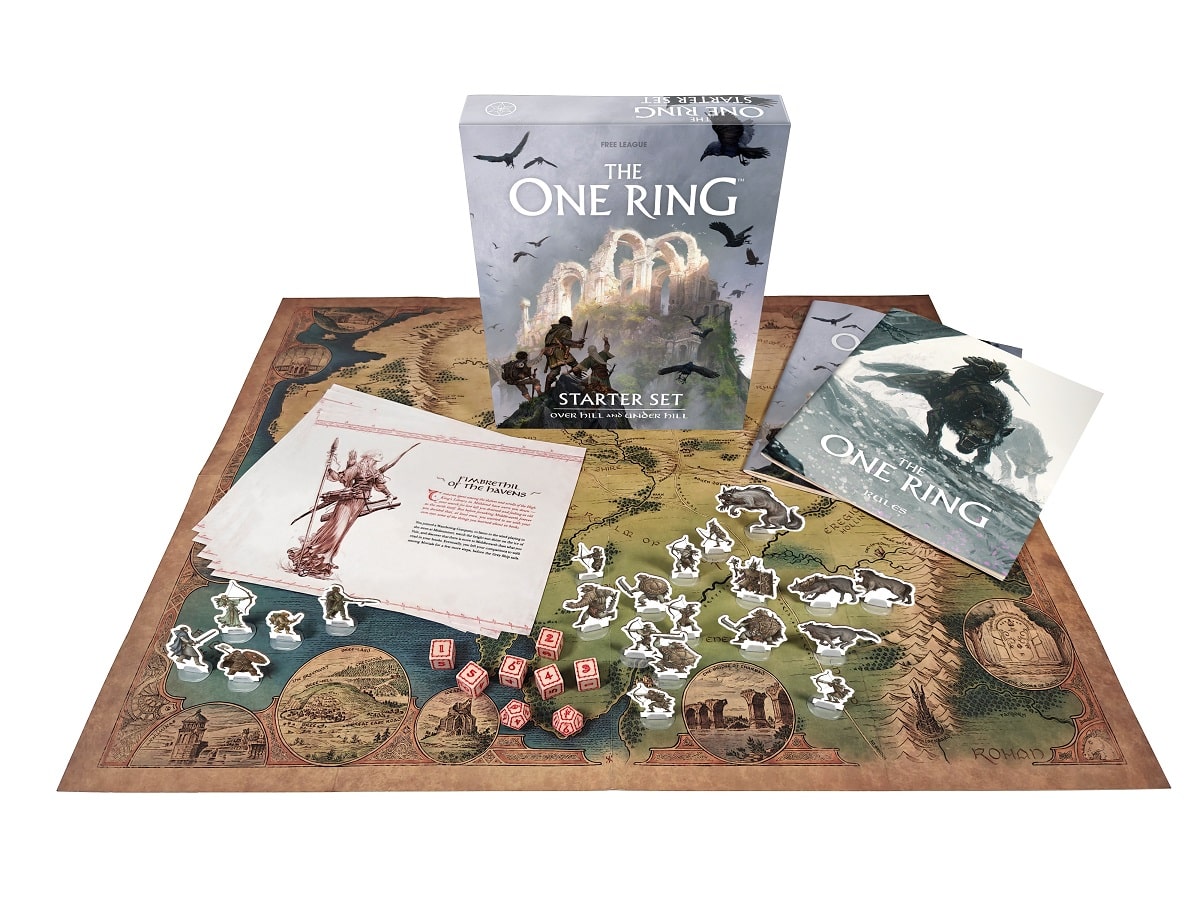
Component and art direction are consistently excellent across both releases. Free League’s production values remain a highlight: heavy-stock books, a large, attractive map of Eriador, engraved custom dice and sturdy illustrated standees elevate the tactile experience and help sell immersion. The visual language nods toward the Alan Lee tradition – soft waters, weary palettes and a restrained iconography that suits Tolkien’s tone – and the tactile quality of the dice and map makes the box feel collectible rather than disposable. Realms of the Three Rings continues that aesthetic with evocative art and useful layout choices; its location write-ups and NPC sketches read like story prompts rather than dry almanac entries, making them serviceable at the table and inspirational for further campaigns.
That said, not everything is seamless. A few missing practical aids that would have made the starter set easier to run: the Journey rules reference 20-mile hexes and a journey log but the physical hexes are not included with the book, leaving Loremasters to estimate distances or print their own; the combat diagram appears without an accompanying grid or ready-to-use movement summary, which means combat positioning can become approximate unless GMs add house rules; and a small number of the pre-generated characters feel underdeveloped compared with the standouts in the pack, producing uneven player satisfaction when characters are chosen without modification. These gaps don’t break the game, but they reveal a tension between making a “complete” starter set and trimming pages to hit a lower price point. For existing players, this is far less of an issue, and this set can be used to bring others in with ease.

Realms of the Three Rings, by constrast, gives Loremasters expanded tools and scenes centered on the West-elven realms. Its chapters outline the three remaining havens of the Elves with evocative landmarks, adventure seeds, and adversary options keyed to the growing shadow of Sauron. The supplement supplies a cascade of story hooks that pivot away from simple dungeon-clears toward political intrigue, subtle corruption and the long reach of elvish memory. It also adds mechanical options: rules to play Rivendell High Elves and Lórien elves, guidance on creating Elf-lords, and scenarios that reward a slower, more contemplative playstyle. For groups who felt the starter set’s arc was too small, Realms supplies breadth and depth without changing the system’s core rhythms.
In play, tactical combat remains less central than it is in many other fantasy RPGs; The One Ring’s flow privileges narrative consequence and journey mechanics over tactical miniature-based play. The cardboard standees are a welcome tactile addition and the combat diagram is useful for approximating ranges, but if you want grid-perfect skirmishes you will end up improvising or converting to a hex or square map. Conversely, the game’s non-combat systems – councils, skill-based social interplay, and resource management across journeys – are where it feels most original and most thematically coherent with Tolkien’s work. Shadow, Hope and the cost of travel are baked into many mechanical beats, and players who engage with those systems experience a distinctive, melancholic Middle-earth rather than a conventional dungeon crawl.
For buyers, the bottom line is pragmatic: Over Hill and Under Hill is an excellent, affordable entry point to The One Ring’s second edition that offers superb production values, a well-acted, fellowship-focused campaign and a coherent, evocative aesthetic, but it is not a fully self-sufficient classroom for complete novices and omits a few convenient play aids. Realms of the Three Rings is the natural next purchase for groups who want to build longer campaigns rooted in elvish realms and elder sorceries, adding lore, NPCs and new playable options that broaden what a campaign can feel like without disrupting the base mechanics. If you prize atmosphere, cooperative story beats and tactile components, this pair of releases is a handsome way to live in Middle-earth at your table; if you prize streamlined, instant-start rules or grid-accurate combat, be prepared to supply a few house rules and printables.
 Press Play Media