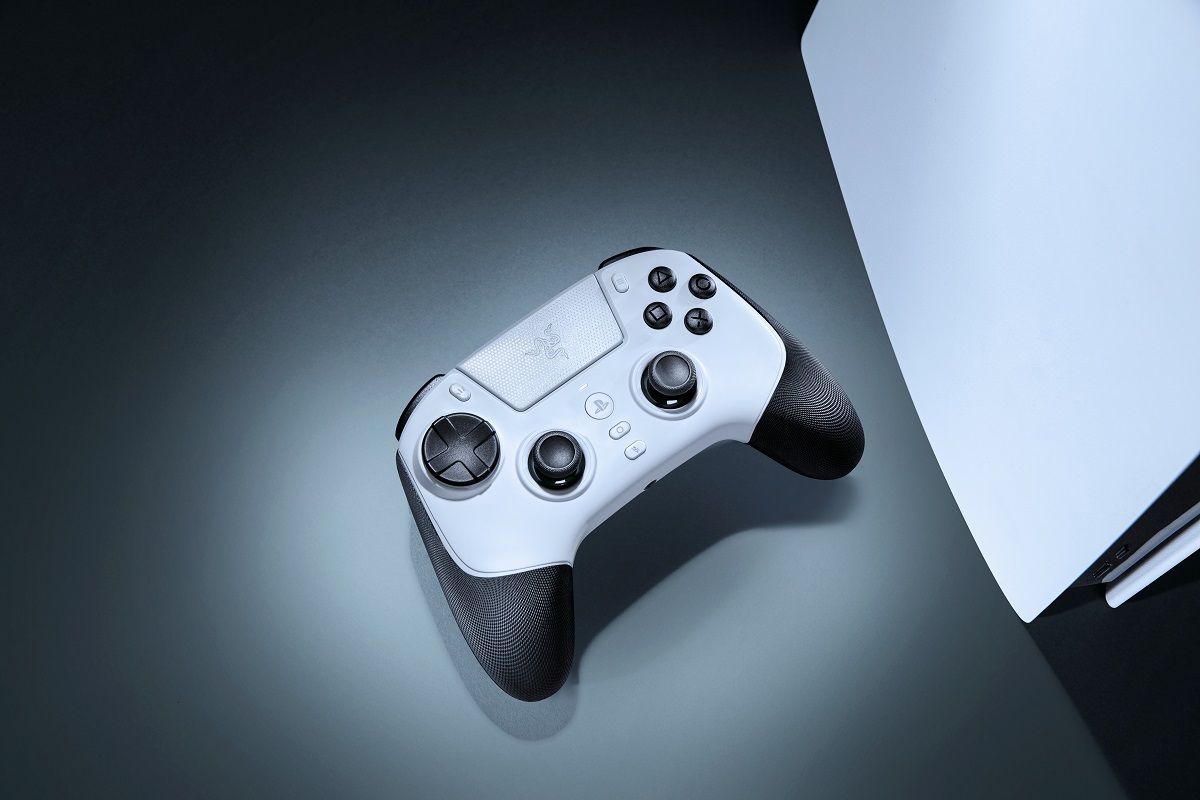
Razer’s Raiju line has long targeted competitive players who want something sharper and more specialized than Sony’s standard gamepads (like the DualSense), and the PlayStation 5-specific Raiju V3 Pro continues that philosophy with unapologetic focus. Officially licensed for PS5 and compatible with PC, this version leans heavily into esports priorities: low latency, mechanical actuation, modular back inputs, and symmetrical thumbsticks that echo legacy PlayStation layouts while refining them for tournament play. It is immediately clear that this is not trying to replicate the DualSense feature set, but rather to streamline it for performance-first users.
The most distinctive design choice is the symmetrical TMR thumbstick layout. Unlike many premium “pro” controllers that adopt an offset configuration, Razer stays true to the classic PlayStation alignment while introducing anti-drift magnetic TMR modules. This results in tighter input consistency and excellent centering, especially in competitive shooters where micro-adjustments matter. Swappable caps – shorter for speed, taller for finer aim – add tangible customization rather than cosmetic variety. That said, stick tension may feel firm for casual players, and the heightened sensitivity can expose imprecision if your muscle memory is tuned to softer analog resistance.
Razer’s HyperTriggers are another defining feature. Each trigger can toggle between full analog travel and a mouse-click-style digital stop, independently. In rapid-fire scenarios such as Call of Duty or Apex Legends, the shortened actuation delivers a decisive competitive edge, registering inputs with minimal travel. Switching back to full analog mode restores the granular throttle control needed for racing titles. The mechanism feels crisp and deliberate, although the click mode can feel abrupt in non-competitive, single-player experiences where immersion trumps response time, so depending on your preferences you might want to experiment a bit between modes.
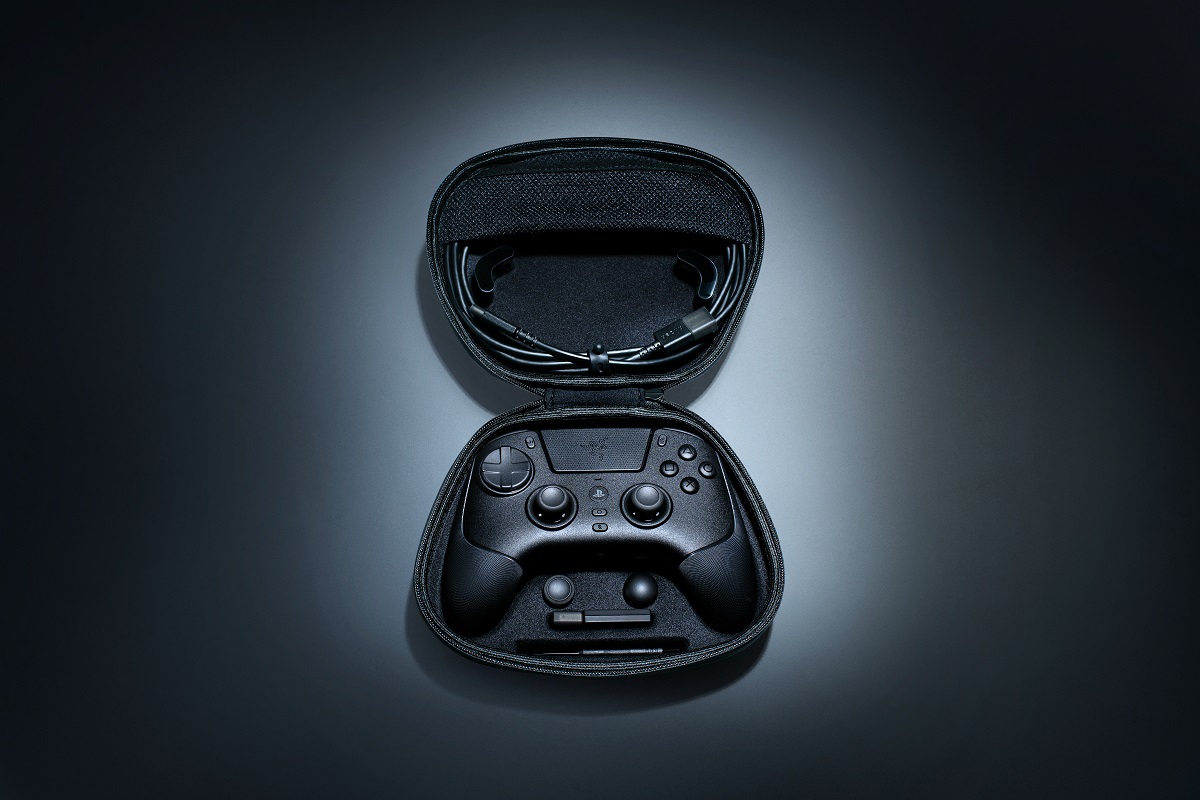
The face buttons use Razer’s mecha-tactile PBT construction, blending microswitch responsiveness with a cushioned underlayer. The result is faster actuation and sharper feedback than the membrane-based buttons of a stock DualSense. Under extended sessions, the buttons remain consistent and resist shine or wear thanks to the PBT material. However, the more audible click and firmer press may divide opinion among players who prefer softer, quieter inputs and aren’t used to what they’re getting here.
Ergonomically, the Raiju V3 Pro is substantial without being unwieldy. At roughly 258 grams, it sits slightly heavier than Sony’s controller but distributes that weight evenly. The rubberized grips feel secure during long sessions, and the four removable back buttons – alongside two additional claw bumpers – offer six remappable inputs in total, though installing or swapping the back buttons requires a small tool and some time and patience. Once configured, the additional inputs become second nature, but there is a learning curve.
Connectivity is handled through Razer HyperSpeed Wireless on PS5 via a USB-A dongle, delivering a 250 Hz wireless polling rate, while wired PC play can reach up to 2000 Hz. Latency performance is extremely responsive, with no perceptible delay in competitive contexts. Battery life when playing wireless is rated at up to 36 hours, which aligns with real-world testing for extended sessions and outperforms our DualSense, though heavy wireless use still necessitates periodic charging.
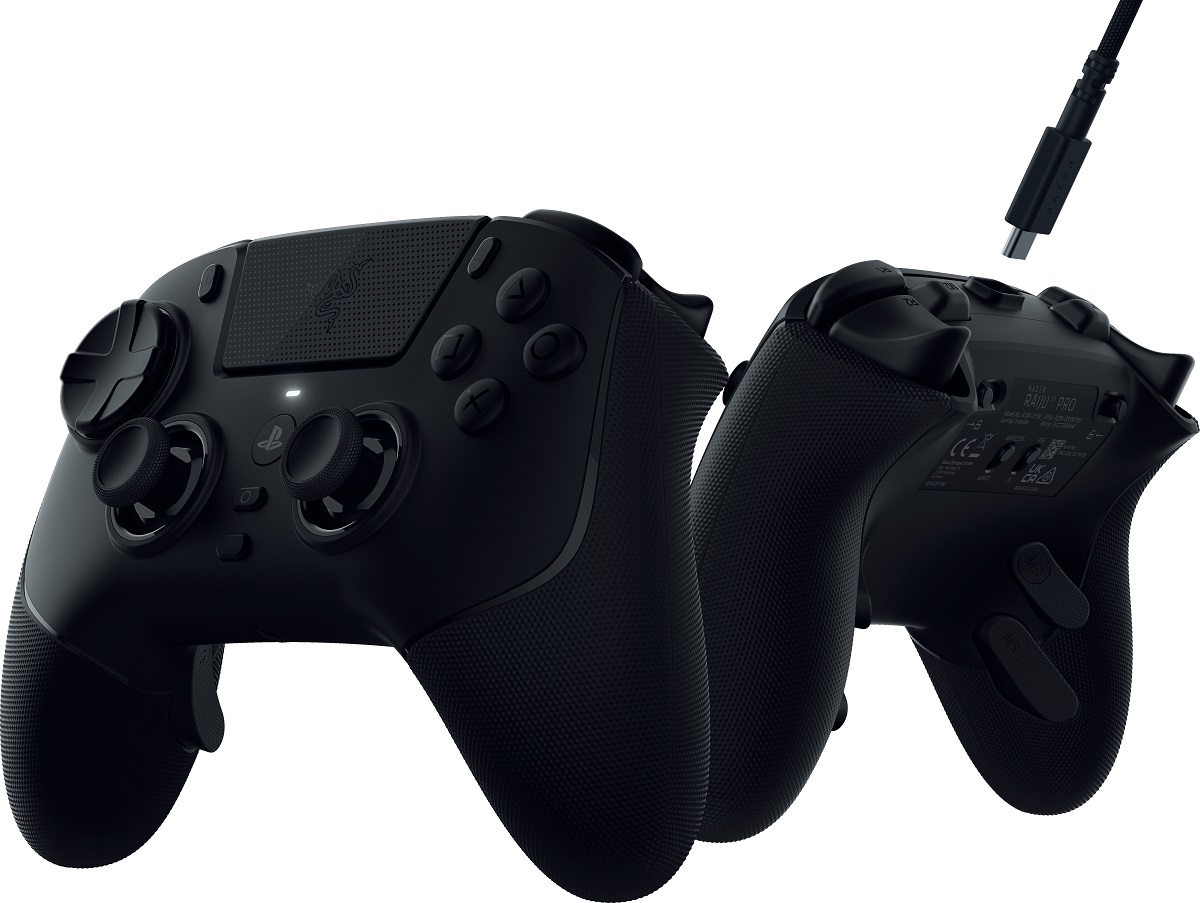
Customization is robust through Razer Synapse 4 on PC and the mobile companion app. Users can remap all six auxiliary buttons, adjust thumbstick sensitivity curves, recalibrate dead zones, and store up to four onboard profiles. The software ecosystem is powerful but not always as seamless as console-native solutions; initial setup requires an internet connection and some navigation through Razer’s broader software environment, which can be a barrier for console gamers. For enthusiasts, the granularity is welcome. For plug-and-play users, it may feel excessive.
There are trade-offs to this competitive focus. The Raiju V3 Pro omits haptic feedback and adaptive trigger resistance found in the DualSense. It also cannot wake the PS5 from sleep, meaning players must initially power on with Sony’s controller or the console itself. For some, the absence of immersive DualSense features is a drawback; for others, it is a deliberate reduction of potential latency and distraction. This controller clearly prioritizes competitive purity over cinematic and immersive flair.
Ultimately, the PlayStation 5-specific Razer Raiju V3 Pro is a purpose-built competitive instrument rather than a universal upgrade. Its symmetrical TMR sticks, adjustable HyperTriggers, and modular back inputs offer measurable advantages in fast-paced multiplayer environments. At the same time, its premium price, missing DualSense features, and slightly more complex setup make it less suited for purely casual or all-purpose play. For competitive-minded PS5 users who value precision and configurability above all else, it stands as one of the most specialized and performance-driven controllers currently available. For everyone else, the question is not whether it performs – it unquestionably does – but whether its focused design aligns with how they play. If you want to lift your game, this one can help.
 Press Play Media