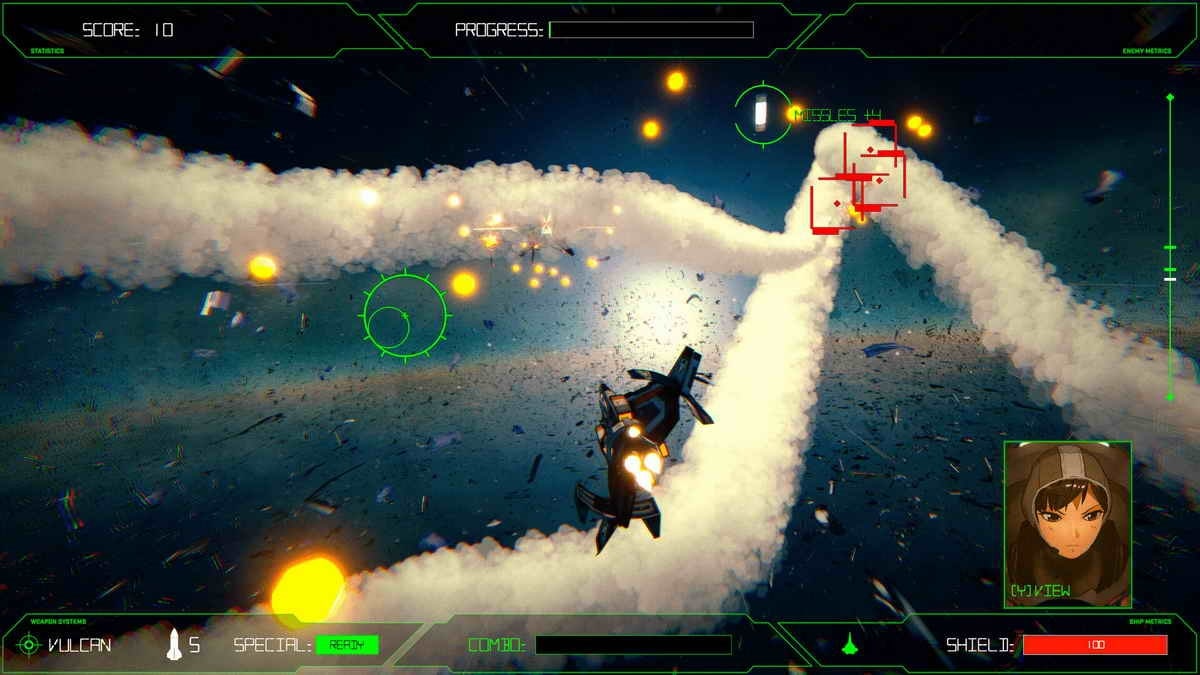
Rogue Flight, developed by Truant Pixel and published by Perp Games, draws its inspiration from classic arcade space shooters while offering a narrative deeply influenced by 80s and 90s anime – making for an interesting mashup. Set in the Sol system, players are thrust into a battle to reclaim humanity’s future from the AI-driven defense force, ARGUS. The blend of fast-paced combat and a branching story, coupled with retro-modern visuals and an anime flair, makes Rogue Flight stand out in a crowded genre. However, while the game excels in several areas, it also shows some limitations. We took a look at the PS5 version.
The narrative is relatively straightforward but fits well within the arcade space combat framework. Humanity, almost wiped out by ARGUS, is preparing for a counterattack, and players step into the shoes of a skilled pilot tasked with leading that charge. While the story elements are compelling and enriched by multiple narrative paths and endings, the plot doesn’t break much new ground in terms of depth. The anime-inspired cast does a solid job of bringing their characters to life and this certainly makes Rogue Flight stand out, even though the storytelling is still secondary to the action. Still, the combination of English and Japanese voice talent, featuring people who previously worked on series like Neon Genesis Evangelion and One Piece, adds an extra layer of authenticity for fans of anime.

In terms of gameplay, Rogue Flight leans heavily into fast-paced, aerial dogfights, reminiscent of classic arcade space shooters. The game offers a variety of spacecraft upgrades, customization options, and weapon loadouts, keeping combat fresh across its nine stages. Players can personalize their ships with a vast array of unlockables, from liveries to badges, allowing for a surprising level of depth in ship design. The branching narrative paths and multiple game modes, including an unlockable roguelite mode, provide plenty of replay value for an arcade-inspired title. However, while the basic mechanics are fun, they can feel repetitive after a while, as the core loop doesn’t evolve much beyond what you experience early on.
The controls in Rogue Flight are responsive and fluid, allowing for impressive aerial maneuvers that feel satisfying, especially in larger space battles. However, the learning curve can be steep for those unfamiliar with space combat games, and some players might find the controls challenging to master, particularly when executing the more advanced maneuvers under pressure. Thankfully, the game offers multiple difficulty levels, which cater to both newcomers and veterans of the genre.
Visually, Rogue Flight nails the retro-inspired aesthetic, capturing the feel of late 80s and early 90s anime. The Sol system’s environments are vibrant, with space stations, planets, and asteroid fields providing a striking backdrop for the action. The game’s use of an analogue-video art style adds a unique touch, lending a sense of nostalgia to the visual experience. However, while the style is appealing, it may not resonate with players who are looking for a more polished, modern look, as the retro aesthetic, though charming, might feel somewhat dated to people not familiar with what inspired it.
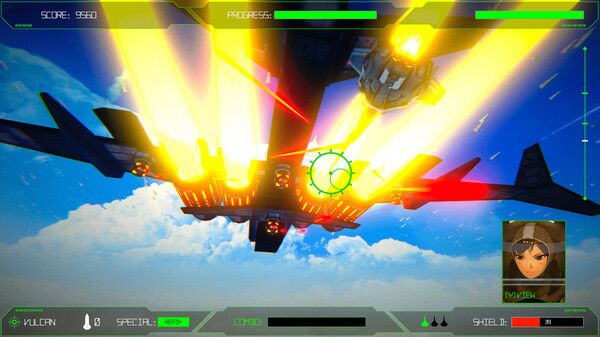
Audio design plays a crucial role in Rogue Flight’s experience. The soundtrack, composed by Fat Bard and featuring additional music by Rinn, complements the high-octane action with a mix of intense battle themes and more atmospheric tracks. The opening theme, with vocals by J-Pop artist Itoki Hana, sets the tone for the game’s anime influences right from the start. Additionally, the voice acting, featuring the previously mentioned talent, brings the characters to life, though some of the dialogue can feel a bit too melodramatic at times.
In conclusion, Rogue Flight offers a solid mix of arcade space combat, anime-inspired storytelling, and impressive customization options. Its nostalgic aesthetic and fast-paced gameplay will appeal to fans of classic shooters, though the slightly repetitive nature of the combat and the steep learning curve may turn some players away. But despite these small shortcomings, this is a very enjoyable throwback to an era when anime and arcade games ruled, and for those with a love for both, it’s a must-play.
Score: 8.1/10
 Press Play Media