Chernobyl Again, developed by Vimagineo, merges the historical intrigue surrounding the Chernobyl disaster with science fiction, immersing players in a VR narrative set against a haunting backdrop. Through its time-travel premise, the game attempts to deliver an emotionally resonant and engaging experience while leveraging VR technology to create a deeply immersive environment. It’s a title we got a sneak peek at a few years ago at Gamescom, and it’s out now for Quest and PCVR platforms. However, while its ambition is undeniable, the execution leaves room for improvement in certain areas.
The story follows Olena Ponomarenko, a scientist driven by a personal quest to uncover the secrets of time travel. Her journey is fueled by an emotional desire to reconnect with her parents, intertwined with a mission to prevent the catastrophic events of the Chernobyl disaster. The narrative effectively combines conspiracy elements with historical fiction, but the story delivery can feel disjointed at times. Exposition-heavy moments and uneven pacing occasionally disrupt the sense of urgency and emotional depth the story aims to achieve.

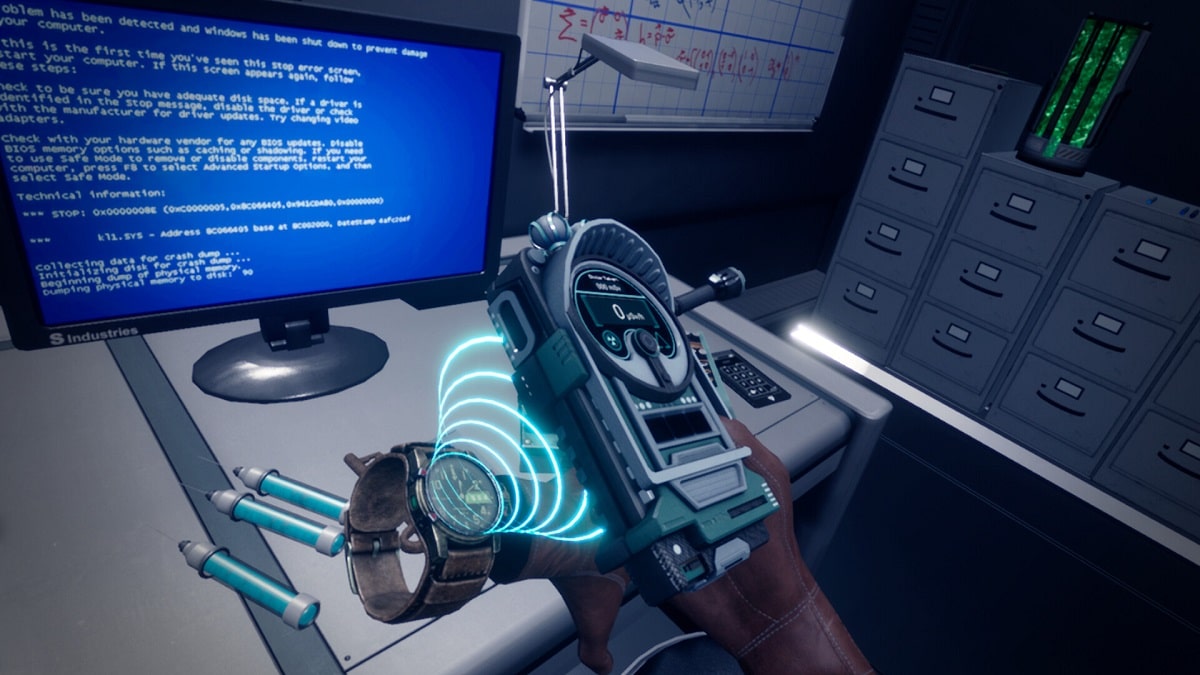
The gameplay in Chernobyl Again is centered on exploration and puzzle-solving, utilizing VR mechanics to interact with the environment. Players use tools like an interactive watch and a futuristic suitcase to navigate through various realities, solving puzzles that range from intuitive to frustratingly obtuse. While the tactile nature of VR elevates the experience, some mechanics feel underdeveloped, leading to moments of trial-and-error that can break immersion. The photogrammetry-based recreation of Chernobyl, however, stands out, offering an eerily authentic representation of iconic locations within the exclusion zone.
Visually, the game benefits from its photorealistic approach, capturing the desolation of Chernobyl with impressive detail. The environments are richly textured, and the lighting enhances the somber, suspenseful tone of the narrative. However, on Meta Quest, the visuals take a noticeable hit in fidelity compared to the PC version, with reduced textures and occasional pop-ins that detract from the immersion – though the recent update for the Quest version has improved the game a lot in this area. The audio design complements the atmosphere, featuring a haunting score and environmental effects that deepen the sense of unease. Voice acting, while generally serviceable, is a bit uneven, with some performances falling flat during what should be key emotional moments.

The controls are another area where Chernobyl Again shows both promise and limitations. Interactions with objects and puzzles are straightforward but sometimes lack precision, an issue exacerbated by occasional tracking problems. On PC-based VR systems, these issues are less pronounced, but on the standalone Quest, they become more noticeable, potentially frustrating players during more intricate tasks.
Where Chernobyl Again shines brightest is in its ambition. The blending of time travel, personal stakes, and a real-world historical disaster is a unique narrative approach that sets it apart from many other VR titles. Yet, its execution doesn’t always match its vision, leaving some aspects feeling unpolished. The absence of polish in the mechanics and uneven storytelling prevents it from fully capitalizing on its potential, as the ideas behind this title are undeniably grand in scope.
For those drawn to historical settings and narrative-driven experiences, Chernobyl Again offers a compelling, albeit flawed, journey through one of history’s most infamous disasters. Its photorealistic environments and ambitious storytelling are worth exploring, especially for players on high-end VR systems. However, its technical shortcomings and occasional narrative missteps mean it may not appeal to everyone. With some refinement, this could have been an essential VR experience; as it stands, it’s a fascinating, if imperfect, glimpse into the past and the possibilities of VR storytelling.
Score: 6.4/10
 Press Play Media