
Party Versus, developed by Schell Games for the Meta Quest 3 and 3S, delivers an innovative take on virtual social gaming. Designed to bring people together in a mixed-reality environment, the game combines the charm of traditional party games with cutting-edge technology. While it offers plenty of chaotic fun, some design choices may limit its appeal for broader audiences.
The premise of Party Versus is as inviting as it is simple: compete with friends and family across a range of familiar and original minigames to win the neon Party Crown. The game emphasizes social interaction, allowing players to join private lobbies with familiar faces or dive into public matches to meet new ones. The concept of blending real-world surroundings with virtual elements works well, turning your physical play area into an extension of the gameplay. Furniture becomes part of the game space, and your room transforms into an arena for friendly competition and a bit of chaos.
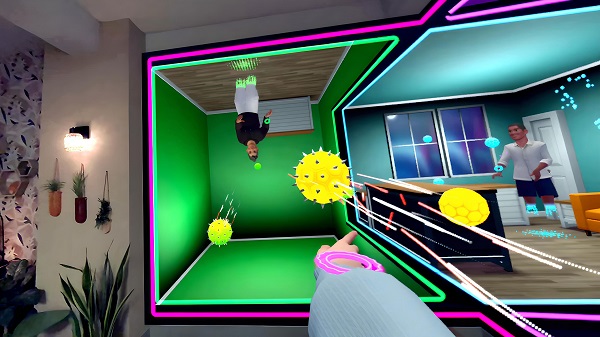
The minigames themselves are a mixed bag. Titles like Sticky Potato and Spike Attack are high-energy and often really fun and funny to play, with mechanics that encourage both competition and collaboration. However, the variety and complexity of the games could feel limited over extended play sessions. Some games rely on simple mechanics that, while accessible, might lack depth for players seeking a more robust gaming experience in the longer term. The inclusion of “twisted” modes, which flip perspectives or turn gameplay upside down, aims to alleviate this by adding a creative twist, but this can occasionally feel disorienting.
Visually, Party Versus is a treat with its use of what the Quest 3 can offer. Its colorful neon aesthetic and playful animations fit the party vibe perfectly. The mixed reality integration is one of the game’s standout features, successfully layering virtual objects onto real-world environments with surprising accuracy. That said, optimal performance depends heavily on a clear playspace, and cramped or cluttered areas can diminish the experience. Audio complements the visuals with upbeat music and energetic sound effects, though some may find the repetitive tracks a bit tiring during longer sessions.
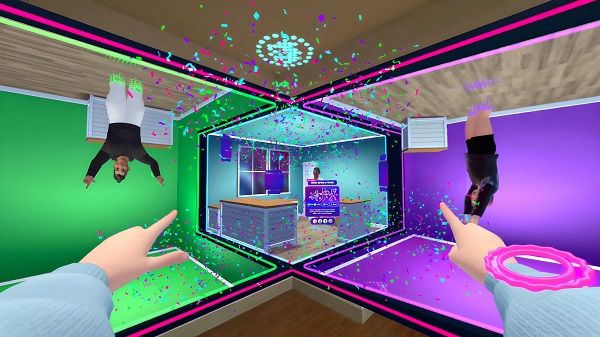
Controls in Party Versus are intuitive and responsive, making it easy for newcomers to jump in. The simplicity of the interface allows the focus to remain on the action rather than the mechanics, although occasional tracking hiccups can disrupt the flow. This is particularly noticeable in games requiring precise movement (and when playing in more cluttered environments), where slight inconsistencies in mixed-reality tracking can lead to frustrating moments.
At its best, Party Versus is an excellent way to connect with others, whether they’re in the same room or across the globe. It’s a game designed for social engagement, and its mixed-reality features offer a fresh twist on traditional party games. However, the lack of depth in some minigames and occasional technical limitations mean it may not sustain interest for extended sessions.
For those looking to liven up their game nights or explore the possibilities of mixed reality, Party Versus offers a unique and entertaining option. While not without its flaws, the game shines as a showcase for the social potential of VR, making it a worthwhile addition to the Meta Quest 3 library for party enthusiasts – though its Quest 3 exclusivity might limit the number of friends you’ll be able to play with.
Score: 7.3/10
 Press Play Media