
With Mario Party always around, it’s not easy standing out in the world of party games on the Switch, but Which Way Up: Galaxy Games, from Turtle Flip Studio, manages to carve out a niche for itself with its gravity-defying antics and whimsical sci-fi charm. Featuring a compact selection of twelve mini-games and a small roster of cute cosmic characters, it’s a family-friendly title clearly built for local multiplayer mayhem – but not without a few bumps along the way.
At first glance, Which Way Up grabs attention with its colorful cast of characters like Orbit and Luna, who bring a gentle, thematic flavor to the overall presentation. But it’s the gravity-bending mechanics that give the game its identity. Rather than playing it safe with traditional platforming and minigame templates, most challenges involve navigating rotating planets, orbiting structures, or gravitational pull zones, giving players the freedom to run across walls and ceilings or fall across entire stages. This idea is more than just a gimmick – it injects freshness into each mode and keeps the gameplay loop light and dynamic.
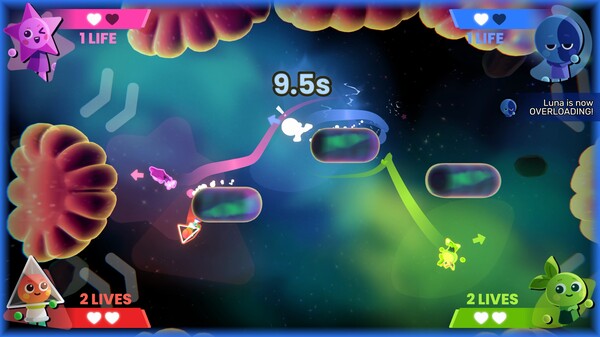
The game’s mini-games are each distinctive enough to keep a group entertained for a session or two, from jostling for position in Star Ring to escaping a black hole in Event Horizon (no connection to the horror film). However, not every concept lands with equal polish. Some games, like Nebula Nab and Overload, suffer from unclear feedback and pacing that doesn’t always match the intended tension. While the diversity of gameplay is admirable, the game leans heavily on its novelty factor rather than deeply developed mechanics in each mode.
Controls are generally smooth, with intuitive movement and a single “Comet Push” ability that gets a surprising amount of use across multiple mini-games. That said, there are moments when the gravity-based navigation can be disorienting, especially for younger players or those jumping in for the first time. The game’s camera and spatial perspective can be difficult to read in fast-paced settings, which detracts a bit from the pick-up-and-play fun it aims to provide.
Visually, Which Way Up shines with its soft pastels, chunky character models, and cheerful animations. The environments and effects, while simple, suit the lighthearted tone. The audio follows suit with bouncy background tracks and satisfying little sound effects that lend personality to each character and event. However, the game does lack some of the audiovisual polish of more prominent party games, and its modest presentation might not leave a lasting impression once the matches are over.
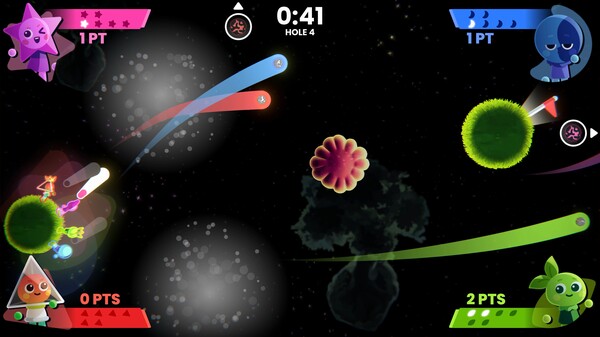
One area where Which Way Up shows a bit of surprising depth is in its single-player content. While clearly not the focus, this oft-overlooked mode gives players the opportunity to explore the mechanics at their own pace, introducing a range of short missions that serve as both a tutorial and a bite-sized challenge arena. It won’t replace a full campaign, but it’s a thoughtful inclusion for solo play or younger players who want to master the game’s systems without the pressure of competitive chaos.
Ultimately, Which Way Up: Galaxy Games succeeds in its primary goal – delivering a light, fun, family-friendly multiplayer experience with a neat gravity twist. It’s best enjoyed in short bursts with a group of friends or family, and while it could benefit from more mini-games and a touch more polish, it’s a charming addition to the Switch’s local multiplayer library that doesn’t take itself too seriously. With a bit more refinement, this could have been a breakout party hit – but as it stands, it’s a sweet, if modest, offering that doesn’t break the bank.
Score: 7.6/10
 Press Play Media