
When a group of veteran developers from Blizzard Entertainment set out to create a new real-time strategy experience, the expectations were bound to be sky-high. With credits that include StarCraft II and Warcraft III, Tim Morten and the team at Frost Giant Studios have a formidable pedigree – and now, with Stormgate, they’re aiming to both honor and evolve the legacy of the genre they helped define and shape. Blending sci-fi and fantasy elements in a post-apocalyptic setting, Stormgate strives to modernize the classic RTS formula while remaining accessible to a new generation of players.
With Early Access now underway and major features like 3v3 “Team Mayhem” on the horizon, we had the opportunity to speak with Tim Morten about the game’s creative direction, the challenges of launching as an indie team, and how community feedback is actively shaping development. From narrative inspirations to UI design and genre ambitions, here’s what he had to share.
Stormgate combines elements of sci-fi and fantasy. What can you share about the creative process behind its universe?
When we were originally discussing what kind of universe to build, we felt like going pure fantasy or pure science fiction would run the risk of being too directly compared to Warcraft and StarCraft.
We also wanted to build a universe where the factions were immediately understandable, but where they had their own unique flavor.
Finally, we liked the idea of being set on future Earth. This led us down a path of a post-apocalyptic world that mixes both fantasy and science fiction. We did watch Warrior Nun as one example of an original take on demons and angels, with portals — but ultimately, the Stormgate universe came from the mind of Micky Neilson, who is Frost Giant’s narrative director, with input from the Tims and feedback from storytelling legends like Marv Wolfman (Crisis on Infinite Earths, Blade, Teen Titans) and Chris Metzen (Warcraft, StarCraft).

The game’s development team includes talent from StarCraft II and Warcraft III, which must be a double-edged sword when it comes to expectation management. What’s been your experience with this?
Coming from Blizzard is a double-edged sword: on the one hand, we’re extremely grateful for the attention that it’s brought to Stormgate, and for the experience we’ve been able to bring with us; on the other hand, Frost Giant is building from scratch with a fraction of the budget, so our ambitions didn’t line up with what we were able to deliver out of the gate. We’ve been working hard to level up, but being an independent studio is always going to be challenging relative to having the resources of a big company.
What has the reception to Stormgate in Early Access been like so far? Are there specific areas where player feedback has led to significant changes?
Stormgate’s Early Access launch was in an earlier state of development than players expected. Since then, the development team has iterated extensively on the look of the game, the balance, the characters and storyline, key remapping, and work is underway to add new game modes like the “Team Mayhem” 3v3 mode with Heroes. All of these changes were in direct response to player feedback.
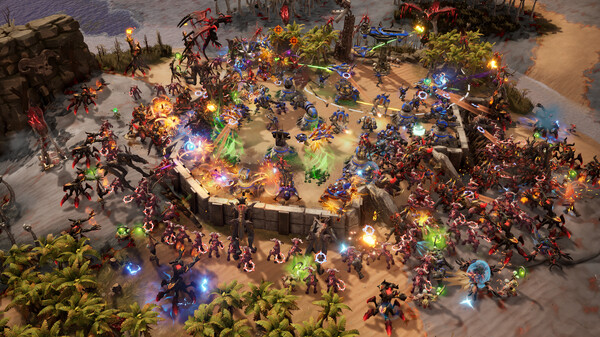
Can you walk us through the process of developing the 3v3 mode and the choice to implement a no-elimination policy? What impact do you hope this has on team play?
The “Team Mayhem” 3v3 mode incorporates aspects of traditional RTS and Hero-focused game types like MOBA.
Traditional resource collection and base building are part of the mode, but each player also has a Hero unit, and the win objectives are directly comparable to a MOBA. The shared win condition mitigates an issue that many large format multiplayer RTS modes face, where balance tilts as individual players are eliminated, creating a snowball. We hope that Team Mayhem will appeal to RTS and MOBA players alike. Responses to closed playtesting of the mode were positive and we look forward to testing it more soon.
How did you approach refining the UI to serve both new players and experienced RTS veterans?
Stormgate defaults to a grid layout, with a simplified command card that makes it possible to build without clicking on individual units and structures first. As units are produced, they are automatically added to control groups. All of the key bindings and control groups are customizable. Additionally, there is a “BuddyBot” available that can assist with macro. These changes were all designed to make things easier for new players, without taking away any opportunities for skill expression from more experienced players.

The RTS genre has a deeply loyal fanbase. What are your hopes for Stormgate’s eventual place within the genre, and how do you envision it standing out among both classic and modern titles?
Stormgate aims to modernize classic RTS, without abandoning what made the genre great in the first place. It is consciously building on what came before, instead of trying to scorch the earth and start over. Between ease of use improvements, technical innovations like global matchmaking and rollback, and the gameplay innovations we’re planning like Stormgates (in the June update) and Team Mayhem (currently in closed testing), we hope that Stormgate will be an enduring success.
 Press Play Media