
After TRON: Identity introduced players to Bithell Games’ vision of Disney’s digital universe, TRON: Catalyst aims to expand that vision with a more action-oriented spin. Developed by Bithell and published by Devolver Digital, this new entry trades dialogue-driven investigation for dynamic combat, a broader narrative scope, and a more traditional gameplay structure. The result is a stylish and intriguing experience that captures the feel of TRON, even if its ambitions sometimes outpace its execution.
Set in the neon-drenched Arq Grid, TRON: Catalyst – which we first saw during the summer last year – casts players as Exo, a courier whose life changes dramatically after a mysterious package grants them strange powers known as the Glitch. From there, the game unfolds across a variety of environments and faction-driven storylines, with Exo caught in the middle of a crumbling society and hunted by a malicious force known as Conn. The premise strikes a strong balance between legacy and reinvention, and returning characters and lore elements will satisfy longtime TRON fans while keeping things accessible for newcomers not familiar with the films. However, while the story is conceptually strong, its pacing can be uneven, and character development tends to feel secondary to the action.
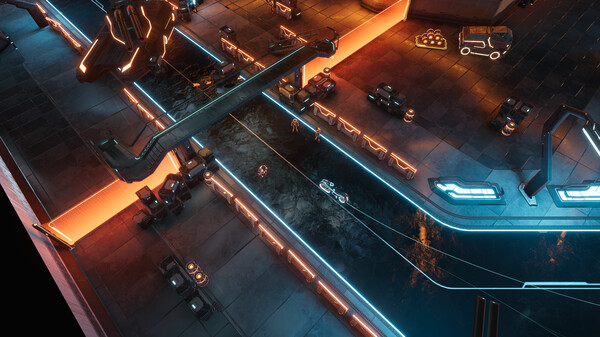
The shift to isometric action-adventure works well in some areas, particularly in terms of environmental variety and combat rhythm. Fights mix ranged disc-throwing with close-quarters melee strikes, and the inclusion of parries, dodges, and special abilities keeps encounters engaging. Vehicle sections featuring Light Cycles break up the action nicely, offering brief but thrilling speed segments (as well as fan service). Unfortunately, the combat’s depth plateaus early, and enemies lack the variety to sustain excitement over the campaign’s full runtime. There’s also a feeling that boss battles could have made more of the game’s mechanics – they look imposing, but most of them are mechanically straightforward.
Exploration plays a significant role, with a modest dose of backtracking as you uncover hidden paths, collect upgrade materials, and manipulate the environment using the Glitch. This time-loop mechanic, which reveals secrets and alternate paths, adds some welcome puzzle-platforming flair. It also ties well into the narrative themes of instability and control. Yet while the design introduces clever ideas, their implementation can feel underutilized. Opportunities to creatively exploit the Glitch are relatively sparse, and many secrets are hidden behind familiar upgrade gating rather than smart use of mechanics.
From a presentation standpoint, TRON: Catalyst absolutely nails the aesthetic. The visual design channels the franchise’s signature digital architecture and fluorescent glow, making the Arq Grid feel alive with stylized tension. Whether exploring cities or descending into more abstract, corrupted systems, the environments are sharply rendered and supported by slick effects. The soundtrack by Dan Le Sac enhances the experience with a moody electronic pulse that elevates exploration and combat alike. Voice acting, while limited, includes solid performances that support the game’s atmosphere, though not all character interactions leave a lasting impression.

Control-wise, the game performs smoothly on the PlayStation 5. The isometric viewpoint translates well to the DualSense, and traversal feels responsive, particularly during Glitch-enhanced movement segments. However, aiming disc throws in the heat of battle occasionally lacks precision, especially during more hectic encounters. The interface is clean but perhaps overly minimalist when it comes to guiding players toward objectives, which can lead to some aimless wandering during story missions.
Ultimately, TRON: Catalyst is a stylish and well-intentioned expansion of Bithell’s take on the TRON universe – and one that should appeal to a wider audience than Identity did because it embraces more traditional gameplay mechanics. Its combat, exploration, and aesthetic presentation all offer satisfying moments, and there’s genuine intrigue in the narrative’s setup. But the game’s limited enemy variety, underdeveloped mechanics, and occasional narrative shallowness keep it from truly transcending into the upper tier of the genre. Fans of the franchise and of Bithell’s previous work will find a lot to like here – but the Grid still has room to evolve.
Score: 7.6/10
 Press Play Media