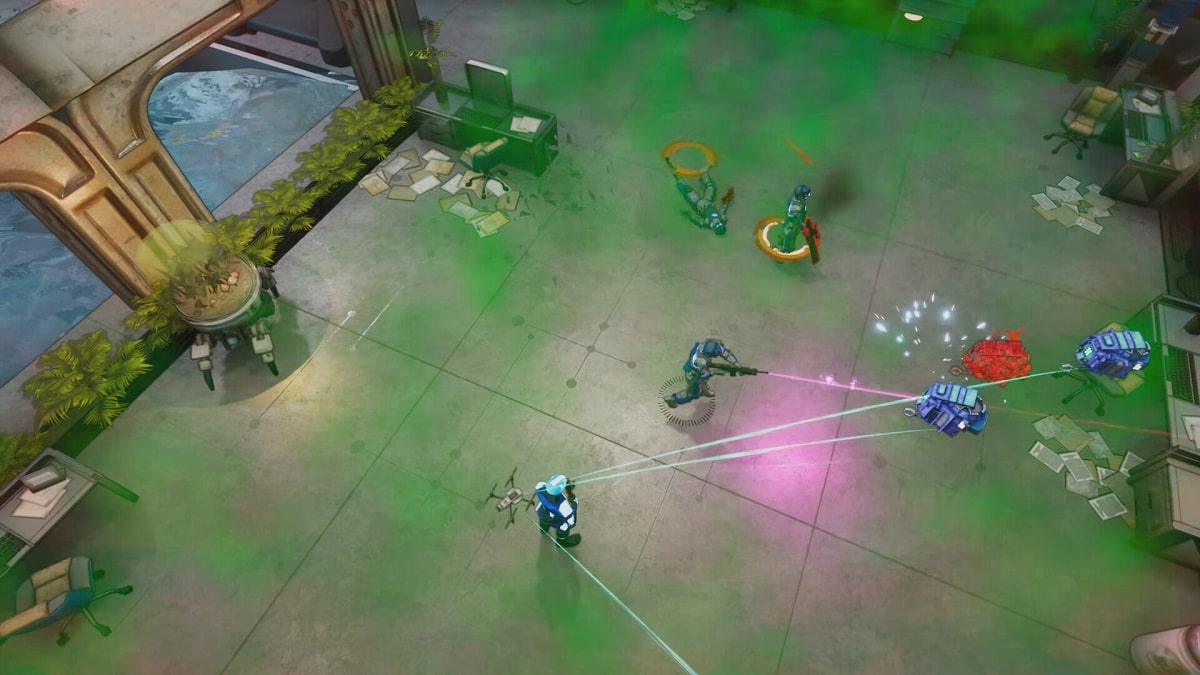
Memory Lost, developed by Magic Hazard and published by ESDigital Games, brings a cyberpunk twist to the top-down shooter genre by putting players in the role of an AI on the run. It’s an ambitious pitch: a rogue digital entity fighting back against its creators by hijacking the bodies of its enemies, leaping from host to host in a constant flow of possession-based combat. The setup is compelling, combining frantic action with a dystopian sci-fi narrative, but while the concept impresses, the execution doesn’t always keep pace with the game’s ambition. Here’s our take on the PS5 version, which recently launched.
The story unfolds in the neon-drenched city of Detraxis, where corporate corruption and inhumane experimentation form the backdrop for your rebellion. As an AI created by the RedSky Corporation, you awaken to the horror of your own purpose and turn against your creators. Thematically, it leans into familiar cyberpunk motifs – oppression, identity, rebellion – but adds a twist by letting the player literally embody different perspectives through possession. Although the world itself has intriguing lore and some genuinely thoughtful side stories, the central narrative feels thin in places, and the promise of multiple endings doesn’t quite deliver the sense of agency the setup implies.
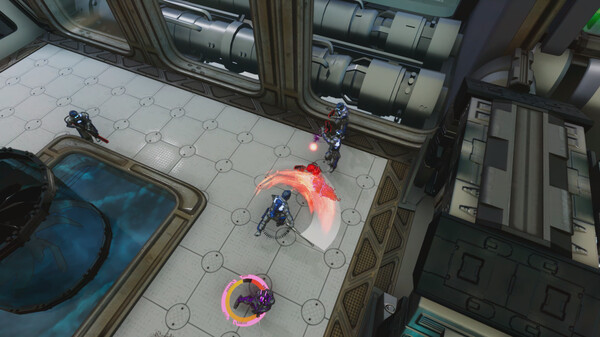
At the heart of Memory Lost is its body-swapping mechanic, which allows you to take control of enemy units in real time. This opens up an immediate variety of weapons, tactics, and abilities, as you can instantly go from a melee bruiser to a sniper or a flamethrower-wielding tank depending on who you jump into. In theory, this creates a constantly evolving combat experience, and there are moments where it clicks and feels great – especially when you leap across a battlefield mid-fight to escape danger or outmaneuver enemies. But in practice, the mechanic can also feel more chaotic than strategic in some situations. Host bodies often lack clear visual distinction, and the transition process lacks fluidity, sometimes leaving you momentarily disoriented in the middle of a firefight.
The game offers a decent arsenal, with over 70 weapons to discover and a modest set of skill trees that let you tweak your approach. But the core shooting and melee combat systems are inconsistent, with hit detection and enemy AI occasionally working against you. Enemies can go from passive to overly aggressive in a flash, and level design doesn’t always support the body-jumping concept – you’ll frequently find yourself cornered or limited by the environment, reducing the tactical depth of your abilities. Boss fights fare better, though they lean more on visual spectacle than mechanical complexity.
Visually, Memory Lost has its moments. The cyberpunk aesthetic is there – all glowing signage and grimy alleyways – but it lacks polish. Character models and animations are functional but stiff, and some environmental assets repeat too often to keep the world visually engaging. Cutscenes, while hand-drawn, vary in quality and can feel tonally inconsistent. On the audio front, the synth-heavy soundtrack fits the atmosphere well, but effects like gunfire and enemy barks start to wear thin over longer play sessions. Voice work, where present, is serviceable, though most of the storytelling is delivered through text and visuals.

On PlayStation 5, performance is generally stable, with fast load times and smooth framerates even during intense action. However, the UI feels designed with PC in mind – menus and ability upgrades are awkwardly mapped, and some navigation elements don’t translate smoothly to a controller. The game also struggles to convey information clearly in the heat of battle; indicators for low health, ability cooldowns, or possession range could be more intuitive, which is especially noticeable in later levels where screen clutter becomes an issue.
Memory Lost is full of creative ideas that flirt with brilliance, but the overall experience is too uneven to fully capitalize on them. The possession mechanic offers genuine novelty, and the cyberpunk setting has flashes of narrative intrigue. Yet clunky controls, unrefined combat, and visual rough edges keep it from reaching the heights it aims for. There’s an undeniably unique concept at the heart of the game, and for players craving a different spin on twin-stick shooters, this could be worth checking out – just be ready to look past its technical and mechanical misfires.
Score: 7.0/10
 Press Play Media