
WayForward’s Shantae Advance: Risky Revolution is a rare case of a game that feels both like a throwback and a fresh release at the same time. Originally conceived for the Game Boy Advance two decades ago and only now completed and brought to modern platforms, it’s a fascinating mix of retro sensibilities and contemporary polish. On PlayStation 5, the game arrives with smooth performance and faithful pixel art presentation, but its roots in handheld-era design are always evident – both for better and worse.
The premise is classic Shantae: a playful yet quirky tale where Risky Boots hatches a plan to literally rotate the continent in order to loot towns more easily. This unusual narrative device neatly ties into the game’s central mechanic, where players shift between foreground and background layers to alter the layout of levels. While the story itself is lighthearted and humorous, it’s not especially deep, mostly serving as a framework for the platforming and exploration. Longtime fans will appreciate the sense of continuity with earlier entries, while newcomers without prior knowledge may find it charming but somewhat shallow.

Gameplay sits squarely in the series’ familiar formula of platforming, hair-whipping combat, and magical transformations, now enhanced by the land-shifting mechanic. The ability to toggle between playfields adds puzzle-solving depth and occasionally clever level design, though not every implementation feels equally inspired. At its best, it offers a fresh wrinkle on established mechanics; at its worst, it can feel like a gimmick that interrupts the flow of exploration. Transformations like the monkey and elephant remain fun to use, and the addition of crab and other forms broadens traversal options, but some labyrinth sections drag with repetitive enemy encounters and backtracking.
Controls are responsive and tight, ensuring that platforming feels satisfying even when the design leans into old-school difficulty spikes. Combat, however, is less refined – the reliance on hair-whipping hasn’t evolved much, and enemy variety doesn’t always keep up with the pacing. Boss battles provide spectacle and creativity, but the balance of challenge can swing unevenly, with some encounters feeling underwhelming compared to others. Still, the foundation of classic Shantae action remains enjoyable, particularly when combined with secrets to uncover and upgrades to earn.
Visually, the game embraces its retro origins with vibrant pixel art that looks sharp on modern displays. The layered backgrounds and shifting landscapes are striking when used effectively, giving the impression of depth and dynamism. Character sprites are expressive, and the animations retain the charm fans expect from the series. On the audio side, the soundtrack delivers upbeat, catchy tunes that fit perfectly with the whimsical tone of the adventure. Some tracks may loop a bit too quickly during longer play sessions, but overall the music and sound design are consistent highlights.
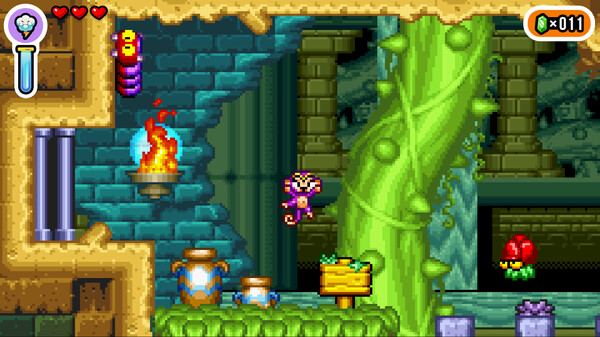
If there’s a notable downside, it’s that Risky Revolution sometimes feels too bound to its past. As a “lost” GBA title resurrected for today, it never fully embraces modern refinements that other recent (Shantae) platformers have adopted. The inclusion of a four-player battle mode is novel, but it feels more like a side distraction than a compelling addition. For those seeking a polished, contemporary evolution of Shantae’s formula, the game may come across as dated. But for fans who appreciate the series’ retro heart and want to experience this long-lost chapter, it’s an affectionate time capsule brought into the present.
In conclusion, Shantae Advance: Risky Revolution is a lovingly restored adventure that blends nostalgia with new mechanics, even if its age sometimes shows. It’s not the most ambitious or expansive entry in the series, but it offers a charming and enjoyable slice of platforming history that finally sees the light of day after 20 years. Fans of Shantae will find plenty to like, while newcomers may see it as an entertaining, if occasionally uneven, curiosity from a bygone era.
Score: 7.6/10
 Press Play Media