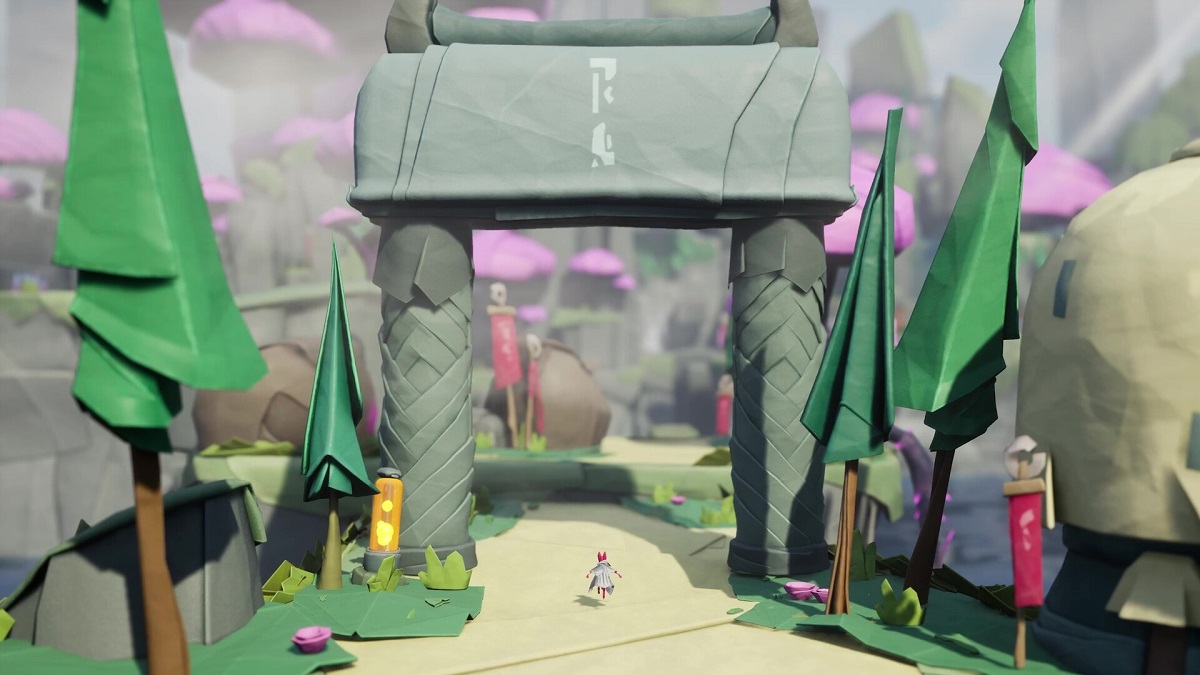
Hirogami on PlayStation 5 is a game that immediately draws attention with its distinct theme: a world made entirely out of paper, inspired by the traditional Japanese art of origami. Developed by Bandai Namco Studios and published by Kakehashi Games, it mixes action-platforming with puzzle-solving, giving players a hero who can fold himself into different forms to overcome challenges. It’s a concept that feels both charming and fragile, just like its papery setting. The result is an experience that shines when it leans into its creativity but doesn’t always hold its shape when it comes to execution.
The story follows Hiro, a performer from Shishiki village, who takes up the task of defending his delicate homeland from the encroaching Blight, a swarm of digital invaders corrupting the world. It’s a simple but effective backdrop that plays into the game’s core themes of fragility and resilience. While the narrative doesn’t dig especially deep, its poetic presentation and cultural flavor help set it apart from more generic platformer plots. At times, however, the story feels more like window dressing than an essential driver of the adventure, with players more invested in the next transformation or puzzle than in Hiro’s personal journey.

Mechanically, Hirogami is at its best when it lets players experiment with Hiro’s folding transformations. Becoming a frog to reach vertical spaces, an ape to smash through obstacles, or even unfolding into a paper plane creates moments of genuine delight. These shape-shifting abilities provide a steady sense of variety across levels, keeping exploration from becoming stale. That said, not all transformations feel equally refined, and the game occasionally struggles with pacing when puzzles lean too heavily on repetition rather than ingenuity. Still, there’s no denying the joy in discovering a new form and the possibilities it opens up.
Combat is similarly creative but uneven. Hiro’s paper fan allows for light melee encounters, and the transformations add extra flavor to fights, whether it’s pounding enemies as an ape or blowing them away with gusts of wind. However, the combat system lacks depth, often boiling down to button-mashing once the novelty of the mechanics wears off. Some encounters can also feel like they disrupt the flow of exploration rather than complementing it, pulling attention away from what the game does best.
Visually, Hirogami is a standout. The origami aesthetic isn’t just a gimmick but a fully realized art direction that makes every environment feel delicate yet vibrant. Paper folds, creases, and textures are lovingly rendered, making the world feel like it could crumble in your hands. The enemy designs, though less striking, still play into the theme of corruption well enough to feel threatening without breaking immersion. This artistic direction is paired with a carefully crafted soundtrack built around traditional Japanese instruments, lending the game a serene and authentic atmosphere that contrasts beautifully with the chaos of combat.

Controls, however, are one of the game’s weaker aspects. While Hiro’s basic movement is smooth, the transitions between forms can sometimes feel clunky, especially in fast-paced sections where precision is essential. This can lead to frustration during platforming segments that demand accuracy. It’s not enough to break the experience, but it does add a layer of roughness to what otherwise feels like a finely folded creation.
Ultimately, Hirogami is a game of contrasts – its originality and visual charm are undeniable, but its gameplay occasionally struggles to live up to that promise. Players who value atmosphere, artistry, and creative mechanics will likely find themselves enchanted by its origami world. On the other hand, those looking for sharp, polished platforming or robust combat systems may come away feeling that the experience is more fragile than it should be. Like a real piece of folded paper, Hirogami is beautiful to look at and rewarding to unfold, but easy to crease if handled without care.
Score: 7.2/10
 Press Play Media