
Rise of Industry 2 arrives on PlayStation 5 as a sprawling, unapologetically detailed industrial simulation – the kind of game that asks you to love spreadsheets, planning grids and logistics for the fun of it. It launched on PC in June and has now made the jump to consoles, bringing its dense systems and 1980s USA setting with it. If you enjoyed painstaking optimisation in other tycoon titles, you’ll recognise the appeal immediately: map out factories, route trucks, balance utilities, and haggle for contracts until the numbers sing. That said, its PC-to-console transition doesn’t magically remove the game’s biggest hurdle – the complexity and steep learning curve that define the experience.
The era and setting are nicely conveyed: a VHS-tinged aesthetic, period products and a soundtrack that lean into the 80s corporate atmosphere. Building an industrial complex here is more than dropping prefab buildings – the game forces you to think about layout, specialised ramps, different storage types, and how intermediate goods flow through your supply chain. That design is satisfying when it works, and the variety of production chains (from vinyl records to airplanes) gives the sandbox plenty of flavorful targets to chase. Yet that same ambition means many useful pieces of information are buried beneath a learning curve where you’re hunting for basic functions (like water extraction) in menus where they’re hard to find at first. The game rewards persistence, but the payoff requires grinding past some confusing UX choices.
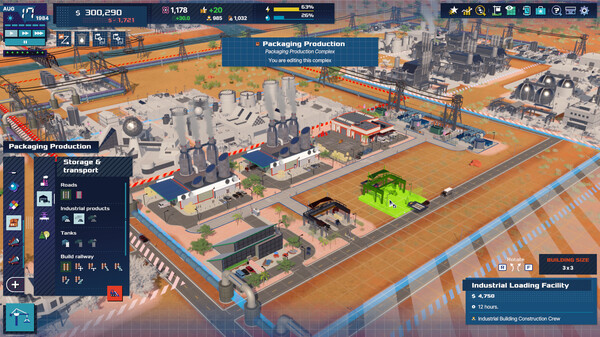
Mechanically, Rise of Industry 2 is gloriously granular. Contracts demand precise volumes on strict schedules, logistics require correct ramp-and-storage types for different goods, and research trees unlock production alternatives that become critical for efficiency. For players who relish optimisation loops, the mechanics offer enormous depth and emergent problems to solve. But that depth comes at a cost. Sometimes it feels like vital information is spread across multiple windows, and micromanagement can feel punitive rather than rewarding. The way contract quantities, transport lines and factory inputs are displayed forces a lot of manual arithmetic and clicks – an honest design choice for simulation purists, but a barrier for everyone else.
Controls and UI translate reasonably to the PS5, but the experience still shows signs of its PC roots. The tutorial and early missions try to ease you in, and when the guidance lands it’s helpful – yet once you’re managing multiple factories the controller can make precise menu navigation awkward compared to mouse-and-keyboard. The tutorial’s clarity for teaching high-level concepts is excellent, but this doesn’t take away the fact that you’re dealing with an interface that requires many context switches and deep dives to retrieve simple numbers. On consoles this means a lot of thumbstick-driven menuing, and occasional frustration when trying to zoom out and understand throughput at-a-glance.
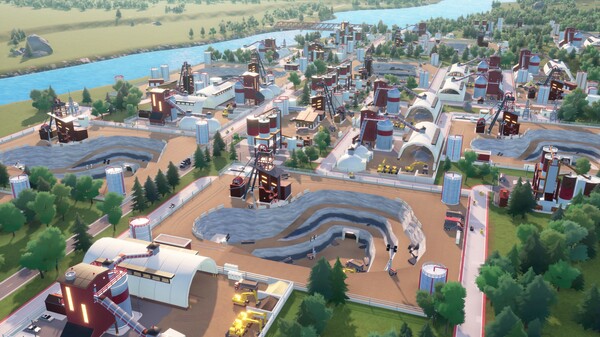
Presentation-wise, the game opts for an approachable, low-poly visual style rather than photorealism, and that works for communicating systems at a glance – trucks, conveyors and furnaces read clearly on the map. Performance on modern hardware is generally solid, and watching a living industrial complex hum along is undeniably rewarding. Yet regional variety and environmental detail can feel thin: the world serves the systems first, and spectacle second. If you’re buying Rise of Industry 2 for glossy visuals or narrative drama, you’ll be disappointed; if you want tidy, readable simulation visuals so you can obsess over throughput, it does the job well.
At the end of the day, Rise of Industry 2 is a love letter to players who enjoy micromanaging economies and designing efficient systems. It’s addictive when the pieces click – there’s a rare satisfaction in watching a well-planned production chain hit its stride – but it also expects patience and tolerates a lot of fiddly bookkeeping. For dedicated fans of economic sims and logistics puzzles this is a generous, content-rich playground; for players who want an inviting, plug-and-play citybuilder, the entry cost is steep. If you’re prepared to live inside spreadsheets and learn a bit by doing, PS5 owners finally get a substantial industrial sim to dig into, which is rare for the system – just make sure you’ve got the time and tolerance for its intricacies.
Score: 7.2/10
 Press Play Media