
Blood of Mehran is an action RPG published by Blowfish Studios and developed by Permanent Way Game Co., released for PlayStation 5. At first glance, it carries the sheen of a mid-tier adventure in the vein of Prince of Persia, boasting Unreal Engine 5 visuals that shimmer with promise. But while its screenshots suggest a cinematic Persian fantasy, that illusion fades a bit in motion, exposing a technically somewhat dated and mechanically uneven experience that falls short of its ambitions.
At its core, Blood of Mehran tells a simple tale of revenge. Players step into the role of Mehran, a warrior hunting down his family’s assassins across a series of sun-baked deserts, ancient ruins, and cursed fortresses. Despite that setup, the narrative rarely ventures beyond familiar territory, relying on predictable exposition and clichéd tropes that recall the hack-and-slash titles of old. Attempts at emotional storytelling or world-building feel half-hearted, and poorly delivered voice acting further dulls moments that might otherwise resonate. What results is a story that feels more like a placeholder than a genuine mythic quest, with little in the way of dramatic tension or memorable characters.
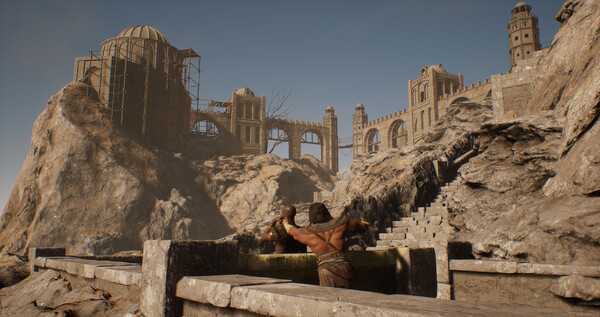
Gameplay follows the familiar blueprint of linear action RPGs, mixing sword combat, light stealth, and the occasional environmental puzzle. Unfortunately, each system feels underdeveloped. Swordplay lacks weight and responsiveness, with sluggish hit detection and awkward enemy behavior making encounters feel more frustrating than empowering. Stealth, while somewhat more reliable, appears to owe its relative success to the weakness of direct combat rather than intentional design. Even the skill tree and loot systems feel perfunctory, existing mostly to pad out a short campaign rather than to support any real depth or experimentation.
The game’s level design fares no better. Each area unfolds as a narrow corridor connecting one repetitive fight to the next, with exploration limited to dead ends hiding token collectibles or basic health pickups. Occasional horseback segments and boss encounters try to inject variety, but instead highlight the game’s technical shortcomings: stiff animations, erratic collision detection, and overly punishing checkpoints that make repeated deaths more tedious than thrilling. It’s a structure that feels rooted in the PlayStation 3/Xbox 360 era, dressed up in modern lighting effects that can’t disguise its dated design.
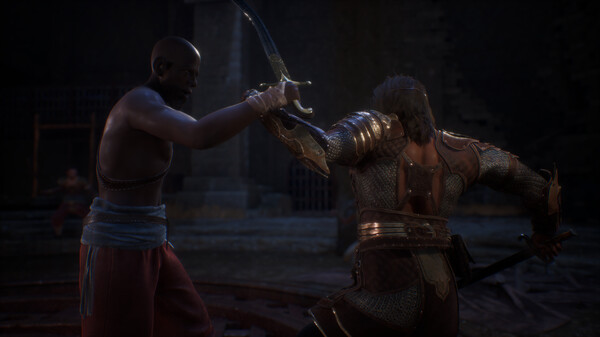
That visual presentation is perhaps Blood of Mehran’s most deceptive strength. Static screenshots reveal strikingly lit Persian backdrops and dramatic contrasts between sand, stone, and fire, yet during gameplay, the illusion collapses. Character models move with awkward stiffness, lip syncs misfire, and lighting flickers inconsistently across environments, betraying the game’s limited production scope. There’s undeniable artistic ambition here – a yearning to capture the mythic grandeur of Middle Eastern folklore – but the execution consistently undermines the concept.
And yet, despite its numerous flaws, Blood of Mehran has a certain low-stakes charm. Its straightforward design and short runtime make it surprisingly digestible – something to mindlessly hack through in a long evening between larger releases. In that sense, it recalls budget-tier action games of a bygone era: unrefined, derivative, and rough around the edges, but still playable enough to scratch a nostalgic itch for simple adventure fare.
Ultimately, Blood of Mehran is a missed opportunity – a visually promising but mechanically tired effort that mistakes technical gloss for substance. Beneath the Unreal Engine shimmer lies a by-the-numbers action RPG that never finds its own voice, offering players neither challenge nor discovery, only repetition. For fans of the genre desperate for something new, it’s hard to recommend when so many stronger alternatives await.
Score: 6.2/10
 Press Play Media