
For those who enjoy games that celebrate creation over competition, Little Rocket Lab is a wonderful surprise. Developed by Teenage Astronauts and published by No More Robots, it’s a cozy automation sim that trades stress and efficiency for warmth and personality. Our Xbox review revisits the industrial sandbox through the lens of a life sim, finding as much heart in a conveyor belt as in a conversation with a local.
You play as Morgan, a young engineer who returns to her quiet seaside hometown of St. Ambroise to complete her family’s dream project: building a rocket. The story feels immediately comforting, yet gently melancholic – a reflection on legacy, healing, and rebuilding both community and purpose. As Morgan mines resources and crafts machines to help revive the town, Little Rocket Lab uses automation as a metaphor for human connection. Where genre greats like Factorio and Satisfactory thrive on efficiency, this game invites you to tinker and take your time.
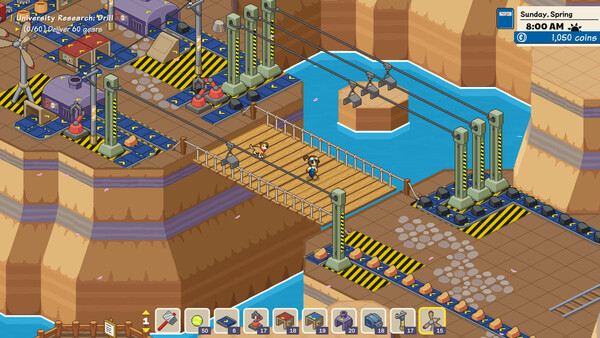
The construction systems are the game’s core, combining accessible building tools with a gratifying sense of progression. Starting with simple drills and smelters, you soon expand into layered production lines of conveyors, cranes, and robotic helpers. What’s striking is how fluid and forgiving the design feels – every contraption clicks into place easily, mistakes are simple to fix, and experimentation is encouraged. This accessibility makes the game far less intimidating than typical automation titles, while still offering depth for players who love optimization. It’s satisfying to watch your humble workshop evolve into a humming network of industry, all without a sense of grind or pressure.
Beneath its cozy premise lies an impressive technical and design polish. The control scheme on Xbox translates the precision of building quite naturally to a controller, and the interface feels thoughtfully adapted for console players – a tricky feat for a genre so tied to keyboard-and-mouse precision. Occasionally, camera movement can feel a touch finicky when managing larger factory layouts, but this is a minor inconvenience rather than a major flaw. The balance between mechanical detail and relaxation remains intact, ensuring even large-scale automation never becomes overwhelming.

Visually, Little Rocket Lab is charming from start to finish. Its pixel-art aesthetic glows with life, with the whirr of machinery blending seamlessly with the gentle ambiance of St. Ambroise’s pastel palette. Each new piece of technology feels handcrafted rather than industrially sterile, giving the world a uniquely personal feel. The audio design enhances that charm – the hum of conveyors, the clank of gears, and the soft, melodic soundtrack all contribute to a cozy rhythm that makes every session feel almost relaxing.
Beyond the machines, the sense of community adds real heart. St. Ambroise’s residents aren’t just window dressing; they react to your progress and gradually bring warmth back to the world as you complete quests. Their simple storylines – fixing a water pump, building an electric grid, helping reopen a workshop – all tie naturally into the crafting loop, grounding the mechanical systems in a sense of purpose. It’s not a grand narrative, but the sincerity behind it feels genuine and gives the game an emotional core that’s rare in the genre.
Little Rocket Lab succeeds not by reinventing automation but by humanizing it. It finds joy in small victories and treats progress as something to savor rather than optimize. While its laid-back pacing and gentle tone may not satisfy those seeking deep logistical complexity, its warmth, accessibility, and charm make it one of the most endearing and relaxing takes on the genre in years – as well as a great starting point for newcomers.
Score: 8.4/10
 Press Play Media