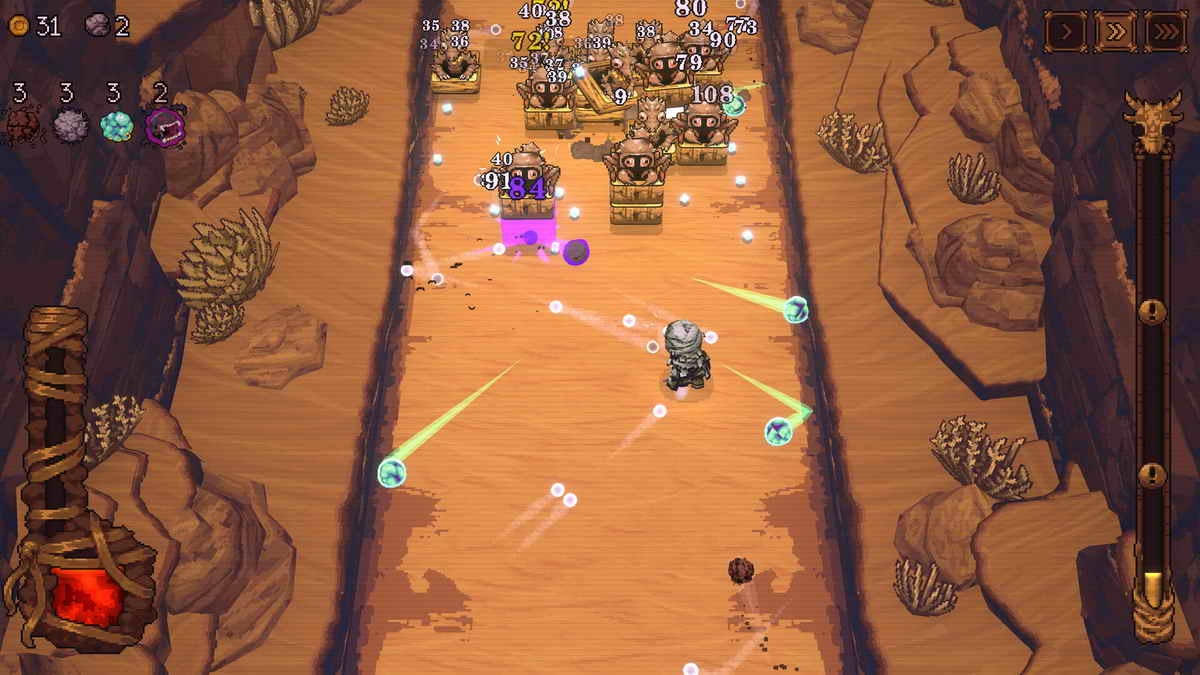
There’s something oddly magnetic about BALL x PIT – it’s the kind of game that starts you off simple (you’re just tossing balls, breaking blocks, avoiding enemies) but gradually spins up into a riotous, beautifully chaotic mixture of genres. Developed by Kenny Sun and published by Devolver Digital, it features responsive controls, vivid audio-visual contrast, and the sort of tight, escalating roguelite loop that both frustrates and compels you to try “just one more run.”
From the moment you descend into the pit – after the framing gimmick of “Bolbylon has fallen” and this world-shaping crater that draws in treasure hunters – you realize that narrative isn’t the hero here; it’s the mechanics. The story serves as context, enough to ground the fantasy, but is never what you’ll remember. What remains vivid are the moments when dozens of balls – babies, elementals, lasers – are bouncing off walls, monsters rushing in, and you’re desperately trying to angle every shot, upgrade every passive, just to survive.
Mechanically, BALL x PIT strikes a fine balance between risk and reward. The ball types each bring something distinct: ghost balls pass through objects, burn balls leave lingering damage, freezing or bleeding effects, and so on. Pair that with passive items, the possibility of fusing and evolving special balls, and the way each run feels a little different – not just in what you unlock, but in how you play. The base/“camp”‐oriented structures around Nova Bolbylon (or New Ballbylon) add a meta layer: buildings unlock bonuses, characters have unique upgrades, and permanent progression cushions the many failures you’ll experience. Menu transitions feel smooth; the aiming feels responsive; you get the sense the frame‐rate headroom handles the madness well, so the core gameplay doesn’t suffer when things get busy.
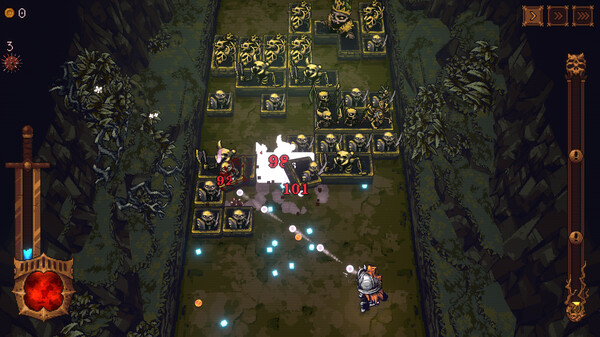
Visually and aurally, BALL x PIT leans heavily into retro stylings with modern skin. The graphics are clean but textured – there are filters, stark lighting, and effects that nod toward darker fantasy. The audio complements that: there’s an intensity in the action phases (pulsing electronic beats, impact sounds that feel weighty when balls hit enemies or walls), contrasted with calmer tones in planning or camp phases. The DualSense on PS5 adds tactile feedback that just enough enhances collisions, without being gimmicky.
But where BALL x PIT is impressive, it is not perfect. The repetition in stage design becomes more noticeable the more you play. After several runs, the variations between levels – in layout, enemies, hazards – begin to feel incremental rather than radical. Even though each zone has its own flavor (a frozen cavern, a forest, etc.), the cycle of descend‐fight‐return to base can start to feel familiar, and for some, slightly grindy. Progression isn’t always smooth: unlocking strong ball combinations, upgrading characters, or building up the base can demand time and resource investment that may test patience. For many players, the early hours are exciting and fresh; further down the road, sustaining momentum can take effort.

In terms of controls and accessibility, the PS5 version fares well. Moving and aiming are intuitive; having auto‐shoot or targeting aids (or equivalents) helps when things are chaotic. There’s a good deal of customisation of visual effects, which helps when the screen gets crowded. That said, the learning curve is steep – a degree of “die, and go back stronger” is baked into the experience. So while the game does embrace the roguelite philosophy, it does so firmly – and sometimes that can frustrate players less enamoured with frequent deaths or incremental gains.
What’s most commendable is that BALL x PIT never misleads about what it is. It doesn’t pretend to offer a deep, branching narrative or character arcs; its strength is in its feedback loops, in the sense of building, mastering, fragility, failure, and incremental growth. If you enjoy roguelites, bullet-hell intensity, and optimizing builds – especially via fusing abilities and evolving balls – this hits a sweet spot that excels in immediacy and experimentation. Its visuals and audio support its frantic gameplay well, and its base / meta systems give reason to keep going. It stumbles a bit in long-term variety and demands patience from players who want fast rewards, but for those willing to embrace the grind and die a few times, there’s a rich, satisfying experience here.
Score: 8.5/10
 Press Play Media