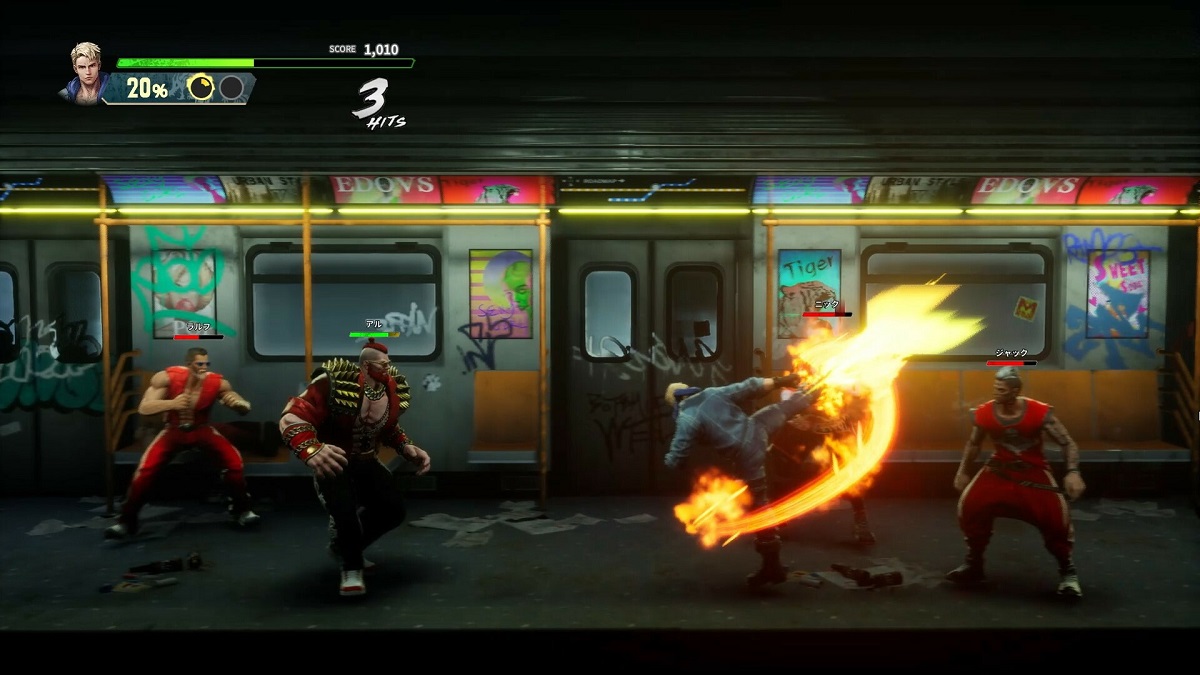
Double Dragon Revive brings the legendary brawler franchise back to life under the guidance of YUKE’S and Arc System Works, promising a modernized take on the 1980s classic. It revives the Lee brothers’ familiar journey through gang-ridden streets with updated 3D visuals and a smoother control setup tailored for current-gen consoles. The story remains intentionally simple, serving mainly as a backdrop for the action – a nostalgic loop of rescue missions, street fights, and escalating boss encounters that retain the flavor of the series’ arcade origins.
Combat obviously lies at the heart of the experience, mixing traditional beat-’em-up mechanics with a handful of contemporary refinements. Players chain together punches, kicks, throws, and special moves while managing crowd control and exploiting environmental hazards. The ability to use objects scattered around each stage – from pipes and boxes to structural traps – adds welcome variety, and the balance between crowd management and tactical timing gives the action bursts of intensity. Yet beneath this surface polish, some inconsistencies creep in. Enemy patterns can be predictable once learned, and juggling mechanics occasionally fail to connect smoothly, dampening the fluidity of extended combos.

The controls are intuitive, and input responsiveness is generally solid, but moments of sluggishness break the rhythm during hectic brawls. Weapon handling, though satisfying, also exposes the limits of precision: throws and hits sometimes misfire, leaving the player vulnerable. Still, when everything clicks, Revive captures the raw satisfaction of classic side-scrolling combat, bolstered by the addition of dodge and parry mechanics that reward attentive timing. Cooperative play rounds out the experience, giving players a chance to relive the couch co-op fun that defined the series decades ago.
The shift to 3D visuals gives Double Dragon a new coat of paint but not necessarily a modern one. Character models are competently rendered yet a little stiff, and environments feel plain despite their occasional destructible elements. The art direction leans on nostalgia, with recognizable stages and enemy types recreated in a way that stays true to the arcade experiences of the past, though it rarely pushes visual boundaries. Cutscenes presented in illustrated panels provide stylish interludes that cleverly mask the engine’s limitations. Accompanying the action is a soundtrack that blends rock influences with remixed motifs from earlier games, offering energy even when the score itself isn’t especially memorable.

Content-wise, Revive keeps things focused: a set of linear stages that can be cleared within a few hours, branching slightly through optional routes and featuring four playable characters. Each fighter brings minor variations in speed and power, but the overall balance keeps them feeling closer than expected. The modest campaign length limits long-term replay value, leaving score-chasing or cooperative sessions as the main draw after completion. While the brawling remains fun in short bursts, the repetition sets in before the finale, especially for solo players.
Performance and technical stability hold up well for the most part, though there are small dips and collision hiccups when many enemies crowd the screen. Load times are brief, and the visual presentation remains consistent across stages, suggesting a solid if unspectacular optimization effort. The sense of impact in the punches and kicks – a defining trait of the genre – is conveyed through crisp sound effects and screen shake, helping the combat feel weighty even when the visuals fall short of modern standards.
In the end, Double Dragon Revive succeeds as a playable tribute rather than a full-fledged reinvention. It rekindles the simplicity and fun of its arcade heritage with occasional flashes of smart design, but its conservative scope, uneven mechanics, and dated visuals keep it from reclaiming its throne among today’s top brawlers. Fans of the franchise will find enjoyment in revisiting familiar streets and exchanging punches with a friend, but those seeking innovation or depth may feel the fight runs out of steam too soon.
Score: 6.8/10
 Press Play Media