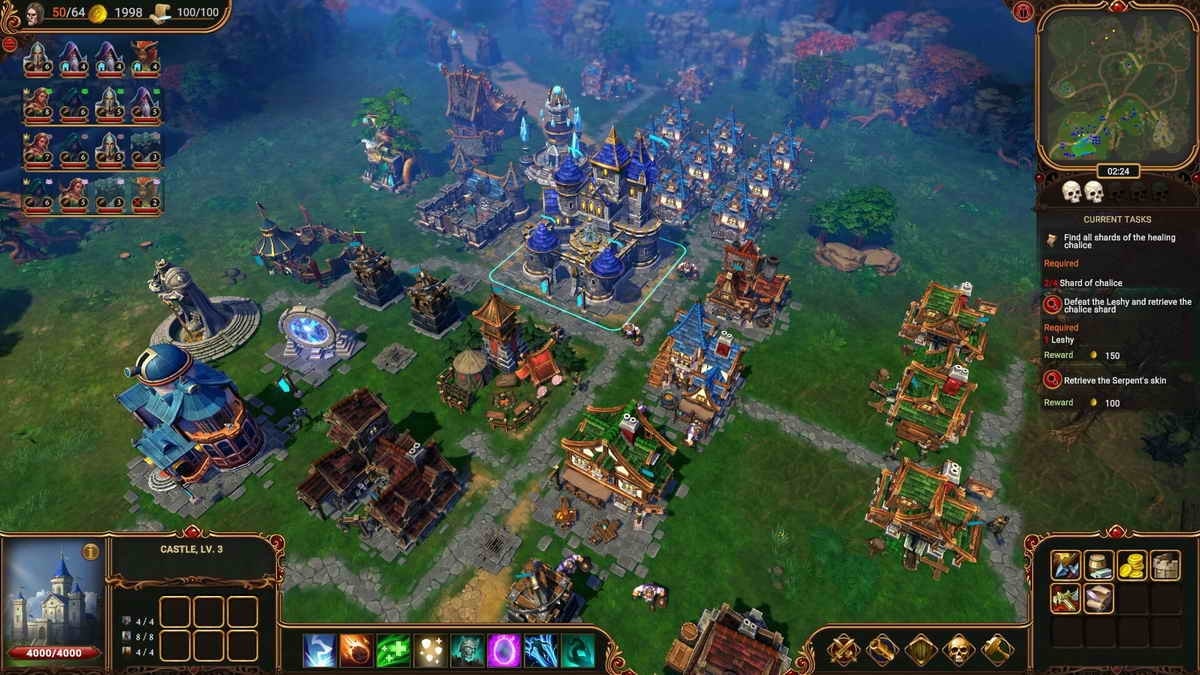
Lessaria arrives as an earnest attempt to update Majesty’s old indirect-control formula for a modern audience, and that sense of purpose is the clearest thing the game carries into each mission. Rather than trading in twitch reflexes, its design keeps the player one step removed – shaping incentives, building economies and issuing costly orders while watching funded heroes go about their lives. That choice gives Lessaria a distinct identity: the fun comes from coaxing emergent moments out of a living world rather than micromanaging unit paths.
The campaign does most of the heavy lifting in teaching that rhythm, introducing new buildings, threats and objectives at a steady pace so players learn to budget scouts, bounties and spells rather than panic-click their way out of trouble. Missions ramp thoughtfully: early encounters act like tutorials for Lessaria’s economy-first logic, while later stages force players to weigh long-term investments against immediate survival – and a separate survival mode stretches those systems into a sandbox where the same trade-offs feel ruthlessly instructive. That structure rarely overreaches, and it keeps the core loop interesting across dozens of hours.
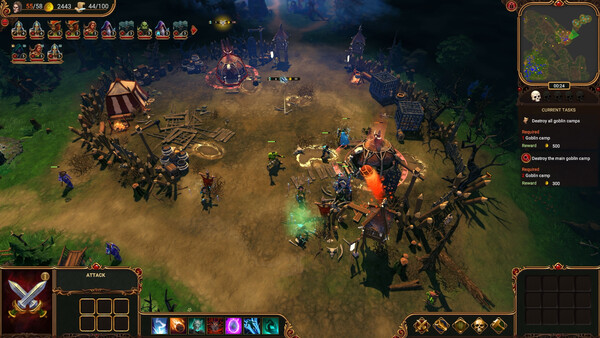
At the mechanical level the game is at its most compelling when hero squads and role-specific behaviours interact unpredictably. Fighters, rangers, thieves and mages behave with personality: scouts probe the map, rogues pursue coin, and groups will coalesce into surprisingly capable defensive lines without player hand-holding. The cost-for-control mechanic – paying to override default behaviour – turns each command into an economic decision, and that dynamic produces memorable emergent victories when it works. It also rewards observation and planning: learning what a faction will or won’t do on its own becomes as valuable as any weapon or tech upgrade.
That design, however, is not without friction. A few recurring rough edges – occasionally awkward pathfinding, inconsistent AI timing and some clumsy menu flow – can turn a cunning plan into a frustrating loss, especially in tight encounters where the margin for error is slim. The economic model also leans heavy: on higher difficulties the balancing act between population caps, expensive orders and map control sometimes tips from satisfying constraint into punitive resource austerity. Those moments don’t break the game, but they do dilute the pleasure of its best emergent scenes.

Visually, Lessaria reads cleanly and with purpose: buildings, heroes and map elements are distinct at a glance, which is crucial for a game where information economy matters. The art leans into a modernized Majesty aesthetic and succeeds at clarity, though animation polish and environmental detail sometimes feel economical where a little extra flourish would have elevated atmosphere and character. The soundtrack reliably supports the mood – calm in the village, taut during encounters – but voice lines and incidental audio cues could use more weight to fully sell the world.
Controls and accessibility are handled with the design philosophy in mind: the interface is purposely straightforward because the game discourages direct unit micromanagement, and that clarity helps new players climb the learning curve quickly. Still, the deliberate distance between player intent and on-field action means Lessaria will not satisfy everyone – players who prefer direct, hands-on control may find the economy-focused cadence slow or occasionally fiddly. For those who relish watching a simulated kingdom surprise them, though, the game delivers a modern, often charming iteration of Majesty’s old premise: imperfect, alive, and worth exploring.
Score: 7.7/10
 Press Play Media