
We stepped into Painkiller’s reimagining with an expectation of pure, unrepentant chaos, and for large stretches the game delivers exactly that: a visceral, arena-driven shooter that prizes momentum and mayhem above all else. The framing – condemned souls in Purgatory enlisted to stop the fallen Azazel and his monstrous children – is serviceable rather than revelatory, a scaffolding built to carry extended sessions of slaughter rather than to invite attachment to characters or plot. That choice sits at the heart of the experience: narrative exists, but not as a driving force, and the result is a campaign that feels both brisk and thin.
Where the story falters, the systems mostly pick up the slack. Painkiller leans into short, arena-style encounters strung through three major worlds, a hub that lets you buy upgrades and tarot modifiers, and a loop designed to reward aggression and experimentation. The combat is built around dual-function weapons, each mapped to a pair of triggers so that your arsenal often behaves like two tools in one, and movement tools such as a generous slide/dash, a jump that takes practice, and a grappling hook expand how you navigate encounters. Those design choices make the shooting feel punchy and varied when they click, but the repetition of similar arena beats and a tendency toward monotonous enemy waves undercut long-term momentum for players seeking more variety.
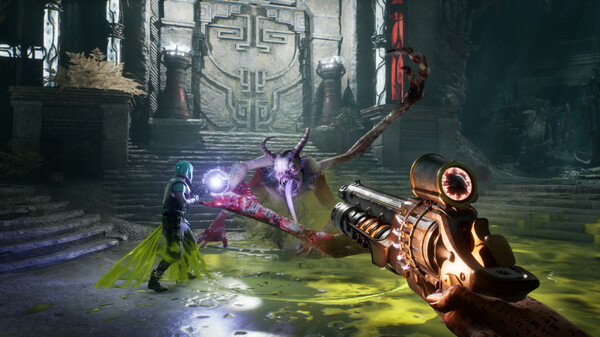
Co-op is engraved into the game’s bones, and that affects nearly every mechanical decision. Playing with others – or with the AI companions the game supplies in solo runs – accentuates the game’s strengths: shared destruction, complementary perks between characters, and emergent chaos that’s often exhilarating. The bots, reasonably, do their part and spare single players from constant babysitting, but the overall design still feels calibrated for human teammates; pick complementary archetypes and coordinate and the game sings, play solo and the multiplayer-first focus reveals some rough edges in pacing and incentive structure. The extra Rogue Angel survival mode expands replay value, but the mode’s handcrafted randomness and the core campaign’s short, looping missions mean the novelty can ebb sooner than expected.
Controls and feel are among the title’s more consistent wins: firing is immediate, weapon transitions are smooth, and the two-handed weapon paradigms provide satisfying mechanical variety. That said, some movement options (notably the jump and certain environmental interactions) demand acclimation, and a few implementations of puzzle-ish tasks feel clunkier compared with the game’s otherwise kinetic flow. Technical performance is generally solid, but we did see some stutters and crash while playing online – which means stability isn’t uniformly assured across every session.

Visually and sonically, Painkiller mostly hits the mark. The game frames its Gothic horror with robust creature models, multilayered environments, and thoughtful lighting and textures that often elevate otherwise routine arenas into striking setpieces. The soundtrack skews toward heavy, melodic metal that complements the game’s cadence without drowning the combat effects, and voice work supplies the pulp punch expected of the property. The aesthetic choices make the game feel like a modern, high-budget take on the boomer-shooter template, even if that modernisation sometimes trades away the idiosyncratic identity that made the original stand out. For players who prize spectacle and clarity in a shooter, the package largely satisfies.
We’ve come away with a tempered recommendation: Painkiller is an energetic, expertly animated shooter that rewards players who come for the loop of aggressive combat, weapon toys, and cooperative mayhem, but it stumbles when it asks us to care about anything beyond the next arena. The game’s modernization smooths and polishes the original’s rough edges, producing accessible and often thrilling combat, yet that same smoothing removes some of the franchise’s unique bite. For people who want multiplayer-focussed, fast-paced demon-slaying with strong presentation, there’s a lot to enjoy – but those looking for a single-player, lore-rich continuation of the classic will likely feel shorted. Ultimately, Painkiller’s revival is competent and frequently exciting, but not always faithful to the peculiarities that once made the series memorable.
Score: 7.0/10
 Press Play Media