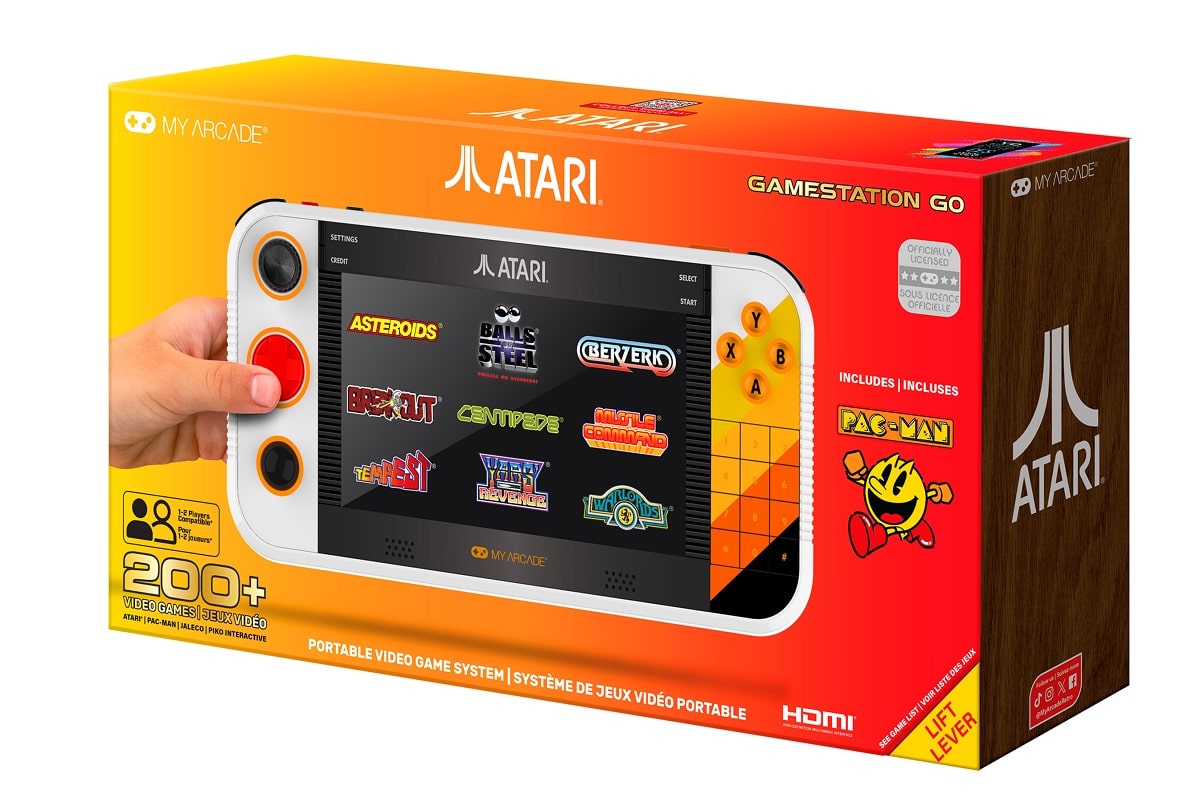
The Atari Gamestation Go, created through Atari’s partnership with My Arcade, aims to deliver a portable archive of classic arcade and console experiences while adding a handful of modern conveniences. Its core promise – more than 200 built-in titles together with five entries from Atari’s Recharged series and notable arcade names such as PAC-MAN, Rodland and Saint Dragon – frames the device unmistakably as a nostalgia-forward handheld that also wants to be practically useful in 2025 thanks to a few standout features.
The hardware’s defining characteristic is the sheer range of control methods packed into one shell. A D-pad and standard face buttons sit alongside a paddle wheel, an integrated trackball, bumpers, and a numeric keypad, while a SmartGlow system lights the controls appropriate to each game. This multiplicity allows games that once depended on custom peripherals to feel closer to their original form when played on the device, especially for paddle and trackball driven titles.
The screen and visual presentation are a mixed bag. The seven-inch display is large for a retro handheld and generally crisp for simple pixel-art and arcade visuals, but it also reveals limitations: modest color fidelity and reflections compromise contrast in bright (especially outdoor) settings. Those display traits temper otherwise attractive convenience features like HDMI output for TV play and USB-C connectivity for external controllers – which can turn the Gamestation Go into a TV-based controle as well. Battery life runs in the four-to-five-hour range under typical play, which is serviceable but not exceptional.

In handheld use the controls often succeed where a single, generic gamepad would not. Paddle games feel more authentic when the wheel is used, and the trackball reproduces the tactile sensation that many arcade originals relied on. That said, not every title achieves perfect parity: the trackball’s sensitivity needs learning and, in a handful of cases, responsiveness falls short of the ideal, requiring frequent minor adjustments from the player. The face buttons and D-pad remain satisfyingly responsive for standard action and platform fare.
Software and emulation choices create further trade-offs. While the bundled roster delivers recognisable classics and some modernized Recharged entries that are truly excellen, the collection’s curation leaves room for improvement: there are gaps where other high-demand retro staples might have deepened the appeal, and some titles exhibit aspect-ratio or audio timing inconsistencies that interrupt immersion. Those fidelity issues are sporadic rather than universal, and perhaps a future update will fix some of these, but depending on your choice of games they are noticeable enough to affect the overall experience.
Connectivity and extra features are among the unit’s more forward-thinking elements. Built-in Wi-Fi enables updates, and HDMI output lets the device double as a simple home console. A microSD slot and USB-C expandability make the handheld flexible for future content or accessories, even if local multiplayer remains limited by the lack of a bundled second controller at launch. These additions help the system feel less like a closed novelty and more like a living device – one that will even allow you to games of your own.

Aesthetically the Gamestation Go is arresting: the combination of unusual physical inputs and SmartGlow lighting gives it real character and makes it a conversation piece. The trade-off is tactile: construction leans toward plastic and feels chunky rather than refined, which undercuts the look and feel of a premium handheld presentation. For collectors and retro enthusiasts who prioritise faithful input methods and hardware novelty, the look and feel will likely be forgivable; for buyers seeking a sleek, polished modern handheld who don’t care about some of the more niche titles, the materials and ergonomics may disappoint.
Taken together, the Atari Gamestation Go is a distinctive, sometimes brilliant exercise in marrying legacy control schemes with a portable format. It rewards players who want authentic-feeling paddles and trackballs in a single device and who appreciate HDMI and Wi-Fi conveniences. At the same time, compromises in display quality, occasional emulation fidelity, and an economy-leaning build keep it from being a universal recommendation. For those prepared to accept those trade-offs in return for the novelty and breadth of inputs and games, it is a very worthwhile and characterful pick; for those whose priorities are flawless hardware polish and perfect fidelity, it will feel unfinished. As a celebration of Atari’s legacy in handheld form with a host of extra games and features, it is unmatched.
 Press Play Media
Solid review of Atari Gamestation Go! Love the paddle & trackball for authentic arcade feel—perfect for my retro shmup sessions. HDMI & Recharged games boost it, despite build quirks.