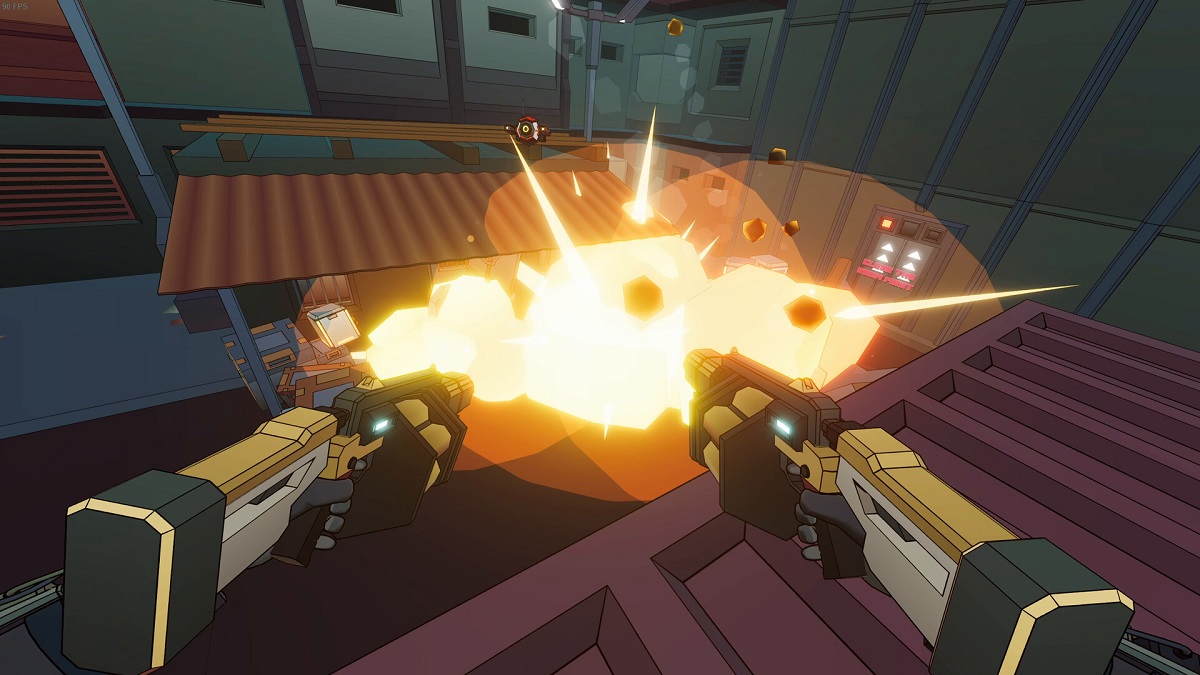
Salmi Games’ Sweet Surrender drops players into a stark, neon-washed megatower where survival is a series of vertical gambits: sprinting through enemy corridors, grappling to new vantage points and blasting automatons on the climb to the summit. The premise leans into arcade immediacy rather than story complexity, using the tower’s verticality and the threat of permanent loss to press players into aggressive, forward momentum.
Combat is brisk and purposefully designed for short, explosive runs. Movement options include smooth turning, snap turning and teleportation, and the inclusion of a grapplegun and ziplines opens traversal beyond simple strafing. Weapons span pistols to explosive launchers plus melee, and each run hands out upgrade chips that can alter how a build behaves. The result is an emphasis on on-the-fly adaptation: they outfit themselves between rooms, chain combos in tight hallways and choose whether to risk deeper floors for richer rewards.

That arcade thrust is both the game’s strength and its clearest source of compromise. The upgrade chip system supplies interesting tactical choices, yet the overall metagame can feel thin; chips often tweak values rather than reshape approaches, and long-term progression lacks the kind of branching unlocks that would make subsequent runs feel markedly different. The weapon pool is varied in name and function, but many pieces lack a satisfying sense of growth over time, which softens the reward loop once the initial thrill fades.
On PSVR2 the package benefits from clear visuals and steady frame pacing, which helps combat feel sharp and immediate. Haptics and adaptive triggers add small but welcome tactile feedback that makes each weapon pull feel more distinct. Still, the physicality of two-handed gunplay sometimes reads as clumsy: holstering and off-hand pivots can interrupt flow, and fast exchanges occasionally demand a degree of controller choreography that undermines the otherwise kinetic design. The PSVR2 improvements reduce some of that friction, but the underlying ergonomics remain a point of friction for those chasing the tightest gunplay.
A stylised aesthetic carries much of the game’s mood – industrial architecture punctuated by neon signage, well-designed enemy silhouettes and punchy effect work give many encounters clear visual readability. That visual clarity pairs well with an adrenaline-forward soundtrack that underlines combat tempo. Where the presentation disappoints is in repetition: room templates and enemy archetypes repeat often, and extended sessions expose a sameness that blunts the sense of discovery the first few runs provide. Sound design hits the right beats but could benefit from greater dynamic layering to avoid musical fatigue.

Difficulty and risk management sit at the core of the experience. The roguelike structure rewards daring but enforces consequences – environmental hazards and sudden damage sources can punish a single mistake and reset progress, which keeps tension high but also narrows accessibility for more cautious or casual sessions. The quick-run design makes for thrilling short bursts, but the lack of deeper variety and longer-term payoff can make repeated ascents feel like a loop that needs more structural additions.
Ultimately, Sweet Surrender VR on PSVR2 is a focused, high-octane roguelike that sells agility, not epics. It delivers on visceral moments: frantic firefights, clever traversal and immediate weapon satisfaction when the pacing clicks. Yet it stops short of becoming a foundational roguelike in VR because progression systems and environmental variety do not yet match the quality of the core combat. For those seeking short, sharp VR runs with tactile feedback and strong visual identity, it’s a fine fit; for those after a deeper metagame or wide architectural variety, it’s a title with clear room to grow.
Score: 7.0/10
 Press Play Media