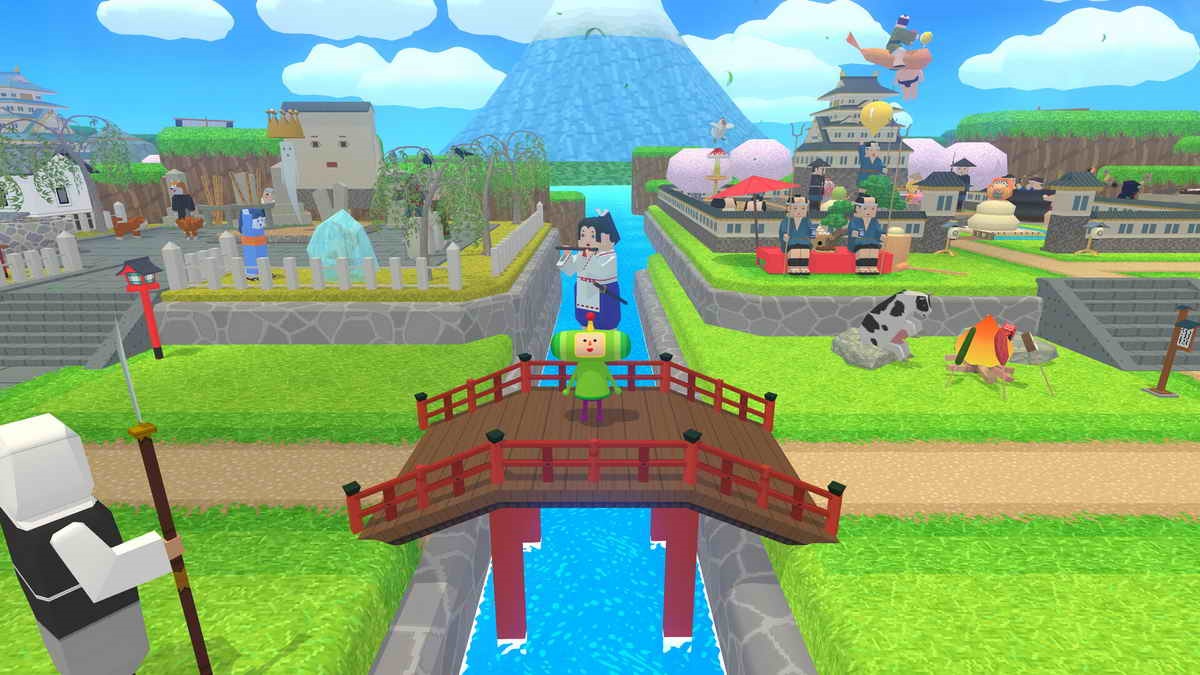
The moment the Prince of the Cosmos rolls out in Once Upon a KATAMARI, players are swept into the kind of absurd misadventures that gave the Katamari franchise its cult status. The narrative premise – where the ever-flamboyant King of All Cosmos accidentally wipes out the Earth, Moon and stars, and the Prince must travel through eras to rebuild the sky – is delivered in the familiar tongue-in-cheek, surreal tone the series thrives on. The journey through prehistoric landscapes, ancient Japan, and other whimsical periods gives the game a playful energy. There’s little dramatic weight behind the story, yet its eccentricity remains essential to the series’ identity and returns in full force here.
At its core, the gameplay immediately feels like coming home. Rolling the katamari to absorb objects, grow in size, and meet target goals is as addictive as ever. The structure hasn’t changed much since the early PS2 days, and the loop remains effortlessly engaging. What’s new comes in subtle forms: a magnet tool that draws in nearby items and speed boosts that shake up the tempo, for example. These additions give brief surges of variety, even if the broader formula is largely untouched. The balance between chaos and control is central again – satisfying when mastered, clumsy until it clicks.
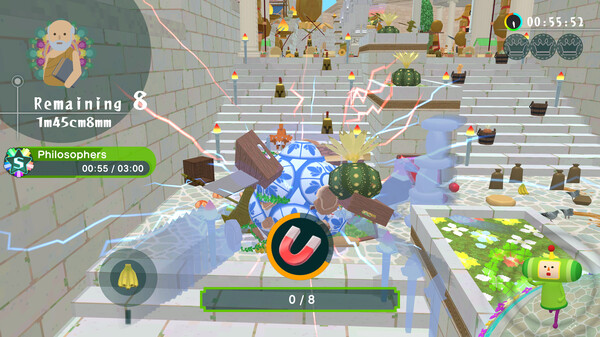
Movement still carries the series’ signature oddness. The physics-driven roll is intentionally quirky, and though it enhances the game’s personality, the responsiveness occasionally wavers. Some early stages demand extra patience as you learn to steer and pivot efficiently. Once rhythm sets in, though, the act of collecting everything from pebbles to entire buildings becomes a joyful dance of momentum and discovery. The PS5’s strong frame stability helps keep that experience fluid, even during large-scale, object-heavy sequences.
Visually, the game preserves Katamari’s playful minimalism. Colors burst across every scene, and environments brim with details that lean into the absurd. It’s not a technical showpiece – textures and lighting are simple – yet its stylized art direction carries a distinctive charm. Occasional camera hiccups in tight areas break immersion but never derail the fun. The soundtrack, meanwhile, is a highlight once again: vibrant, eclectic, and gloriously unrestrained, combining J-pop influences with jazzy interludes and cosmic jingles that perfectly fit the tone.
Beyond the main campaign, new features bolster longevity. “KatamariBall” transforms the premise into a competitive four-player mode, playable both online and offline, offering delightful bursts of chaos. The extensive roster of 68 cousins adds plenty of character variety, and customization options allow playful experimentation with colors and expressions. Structurally, the game feels more open than some predecessors, with eras functioning as thematic hubs instead of linear chapters. It’s a welcome change that invites exploration without losing the pick-up-and-play accessibility that defines the franchise.
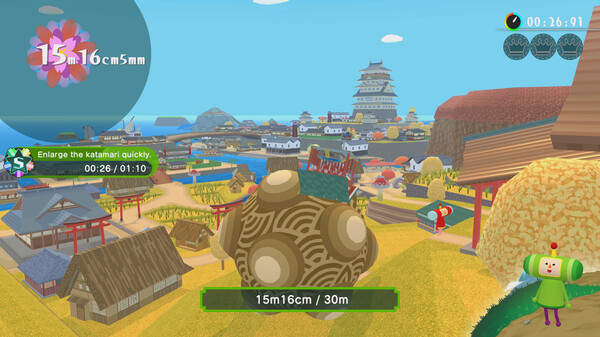
Despite these enhancements, repetition does creep in. After a dozen stages the familiar routine of rolling and collecting risks overstaying its welcome. The charm of the concept holds strong, but not every level delivers a memorable twist. Those seeking a dramatic evolution of the formula may find the creative risk too mild, while fans content with “more Katamari” will find plenty to enjoy. In that sense, Once Upon a KATAMARI is more of a lovingly expanded encore that fans will love than a reinvention that will draw in a new crowd.
Ultimately, the game captures what makes Katamari so enduring: it’s eccentric, tactile, and irresistibly cheerful. The added content enriches the experience without complicating it, and the PS5 edition runs smoothly while preserving the heart of the series. It doesn’t roll into uncharted territory, but it shines in what it sets out to do – delivering pure, colorful chaos and simple joy that’s as charming now as it was twenty years ago.
Score: 8.1/10
 Press Play Media