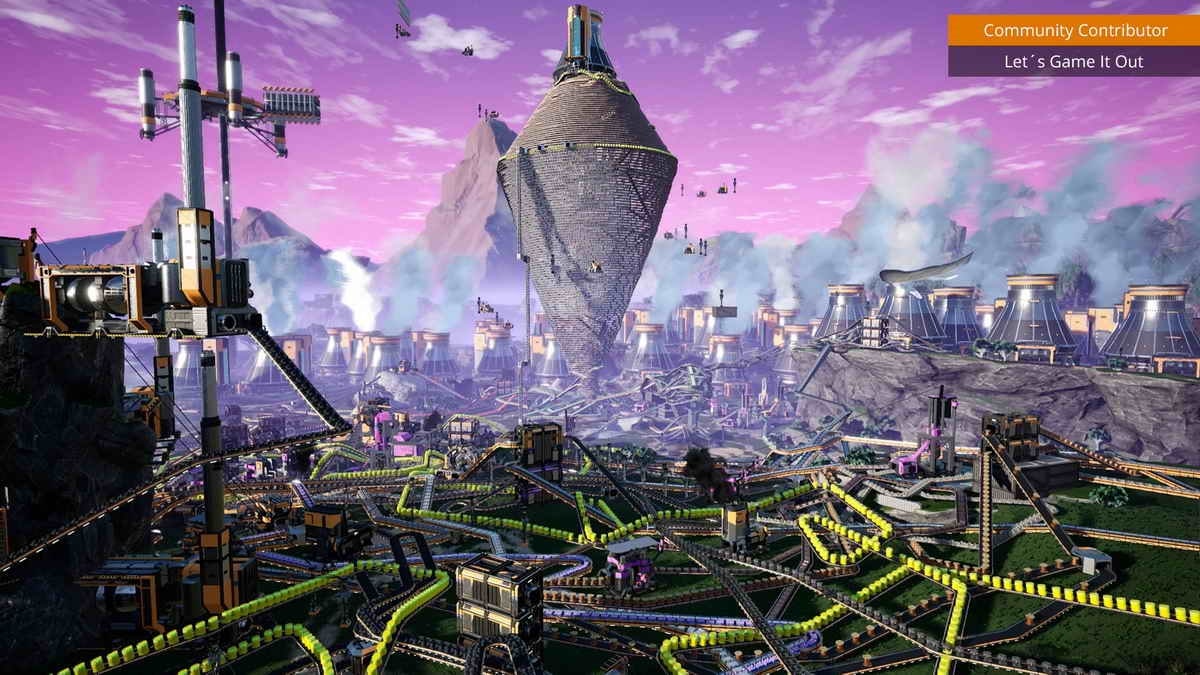
Satisfactory – developed and published by Coffee Stain Studios (via Coffee Stain Publishing) – leaps from PC sandbox success onto the PlayStation 5, bringing its ambitious factory-building world into living rooms and onto the DualSense. In this console version, the core loop remains unchanged: you’re dropped onto an alien planet, tasked with building factories, automating infrastructure, and exploring as your production empire expands. Yet the translation into a console environment introduces both welcome refinements and subtle compromises.
From the outset the game sets a tone of boundless ambition. The first-person vantage is still in place, and the freedom to expand across the terrain, layering sprawling networks of conveyors, pipes, trucks and trains, remains the primary draw. The console version handles this transition remarkably well, with stable performance in normal sized builds and an interface that translates to the DualSense controller with fewer compromises than one might expect. For players who relish designing logistical webs and watching them hum, that core satisfaction remains intact.
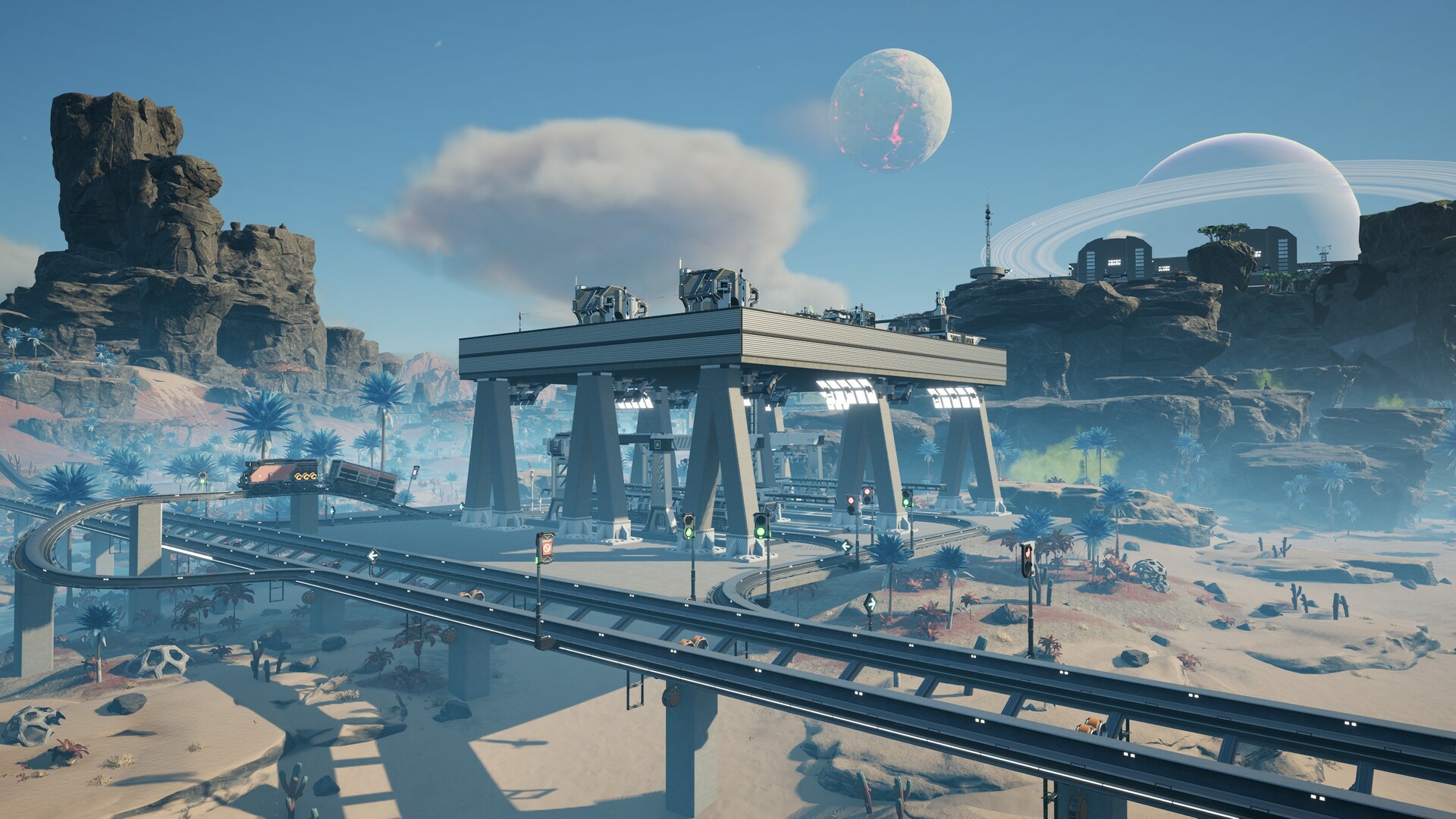
That said, the narrative framing and pacing are modest – the “you’re a worker of FICSIT on an alien planet” premise is functional, providing context rather than deep storytelling. Indeed, the structure doesn’t emphasize dramatic arcs or strong character development; this is very much a sandbox toolset first, narrative second. Some players might find that lack of narrative weight and structured progression a downside, especially if they seek story-driven motivation rather than self-set goals. Thus, while the premise serves the gameplay well, the narrative is not the main attraction.
Instead, gameplay mechanics remain the highlight. From your first scanner to your twentieth conveyor belt, the satisfaction of scale and automation is potent. The progression system smoothly unlocks new machines, vehicles and technologies, which keeps the feeling of growth alive and meaningful. On PS5 the three performance modes (60 fps, 40 fps Balanced, 30 fps Quality) give players choices between responsiveness and visual fidelity; in the 60 fps mode the console version holds up very well in mid-sized factories.
However, the controls bear closer scrutiny. A mouse-and-keyboard scheme suits the depth of this kind of game, and while the PS5 version handles the controller admirably in many scenes, the precision required for large-scale factory planning can feel slightly less nimble on a DualSense. Some build-planning moments, especially when zooming out and aligning multi-storey structures and conveyors, might have benefitted from finer input control or a UI redesign tailored for consoles. The three-dimensional layer of planning, while rich, can become unwieldy when finer control is needed – for example in power-grid tweaking. So while the mechanics are intact, the shift to consoles brings trade-offs.

Visually the alien world is still attractive and the scale of the factory expansions impressive. On PS5 in Performance mode the frame rate held steady, even under moderately large factories. Texture pop-in and occasional distant building delays were seen, but did not significantly detract from the experience. Audio design, too, supports that sense of industrial immersion: the ambient hum of conveyor belts, the punctuated clang of machines, and the score are respectful of the genre – though nothing groundbreaking or too memorable. One slight caveat is that once the novelty of the setting wears off, the biomes and fauna can begin to fade into the background, with less narrative or environmental variation than some might hope.
On stability and longevity the console version appears solid, but some concerns linger. Large-scale builds seem like they push the hardware, because while the PS5 port performs well up to a point, extremely sprawling factories seem to introduce framerate dips or longer load times. The game’s energy-grid and power-distribution systems can become a little fiddly and maybe more frustrating when extended to large sizes, especially on consoles where precision input is less natural than it would be with a mouse. Moreover, the loop of expansion and optimisation can become repetitive after a certain point, particularly if you aren’t invested in the “chase for efficiency” mindset. This isn’t necessarily a drawback if you enjoy micromanagement, but it may limit the appeal for some.
In summary, Satisfactory’s PS5 version is an excellent port of an already outstanding PC sandbox. The developer and publisher have done a commendable job of bringing the deep automation tools and vast factory-building possibilities to console, preserving the essential feel of the experience. The trade-offs are familiar: input precision is less ideal, and at extreme factory scales the hardware load may become more noticeable. The game is best suited to players who relish open-ended creation, logistical puzzles, optimisation and scale rather than tight narrative or frenetic action. If you fit into that niche, the PS5 version delivers near full value and does so with polish. For those expecting a more guided, story-driven or action-heavy experience, the depth may not translate as strongly. Overall, this is a highly recommended addition to the console library for the builder-enthusiast, and a really strong showing from Coffee Stain in this new platform context.
Score: 8.6/10
 Press Play Media