
Dark Quest 4 opens with a tidy, old-school fantasy premise: Gulak, the sorcerer’s puppet, has stitched together an army of monsters and left villages emptied of their people. The narrative presents that setup like pages from a storybook, using framed text and tableau scenes to move the party from dungeon to dungeon; it never aims to be a twisting epic, instead giving each mission a clear, focused purpose that keeps the tone consistent and the stakes easy to follow. The simplicity of the tale becomes a strength rather than a failing, because it keeps attention on the small, tense dramas that play out on the board-style maps and lets the mechanical systems carry most of the emotional weight.
Mechanically, Dark Quest 4 is faithful to its tabletop roots: movement and card-based actions on a grid force players to consider positioning, line of sight and the order of play. The party composition system encourages rotation of heroes rather than reliance on a single over-powered unit, and the card pool and ability synergies reward experimentation. Those systems make individual encounters feel like puzzles to be solved rather than mere stat checks, and the presence of traps and environmental hazards adds a welcome layer of chess-like calculation. That said, the progression economy leans toward repetition – repeating missions to unlock better heroes and cards can feel like a grind at times, and the lack of traditional level-up mechanics keeps some characters fragile in longer, riskier runs.
Controls and the user interface on PlayStation 5 mostly do what is required: menu navigation is clear and the core interaction model maps sensibly to a controller, which helps keep the pacing steady. Wherever precise tile selection matters, however, the feedback could be clearer; players may occasionally fumble when selecting doors or toggling between movement and action ranges. Inventory and card management are functional but would benefit from slightly more informative HUD cues to reduce micro-friction during tense turns. These are polish issues rather than systemic flaws – they interrupt flow but do not break the underlying tactical engagement.
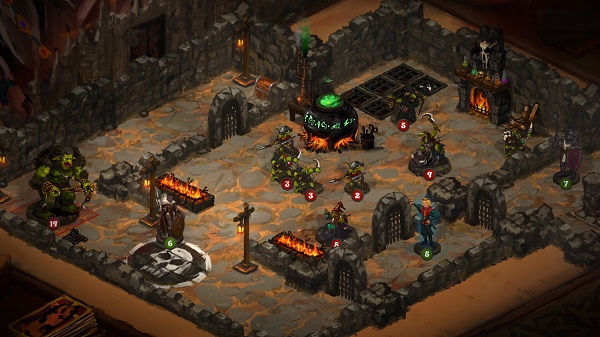
The visuals lean into a handcrafted, miniatures-on-a-table aesthetic: characters look like painted figurines and dungeons appear as theatrical sets lit by moodier lamps and torches. That look supports the board-game conceit beautifully and the soundtrack amplifies the atmosphere with brooding, orchestral cues and punctuated fanfares for combat. Performance on consoles is steady and the animations, while modest, are serviceable and readable in combat. Over longer play sessions the reuse of certain assets becomes noticeable, which slightly reduces the sense of discovery in later chapters, but the overall package nails the nostalgia the design intends to evoke.

Beyond the core campaign, the game’s multiplayer mode substantially extend its life. Local co-op for up to three players recreates the camaraderie of tabletop sessions, For players who relish group strategy, these features are a real selling point; for more solitary players the base campaign still offers many hours of tactical play but leans on repetition to stretch its longevity.
On balance, Dark Quest 4 is a well-crafted homage to board-game dungeon crawls that translates the tactile pleasures of tabletop play to the PS5 effectively. It prioritises clear, deliberate tactical design and atmosphere over narrative complexity, and it succeeds most where players enjoy careful positioning, card synergies and cooperative planning. The main drawbacks are a slightly grindy unlock loop, occasional interface niggles on a controller, and some reuse of visual assets late in the run; these keep the score from being higher but do not erase the core enjoyment. For fans of tactical, turn-based dungeon crawlers and anyone who wants a faithful digital take on the HeroQuest-style formula, this is a recommendable pick.
Rating: 7.5/10
 Press Play Media