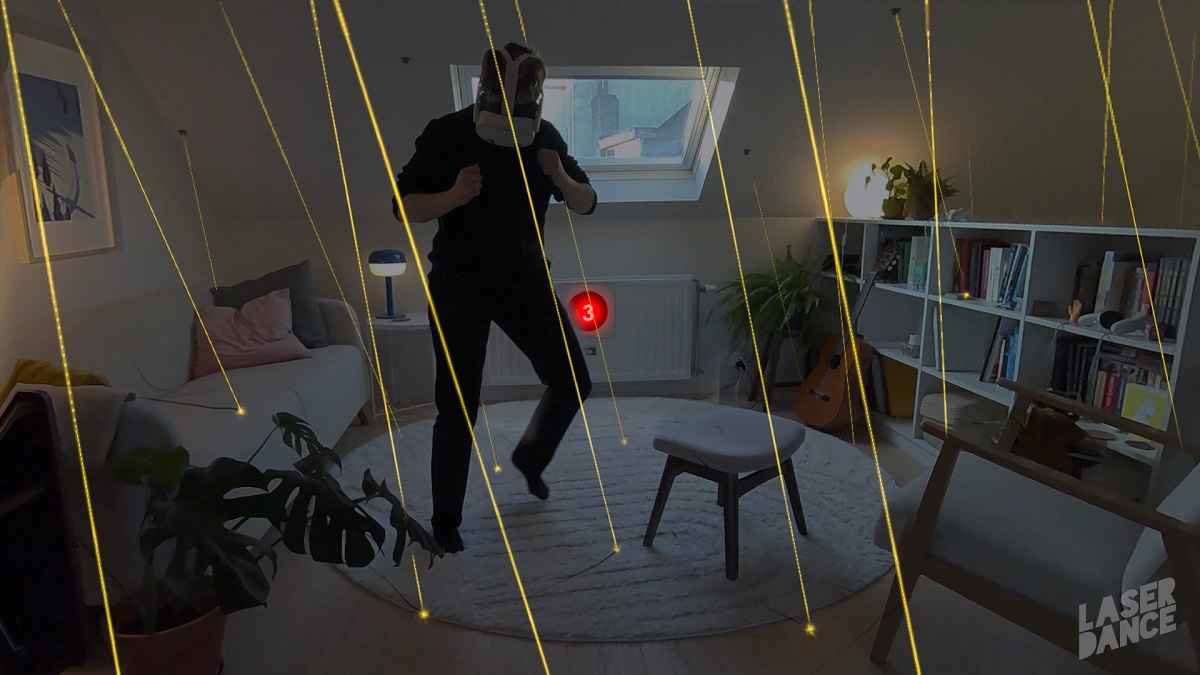
From the moment the headset’s passthrough activates and transforms your living room into a laser-filled gauntlet, it’s clear that Laser Dance (developed by Thomas Van Bouwel and published by Vanbo) is carving out its place on Meta Quest 3/3 S as a standout mixed-reality experience. The objective is deceptively simple: place two buttons on opposite ends of your room, then dodge, duck and weave through laser patterns to hit the target on the far wall. What elevates the game is how the room itself becomes the arena. It’s a premise that works instantly – no long setup, no complex mechanics to learn, although having ample room to play certainly helps.
From a gameplay mechanics perspective, the adaptation to the player’s environment is especially strong. The game uses the Quest’s passthrough and spatial scanning to map your room, placing the start and finish buttons and then generating laser beams that interact with your room’s furniture and layout. As the levels progress, you move from fixed beams to blinking ones to sweeping lasers that demand timing, awareness and movement. This range keeps things fresh while still being approachable. The control scheme – whether by hand-tracking or controllers – feels intuitive, and the lack of artificial locomotion means your body actually becomes the controller. That bodily stake in the game is where Laser Dance delivers its biggest thrill.
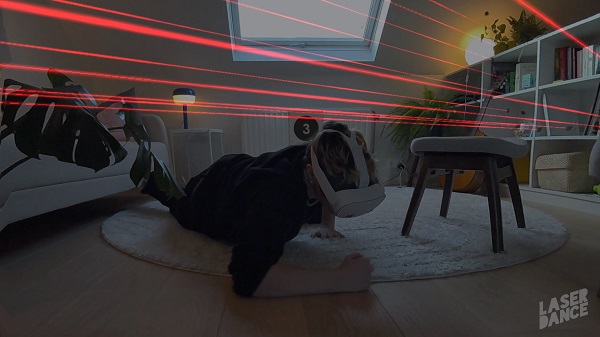
Visually and aurally, the game makes strong use of its MR context: The lasers hum and flicker, you see your own limbs traced in ghost-form when hit, and your own furniture becomes both an obstacle and a shield. There is a certain purity in the presentation: you aren’t navigating an elaborate narrative, just physical challenge and spatial reasoning. That minimalism works to the game’s favor because it allows the room transformation to shine. On the audio side, the sound design nails the atmosphere – an ominous buzz, a satisfying chime when you succeed – though the music component is still minimal at this early access stage.
On the accessibility front, Laser Dance includes adjustable settings for height, mobility, and laser speed, which means the experience scales beyond agile gamers. That inclusivity is welcome; being able to slow beams, adjust how low you must crawl or bend, and account for varied room sizes means the play space is broader than many MR titles. However, there are trade-offs. The collision detection currently tracks only head, arms and torso – legs and feet aren’t reliably detected. That means you could, for example, step over a low laser without penalty, which slightly undermines the physicality of the challenge when you don’t commit. In some rooms the geometry still feels constrained; if your path between buttons is too short or furniture awkwardly placed, the “arena” effect shrinks and the variety of movement is less impressive.
In terms of pacing and content, what’s available in Early Access is impressive but also revealing of what could come. At launch the game includes close to two dozen levels and more than 80 laser patterns, with more promised. But some wear-and-tear shows: the total playtime may feel short for some, especially once you’ve mastered the patterns or room layout. While unlockable challenges add replay value, for players who roam large spaces or seek deeper progression, the current scope may feel modest. The promise of further levels, music and modes is solid, but the current build isn’t yet the “indefinitely replayable” package – although moving furniture around has never been more rewarding.
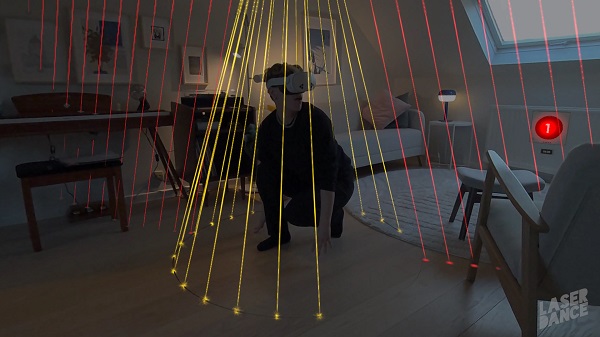
The biggest “but” with Laser Dance is the reliance on the player’s space and the limitations inherent in that. You need at least about three metres (10 feet) between your selected buttons, and the game works best with a clear floor, free from obstructions or hazards. For some players that means clearing furniture or playing in a dedicated space. And though the Mixed Reality mapping is robust, there are occasional moments where the system mis-registers or you find yourself repeating a section because a beam clipped you unexpectedly. Given the physical nature of the experience, proper setup and clearing risk are important. It also currently lacks multiplayer or social features, something many will expect in a party-friendly title.
In sum, Laser Dance is a standout early access for the Meta Quest platform – and arguably one of the best demonstrations yet of what mixed reality can bring to the living room. It marries intuitive movement with spatial design, giving immediate and memorable moments of “I feel like a spy” as you dodge beams around your sofa. The technical take-aways (passthrough, body tracking, dynamic occlusion) impress and the gameplay holds up. The current limitations in content scope and tracking detail don’t overshadow the experience, but they are worth noting. If you have the space and the Meta Quest 3/3 S, this is a strongly recommended title – especially if friends or family will join in the fun. The full release promises even more; but right now, Laser Dance already hits hard.
Score: 8.0/10
 Press Play Media