
From the very first moments of Dark Atlas: Infernum, a sense of disorientation settles in. You assume the role of Natalia Asensio, Grand Master of an ancient esoteric order, now drugged, trapped in a crumbling basement, and thrust into a spiralling descent of memory, ritual and collapsing reality. Framed within the larger Radiata Saga trans-universe, the game embraces psychological survival horror rather than straightforward action. The premise evokes a haunting inner-journey: stop the apocalypse while you’re not even sure who you are. The developer-publisher pairing of Night Council Studio and Selecta Play sets accordingly a tone of ambition – but the results are mixed based on the PS5 version we played.
Narrative and premise are among the stronger points here. The union of occult overhead (a secret society, dimensional gates, and a voice whispering inside your head) and the personal (Natalia’s fragmented identity) builds a compelling foundation. The world-building, thanks to the Radiata Saga tie-in, gives the events a larger mythic weight and the sense that each corridor and ritual has weight beyond the immediate jump-scare or puzzle. Yet the delivery never fully captures the emotional horror the idea promises: the voice acting fails to carry the despair and horror of Natalia’s situation with conviction. Thus while the story is intact in concept, its execution leaves something to be desired.
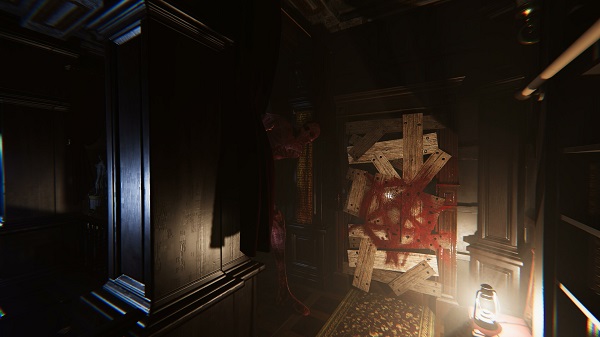
In gameplay, Dark Atlas pivots away from combat and instead emphasises exploration, stealth, and puzzles. You’re often encouraged to hide, listen, observe, retrace memories, and navigate between the physical world and more surreal mental states. The pace is deliberate, not frantic, and that can create effective tension. But this deliberate pace also exposes design weaknesses. The absence of a map demands that players keep their bearings mentally, which can become a major frustration: repeatedly back-tracking through dim, confusing spaces because of missing items or unclear pathing. The hint/objective system is weak and some puzzles feel under-explained, making the experience harder than it needs to be. The choice to let players disable enemies in “story mode” is a welcome concession, but that may simply pick one frustration (combat/stealth pressure) only to leave you with another (navigation/clarity) instead.
The controls and interface deliver the basics: walking, looking, interacting, hiding. Initially you’ll want to tweak looking sensitivity because the default feel is stiff, and sound-balance issues (voice volume too high) may require adjustment. On PS5 the overall scheme is serviceable, but the lack of HUD or navigational aids undermines accessibility for some players. In a game where mental spatial memory is key, the absence of a map stands out. That said, for players willing to embrace disorientation, that may be part of the design intent – albeit a frustrating one to some players.
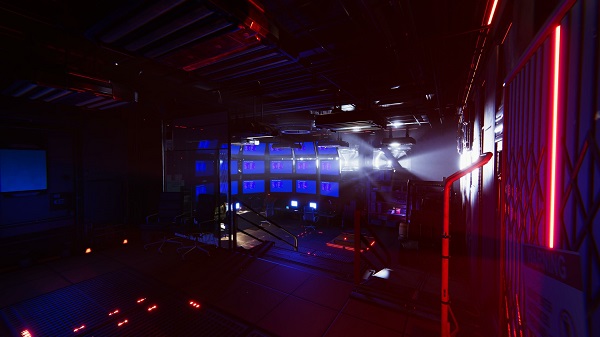
Visually and aurally the game offers genuine moments of atmosphere. The interplay of blue (‘celestial’) lighting and red (‘infernal’) in the environments is a strong artistic choice: lighting becomes a character itself, shadows shifting with foreboding purpose. The art direction earns praise: the colour palette and use of volumetric lighting help bring the dream-like, nightmarish spaces to life. On the other hand, the visuals can be underwhelming on a PS5 Pro, with lighting so dim that navigation becomes a chore and ambient assets feel repetitive. Audio design is more successful: ambient creaks, whispering voices, the hum of unseen dangers all contribute to the mood.
Ultimately, Dark Atlas: Infernum presents a bold vision that doesn’t entirely land. For those drawn to slow-burn psychological horror rooted in occultism, there is reward: exploring memory fragments, creeping through eldritch rooms, feeling vulnerable rather than empowered. But the experience is uneven – navigation issues, unbalanced enemy/stealth mechanics, weak objective clarity and occasional technical/visual mis-steps drag down the immersion. The story is interesting but overshadowed by multiple frustrations.
In the context of 2025’s horror market, where strong titles proliferate, Dark Atlas: Infernum may struggle to make a lasting impression. It does not redefine the genre, yet it does offer glimpses of creativity and atmosphere worth recognising. If you’re a horror purist who enjoys the challenge of imperfect design in favour of mood and narrative, this might be worth a look. If you prioritise smooth navigation, strong voice performance, and tight mechanical polish, you may find yourself increasingly aware of what this game doesn’t do. In short: darkness embraced, but not fully mastered.
Score: 6.4/10
 Press Play Media