
From the very start on PlayStation 5, Sektori announces itself as a distilled arcade beast – three-button precision, twin-stick movement, and a relentless surge of neon geometry. The presentation is deceptively minimal: your ship, a field of polygonal foes, and a battlefield that never stays still. Yet in that simplicity lies a core designed for mastery, not memorization, and the game leans into that deliberately.
Mechanically, Sektori feels like a finely tuned arcade machine. Moving with one stick, aiming and firing with the other, and using a charged “strike” dash gives players a rich toolkit within a very clean control scheme. Progressing through each run demands not only split-second reflexes, but also smart choices: the glimmer dropped by enemies is used to unlock stat upgrades mid-run, while yellow tokens let you pick from a deck of “perk cards.” The dash – more than just a movement option – becomes a high-risk, high-reward tool: you can use it to reposition, deal damage, or chain devastating explosions if timed right.
This tight design gets elevated by Sektori’s structure. Over the course of the main campaign, the map evolves: walls shift, corridors appear and disappear, and enemy waves adapt. That constant transformation reinforces a core principle: no run is identical. It’s not about learning fixed patterns so much as learning how to read chaos. That said, when things get visually intense, there are moments where clarity suffers – the flurry of shapes, effects, and color, especially in high-density combat or “mirage” modes, can make it hard to track danger.
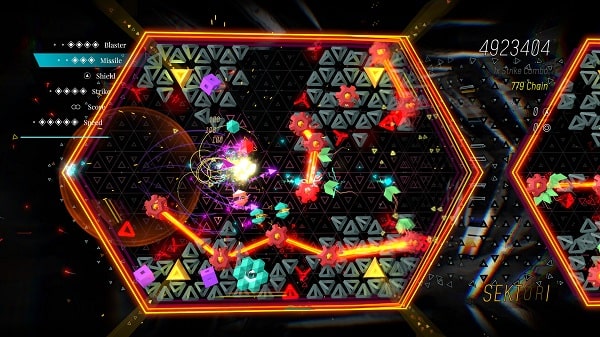
Visually, Sektori is raw neon electricity. Geometric enemies fly in predictable but often surprising formations; their shapes, color, and behavior signal their threat and pattern, giving you room to learn. The arenas themselves are alive – transforming, expanding, contracting – and that sense of flux makes every moment feel both urgent and alive. But that same visual intensity can be its own obstacle: when the screen pulses with color, the player’s reaction window sometimes becomes clouded.
Sound plays a central role in Sektori. The techno-based soundtrack isn’t background – it feels like a synesthetic partner in your run. Beats provide rhythm, energy, and momentum, and the feedback from your weapons – blaster, missiles and strike – is tightly woven into that audio fabric. The result is a loop where music and action feed into each other, drawing you into a kind of flow state, especially during longer or more intense runs.
In terms of content, Sektori offers more than just its campaign. There are six alternate modes – Classic, Surge, Crash, Assault, Gates, and Boss Rush – each reinterpreting the core rules in interesting ways. These modes help the game avoid stagnation: you can pick a mode that tests your skill, changes the pacing, or shifts which mechanics you rely on.

Yet, Sektori is not a universally gentle experience. The difficulty curve can be steep: even on the lowest difficulty, it demands focus and precision. The upgrade deck system, while clever, doesn’t always feel impactful enough – sometimes the cards you draw don’t feel dramatically different, and mastering which deck to bring becomes a bit of trial and error. And, as noted, the visual feedback in chaotic moments can become a double-edged sword, potentially undermining split-second decision-making.
All in all, Sektori on PS5 is a masterclass in modern arcade design. Kimmo Factor (Kimmo Lahtinen) channels decades of twin-stick experience into something that feels fresh, intense, and deeply replayable. It’s not built for relaxation: it’s built for engagement, for that satisfying tension when you navigate chaos with clarity, and for the high of chaining perfect runs. If you’re willing to meet it on its own terms – absorbing the challenge, embracing the swirl of color and sound – it’s an experience that rewards with raw, unfiltered arcade joy. But if you’re looking for a breezy or story-driven ride, Sektori makes it clear it’s here to test your reflexes, your build-craft, and your endurance.
Score: 8.8/10
 Press Play Media