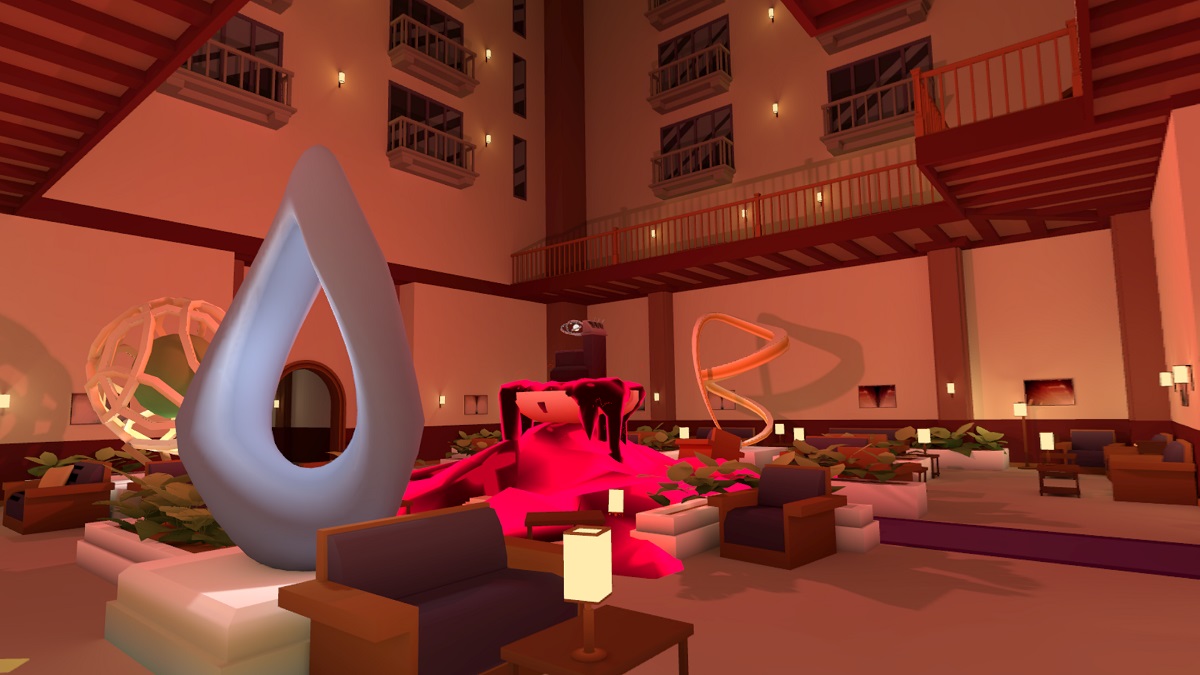
Stepping into Hotel Infinity is like checking into a dream you can’t quite believe – a sprawling, surreal space where geometry folds and time loops, and every footstep feels charged with both wonder and disquiet. Studio Chyr’s latest is a VR puzzle-adventure that leans fully into room-scale design, encouraging you to physically move through a 2 × 2 meter area so that the hotel world rearranges itself around you in delightfully impossible ways. This isn’t just a gimmick: it’s the heart of the game’s identity, and its boldest strength.
From the very first corridor, Hotel Infinity unsettles you. Turning a corner might drop you back where you started; opening a door may lead not to the expected room, but to an entirely different floor. The environments shift as you move: lifts, portals, and staircases twist space so that your small physical area actually feels vast because VR can make you believe things are there even when they’re not physically possible.

That said, this design isn’t just for show – it’s married seamlessly to the puzzle mechanics. The challenges are mostly intuitive and tactile: levers, buttons, switches. When you pull one, you might hear walls sliding, or watch entire passages unfold into new shapes. The payoff isn’t always mental acrobatics; it’s more often that satisfying moment when the world reconfigures itself around you and opens up a new perspective.
But for all its architectural trickery, Hotel Infinity does stumble in places. Performance on the Quest isn’t perfect due to frame drops and small glitches that can pull you out of the illusion, and on PSVR2 the cable can interrupt the roomscale experience at times. The PSVR2 visuals also feel like a direct port of the Quest version, not making full use of the PS5’s power.
Visually, the hotel leans into a minimalist, low-poly aesthetic – not hyper-realistic, but clean and color-coded in a way that serves the weird spatial architecture rather than hides it. The sparse but eerie soundscape supports the mood without overwhelming it: occasional musical riffs, doors creaking and distant hums do most of the heavy lifting here. The subtle audio helps sustain a sense of unease, even in relatively empty corridors.
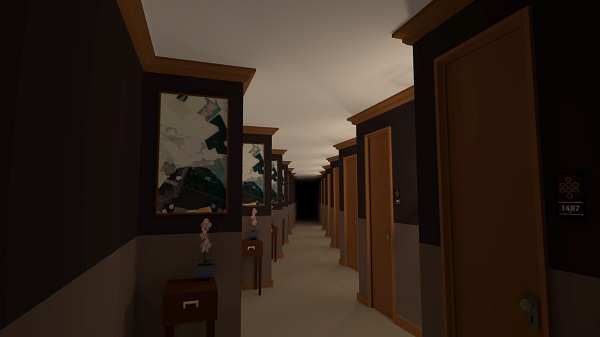
However, the emotional or narrative weight is quite light – there’s no heavy dialogue, and the “why” of your presence in the hotel remains ambiguous. That mystery works in favor of exploration, but some players might be left wanting more in terms of story or reason to return after finishing, and we felt like the game’s formula could work great with a mystery narrative. As it is, return you might not: the experience is quite short. Depending on your pace, you could clear it in around an hour to ninety minutes.
From a design standpoint, the controls are smart, but not perfect. When you have the full playspace, room-scale walking is the best way to experience the world – it’s precisely how the game was built, and that physical freedom makes the illusions feel magical and reason enough to pick this one up. If you don’t have that space, there are alternative locomotion options via controller, but these fallback methods feel like they miss the soul of the game.
In its best moments, Hotel Infinity is a testament to the unique power of VR: it transports you somewhere impossible, but one that you can physically inhabit. That said, the game’s brevity, occasional performance hitches, and lower visual fidelity on PS VR2 hold it back from being a truly transcendent experience. For curious VR players who have the space, it’s absolutely worth a stay as a short and unique experience that twists your perception of space in ways only VR can. It’s a kind of clever and playful exploration of perspective and space, elevated by room-scale movement and charming spatial puzzles. It’s not long, and it doesn’t always look or run perfectly – but when it works, it’s a gleefully mind-bending VR experience.
Score: 7.7/10
 Press Play Media