
The Last Case of John Morley opens as a small, bitter glass of noir: John Morley, recently discharged from hospital, is hired by the grieving Lady Margaret Fordside to re-examine the murder of her daughter, a case closed two decades prior. The setup leans on classic ingredients – a creaking manor, an abandoned asylum and a detective with past wounds – and the game uses those ingredients to build a compact, melancholic mystery that generally favours mood over mechanics.
Narratively the game is strongest when it lets the past creep forward through small discoveries. Flashback reconstructions and scattered diary pages reframe earlier assumptions and, at points, turn what looks like a simple whodunnit into something quietly tragic; motivations become human rather than purely plot devices, and the finale lands with a poignancy that rewards patience. That said, the story’s central twist is signposted early enough that its shock value is reduced for more observant players, and the short single-play runtime limits deeper character beats that might have amplified the reveal.
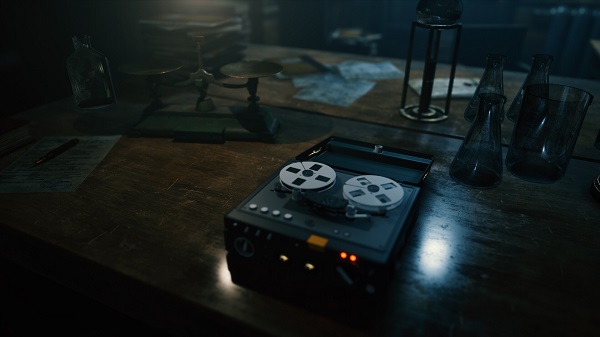
Gameplay steers firmly toward the walking-sim / narrative adventure side of things: progress is driven by exploring rooms, interacting with highlighted objects and triggering setpiece flashbacks which then advance the case. There is little in the way of active deduction – no crimeboard, no notebook for cross-referencing clues – so players are often reduced to memorising codes or jotting notes externally if they want to feel like a proper sleuth. That streamlined approach keeps the experience accessible and paced, but it also makes the detective role feel a degree removed; the game orchestrates the revelations more than it lets the player assemble them.
Where the production shines is in atmosphere and locations: the manor’s faded rooms, the asylum’s echoing corridors and the careful use of shadow and piano-led underscoring create a persistent sense of unease that often compensates for mechanical sparseness. Small visual touches and well-timed audio cues produce real, brief frissons, and several moments use lighting and set dressing to create optical illusions that linger in memory. Those high points are the game’s raison d’être – its capacity to make a short, nightlong case (this is a game that wraps up in about three to four hours) feel like a lived memory.
Unfortunately, technical rough edges keep pulling the experience back down. Object pop-in, disappearing items and occasional invisible collisions frustrate pacing and can break immersion; save points (and their placement) exacerbate this, sometimes forcing players to repeat several minutes of slow, atmospheric exploration after a freeze or a stuck animation. Voice work is serviceable in places but inconsistent, with supporting performances less assured than the leads; together with the bugs this unevenness prevents the game from fully realising the emotional weight it strives for.

Controls and puzzle design emphasize ease of entry over challenge. Puzzles are mostly short code-oriented tasks or simple object interactions and rarely demand lateral thinking; they keep the story moving but deliver few “a ha!” moments. For players who want a contemplative evening of exploration, that’s fine – the game is short, tidy and rarely punitive – but those looking for complex crimecraft or branching investigative tools will likely find the systems disappointingly prosaic.
For what it sets out to be, The Last Case of John Morley is a modest success: an evocative, evening-length noir whose atmosphere and core mystery are compelling in spite of – and sometimes because of – its small scale. Its chief pleasures are environmental mood and a story that tilts toward sorrow rather than spectacle, but its impact is dulled by predictability in the twist, lightweight investigative systems and a few technical problems. At its best it is a memorable short story in game form; at its worst it feels like an intriguing premise that needed more time and polish to match its ambition. For players seeking a brief, moody detective outing on a budget price, it is worth a look; those seeking a deeper investigative simulation should temper expectations.
Score: 6.7/10
 Press Play Media