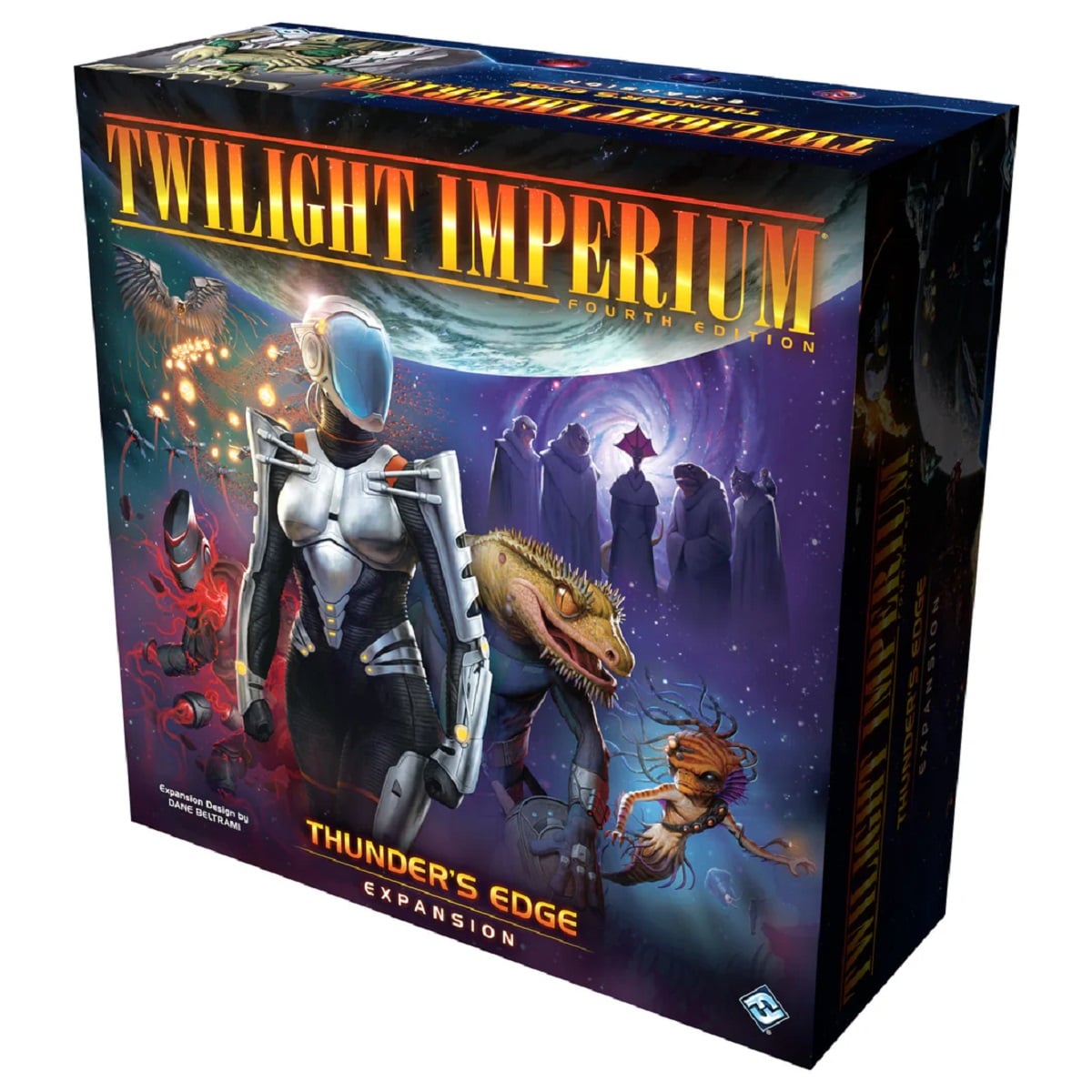
Twilight Imperium’s new Thunder’s Edge expansion arrives as part of the recent refresh for the fourth edition, and it does so with a sense of ambition that feels entirely in step with the game’s reputation. Published by Fantasy Flight Games under Asmodee, it broadens a ruleset already known for its vastness and injects new layers of variation, asymmetric depth, and long-form strategic tension. It also reframes early-game pacing by introducing new incentives and optional systems, giving veteran groups a surprisingly different tempo from the moment the first strategy cards are drafted.
The thematic centrepiece is the titular planet, Thunder’s Edge, which no longer functions as a mere point of interest but instead anchors the new expedition system. Players collectively uncover the planet by contributing resources, trade goods, or even tossing away objectives to push exploration forward, after which Thunder’s Edge materializes on the map as a legendary world with potent production and powerful abilities. Control of it becomes a political and military flashpoint, not only because of its value but because every faction can unlock a unique “Breakthrough” by participating in those expeditions. These breakthroughs operate as faction-specific enhancements that settle long-standing balance gaps, enabling weaker factions to reach competitive footing while giving stronger ones fresh lines of play.

This balance-through-innovation approach ties directly into Thunder’s Edge’s broader gameplay philosophy. The expansion’s new systems aren’t forced on players; instead, they operate as modular layers that can be freely combined. The Fracture, for instance, is a side-dimension accessed via ingress tokens, opening pockets of neutral opposition, rare relics, and additional planets – including the VP-bearing Stixs. It adds a controlled dose of chaos and helps combat-oriented players stay active without destabilizing the central map. Some groups might prefer the added volatility it brings, while others may find the dice-dependent trigger somewhat inconsistent, but its presence undeniably enriches board texture and introduces space for skirmishes that don’t automatically spiral into political consequences.
Supporting these marquee additions is a slate of new tiles, anomalies, action cards, and relics. The Entropic Scar accelerates technology acquisition while temporarily disabling upgrades during combat, prompting novel tactical considerations. New legendary planets each come with their own dramatic abilities, encouraging map designs where high-value hotspots emerge beyond Mecatol Rex. Even small quality-of-life touches, such as the large-format faction reference sheets, streamline play and reduce the constant rulebook flipping that can slow down major sessions.

The new roster of factions adds even more variety, and the design work here is particularly notable. Ral Nell manipulates action cards and board presence through mobile PDS structures, while the Last Bastion leans heavily on ground superiority and economic timing. Crimson Rebellion introduces a confrontational twist on wormhole and rift movement, and the Deep Rot Scholarit rethinks the concept of planetary control by encouraging coexistence. Even the dual-faction Firmament/Obsidian offers a narrative arc, shifting from benevolence to menace as its toolkit develops. Taken together, they contribute to the sense that the expansion prioritizes varied pacing and asymmetric problem-solving over raw numerical escalation.
The Events module further pushes this philosophy by altering the ruleset from session to session. Whether they introduce political rigidity, scoring incentives, early economic bursts, or tweaks to strategy cards, these mutators keep long-running groups on their toes. Some events land better than others, and a few can feel either too slight or too disruptive depending on table composition, but the module overall enhances replayability in a way that feels consistent with Twilight Imperium’s roots.
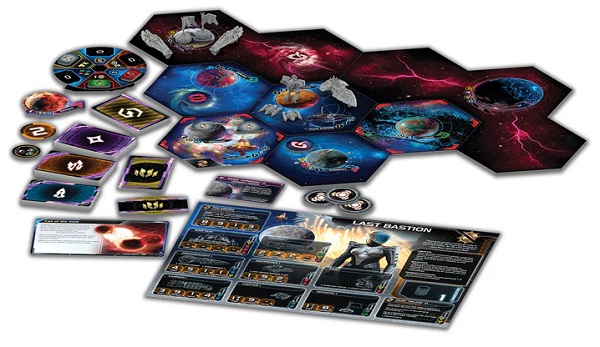
At the opposite extreme sits Twilight’s Fall, a sweeping alternate mode that effectively transforms the expansion into its own standalone experience. With customizable factions, genomes, paradigms, draft-based upgrades, and a wildly asymmetric ruleset, it offers a sandbox for groups that treat Twilight Imperium as a long-term hobby. It is unquestionably demanding – both in learning complexity and table space – yet its design discipline is hard to ignore. For groups willing to invest, it becomes one of the most inventive variants the series has produced.
All this ambition does come with trade-offs. Thunder’s Edge adds more rules overhead to a game already stretching the upper limits of what many groups can realistically table, and the full modular setup can significantly lengthen playtime. Price is another possible friction point, particularly given the large component count but slightly thinner cardboard and cards compared to those in the base game. Some modules, such as certain Events or the Fracture in low-player-count games, can also feel more situational than essential.
Yet taken as a whole, Thunder’s Edge strengthens Twilight Imperium in ways that feel intentional and thoughtful. It modernizes faction balance, experiments with early-game incentives, and gives experienced players more to discover without undermining the core identity of the refresh edition. It is not designed for beginners and is not required for every playgroup, but for those who see TI4 as a long-term mainstay rather than an occasional game night event, this expansion represents a fresh horizon of strategic possibility.
 Press Play Media
One thought on “Twilight Imperium – Thunder’s Edge review”