
As the year winds toward its close, this week’s slate of new releases showcases how varied today’s gaming landscape has become, with family-friendly exploration, competitive shooters, and bite-sized mixed reality puzzling each carving out space in the spotlight. Bee Simulator: The Hive brings a gentle ecological adventure to PS5 with expanded systems aimed at younger audiences and casual players, while Battlefield 6’s Season 1 injects fresh urgency into its tactical firefights on PC through new modes and revised battlegrounds. Meanwhile, Pipe Dream Co. re-emerges on Quest with a mixed reality overhaul that blends classic puzzle DNA with modern hand-tracking interaction.
Bee Simulator: The Hive review (PS5)
Bee Simulator: The Hive on PS5 lands somewhere between endearing novelty and earnest simulation. Stepping into the diminutive legs of a honeybee aiming to safeguard your colony and gather pollen across a semi-open world inspired by Central Park offers a curious blend of whimsy and gentle exploration. The overarching narrative is innocuous and simple, its environmental stakes modest, yet it provides a functional thread to guide you from flower to hive and back again, underscoring themes of teamwork and ecological care without ever becoming overwrought. For players seeking a narrative with emotional depth or dramatic tension, its warm tone may come across as straightforward and occasionally predictable, but its heart is undeniably in the right place.
Gameplay in The Hive edition mixes familiar loops and fresh additions in an agreeable, if sometimes thin, package. Core mechanics – pollinating flowers, navigating jet streams, and returning to the hive – remain satisfying in their simplicity, and the introduction of hive-building and resource management adds a more purposeful endgame once the story concludes. Mini-games and quick-time combat against wasps and other insects inject variety, though these sequences can feel rudimentary and repetitive, lacking the mechanical weight that more seasoned players might crave. Controls on PS5 generally feel responsive and fluid when flying, but fiendishly finicky when pressed into tighter challenges like races or precision tasks, occasionally undermining momentum.

Visually, Bee Simulator’s aesthetic leans into bright, colourful environments that are engaging for a broad audience. The world’s palette and stylised characters – humans, animals, and insects alike – evoke a family-friendly mood, though textures and animations sometimes fall short of generating a truly immersive ecosystem, leaving some areas feeling static or simplistic. That said, the soundtrack by Mikołaj Stroiński complements the overall vibe with calming, atmospheric tracks that elevate exploration and soften moments of repetition. Voice performances, while occasionally endearingly quirky, can drift toward exaggerated delivery, reinforcing the game’s aim toward younger or casual audiences rather than hardcore simulation fans.
In its totality, Bee Simulator: The Hive on PS5 is a heartfelt love letter to the humble honeybee that balances charm with approachable mechanics. It does not revolutionize the simulator genre, and returning players may feel the new content doesn’t drastically overhaul the experience, but its hive expansion gives thoughtful progression and a reason to linger longer in its buzzing world. For families, younger players, or anyone seeking a relaxed and quirky exploration game with educational undertones, it stands as an inviting title, even if more seasoned players might find its simplicity and repetition limit long-term engagement.
Battlefield 6’s Season 1 is underway
Battlefield 6’s Season 1: California Resistance update arrives at a point when the base game has already established itself as a technically solid – if occasionally uneven – AAA shooter on PC. The foundation that Battlefield Studios built for the PC version still impresses under the hood: stable performance even at high settings, detailed environments, and satisfying spatial audio that brings firefights to life. What was once a fairly muted palette across the launch maps now gains new character in Eastwood’s sunny Southern California neighborhood, though the broad strokes of color and lighting still lean toward the series’ signature toned-down realism rather than flamboyant spectacle. Audio cues feel similarly robust in the new content – explosions and weapons retain their satisfying punch – though the idyllic backdrop juxtaposed with war-torn villas can sometimes feel visually discordant.
Mechanically, Battlefield 6’s core systems haven’t been reinvented by California Resistance, but they gain new depth where it counts. Sabotage – the fresh limited-time mode – harnesses the game’s existing pace while demanding sharper objective focus, turning frantic skirmishes into calculated demolition runs. Whereas the base multiplayer had occasional balance quirks and a grind-heavy progression, Sabotage’s rapid engagements help mitigate some pacing concerns by funneling action into tighter, more urgent loops. Eastwood and Blackwell Fields imbue these modes with varied terrain that rewards both vehicular play and infantry tactics, preserving the sandbox feel that was a relative highlight at launch.

That sandbox ethos is most evident in the expanded toolset, now pitched as a “blank canvas” for creators. It’s an ambitious move that aligns with Battlefield 6’s promise of emergent experiences, though lingering discoverability issues with the interface (still buried in menus) risk muting its impact. Yet for players willing to dive in, the enhanced customization and scripting freedom offer one of the most promising long-term hooks beyond standard PvP. The addition of rare “Battle Pickups,” new weapons like the DB-12 shotgun, and niche attachments such as the Slim Handstop further enrich loadout variety, addressing slow weapon progression.
California Resistance doesn’t transform Battlefield 6 overnight, but it addresses many of the strengths and weaknesses laid bare at launch. The update’s environments and new modes expand tactical options without undermining the core identity of all-out warfare, and on PC the experience continues to run with polish and resilience. Still, those hoping for radical innovation in narrative, UI clarity, or map design will find familiar frustrations persist alongside fresh content – a reminder that Battlefield 6 remains a strong but iterative evolution rather than a reinvention of the franchise.
Pipe Dream Co. now supports mixed reality and hand tracking
Pipe Dream Co.’s new mixed reality update reframes Field of Vision’s early Quest puzzle title for a far more contemporary audience, blending its frantic plumbing challenges with an augmented layer that brings its oddball leaks into the player’s own environment. The core premise remains intact and was inspired by classics like Pipe Mania, tasking players with creating functional pipe layouts under time pressure, but grounding these water-flow puzzles in the real world adds a more immediate sense of spatial problem solving. The result maintains the game’s lighthearted and humorous personality, especially when leaks appear in unexpected positions around your living room.
What truly differentiates this update is its implementation of hand tracking. The original controller-based setup worked well enough, but input that allows players to physically grab, rotate, and connect pipes gives the experience a tactile responsiveness that feels more in line with the game’s theme. Although this system can occasionally be imprecise when levels reach their more frantic peaks, the novelty of manipulating puzzle pieces directly helps elevate the moment-to-moment experience. The mixed reality layer also sharpens spatial readability, making each setup feel distinct, though some difficulty spikes remain and can catch players off guard as the tempo ramps up.
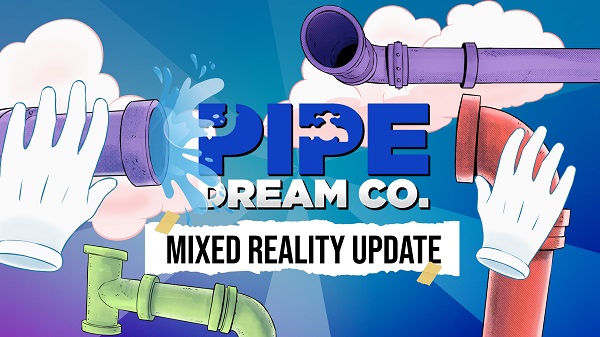
The game’s audiovisual presentation remains simple but effective, leaning into a clean, colourful style that suits quick-fire puzzle solving. Short levels encourage repeated attempts, which makes the hand-tracked interactions feel even more natural over time, reinforcing the game’s strengths as a casual pick-up-and-play experience. That said, the underlying structure still leans toward snackable sessions rather than deep engagement; this update broadens immersion but does not fundamentally expand content volume, which may leave players wishing for more levels or complexity.
Still, as a modernisation effort, this mixed reality update successfully recontextualises Pipe Dream Co. for the current Quest landscape. It heightens the immersion, streamlines interaction, and brings the puzzles into a more personal and intuitive space, even if some mechanical quirks and abrupt difficulty jumps persist. For players seeking a light, energetic puzzle game that thrives in short bursts and leverages the strengths of mixed reality, this is a welcome return to a charming concept now refreshed for 2025.
 Press Play Media