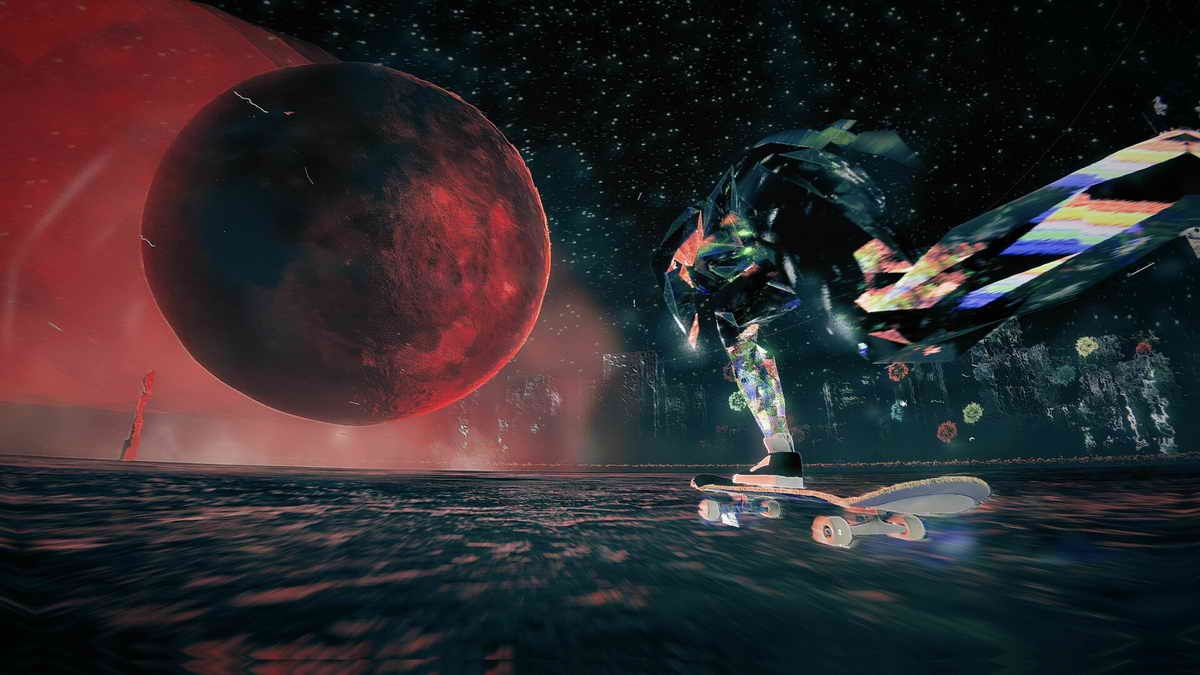
From the first seconds you spend on the fractured concrete of its surreal Underworld, Skate Story makes plain that it’s not just another skateboarding game. Sam Eng’s direction – long anticipated and finally realized in this project – marries stripped-down skating mechanics with a bizarre, symbolic narrative: you control a demon forged of glass and pain, tasked by the Devil with skating to the Moon and devouring it to win freedom. The storytelling here sidesteps conventional exposition; there are no full voice performances, no long cutscenes, just a sequence of poetic intertitles and almost absurd encounters with other damned souls – from forgetful animals to speaking statues – that overlay an already dreamlike journey. At times, this surrealism elevates the premise into something genuinely poetic, but it occasionally risks drifting into abstraction that some players may find difficult to emotionally invest in.
Mechanically, Skate Story feels like a distilled, ritualistic interpretation of skateboarding rather than a straightforward simulation or arcade spin on the sport. Controls are accessible yet demand precision: trick timing, weight shifts, and combo sequencing are central to progression. Unlike many contemporaries, the game eliminates sprawling parks and instead delivers a blend of open zones for exploration and tightly scripted segments where speed and momentum must be mastered to survive. The combo meter system rewards variety and flow, particularly during boss encounters where trick chains translate directly into damage. This fusion of skating and combat is one of the game’s most intriguing twists, giving the act of tricking both functional and aesthetic weight.

The weight and responsiveness of the board itself are strengths of the design. Landing an ollie or grind feels substantial, the physics creating a palpable sense of speed and risk – especially given the protagonist’s glass vulnerability. The fragility of your avatar turns every misstep into a visual and mechanical consequence, reinforcing the theme of pain and perseverance woven through the narrative. However, this same fragility can disrupt flow; the frequency with which you shatter and must restart segments can feel punitive to some players, and the camera angles chosen to accentuate speed sometimes make precise navigation difficult, especially in tighter courses.
One of Skate Story’s most consistent areas of high quality is its audiovisual presentation. The aesthetic is an intoxicating mix of vaporwave and gothic surrealism: shimmering reflections, postmodern environments, and a color palette that constantly blurs the line between beauty and dread. Complementing this is a hypnotic soundtrack that ranges from ethereal to pulse-driven, anchoring the sensation of motion and occasionally achieving moments that feel almost transcendental. While the PS5’s DualSense features feel underutilized in some moments, the music and visuals together cultivate an atmospheric experience that outshines what the narrative alone could convey.
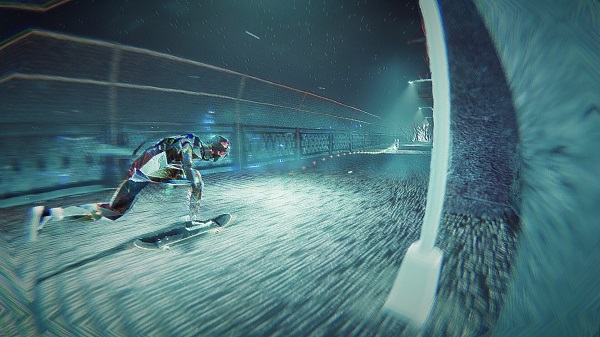
Despite these highs, the experience isn’t without its rough edges. Technical quirks – such as occasional performance hitches and minor collisions inconsistencies – crop up even on a PlayStation 5, undermining what should be an otherwise fluid ride. The lack of an in-game trick guide or quick reference for advanced moves also interrupts momentum for players still mastering the control scheme. These issues are not catastrophic, but in a game so tightly bound to its movement systems, even small disruptions can be distracting.
Overall, Skate Story is a compelling and idiosyncratic work that eschews skateboarding game orthodoxy in favor of an expressive, interpretive journey. It’s at its best when its mechanics, music, and visuals align to create brief but powerful moments of flow – moments that linger well after you’ve removed the controller. Some players will revel in the ritualistic challenge and conceptual depth that this game offers; others may find its abstraction and occasional roughness alienating. What remains undeniable is that Sam Eng’s vision here is bold and memorable, expanding what a skate game can be by treating movement itself as a form of storytelling and existential inquiry.
Score: 8.0/10
 Press Play Media