This latest VR roundup underscores just how wide the medium’s creative bandwidth has become within the confines of standalone headsets and console-tethered hardware. From the stripped-back, flow-driven aerial racing of Aerosurfer to the conversational AI experiment of Stellar Cafe, the punishing roguelite combat of Crossings, and the bite-sized chaos of PSVR2’s Chaos Method, these releases each explore a very different philosophy of what virtual reality can – and perhaps should – be. Some chase purity of mechanics, others novelty of interaction or accessibility, but all of them reflect a VR landscape that is still experimenting, iterating, and occasionally stumbling in search of its next defining shape.
Aerosurfer review (Quest)
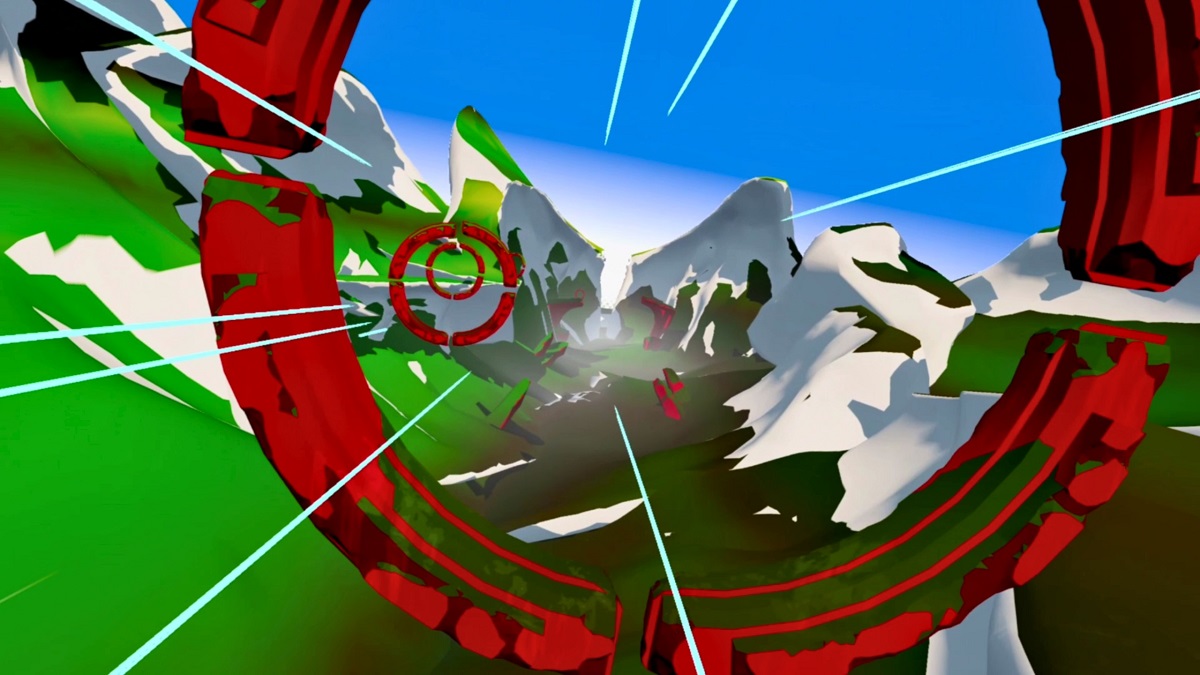
Aerosurfer trades bells and whistles for a lean, skill-centric VR experience that places you in the skies with an almost meditative emphasis on precision and flow. From the moment you grip the controllers and extend your arms like wings, the core idea is intuitive and immediate: tilt, glide, and carve your way through a series of handcrafted aerial tracks that demand finesse as much as speed. While the absence of any narrative context or thematic layering keeps the focus firmly on mechanics over storytelling, the purity of the flying challenge is undeniably engaging in short bursts, rewarding measured risk-taking and tight lines close to the terrain – evoking memories of games like Eagle Flight in the process.
The gameplay loop centers on chasing times, shaving seconds off your best runs, and contending with your own ghost on online leaderboards, which gives Aerosurfer its competitive lifeblood. Turning and descent are responsive and, for the most part, intuitive, though the physicality of the arm-based controls can feel fatiguing during longer sessions. The campaign’s 24 tracks provide variety in emphasis – from pure velocity to momentum management and obstacle threading – but their brevity and relative lack of escalating complexity can make the experience feel shallow once the basics click. Additional challenge modes unlocked post-campaign lean into gimmickry rather than deepening mastery, which can undercut long-term motivation to return beyond leaderboard vanity.
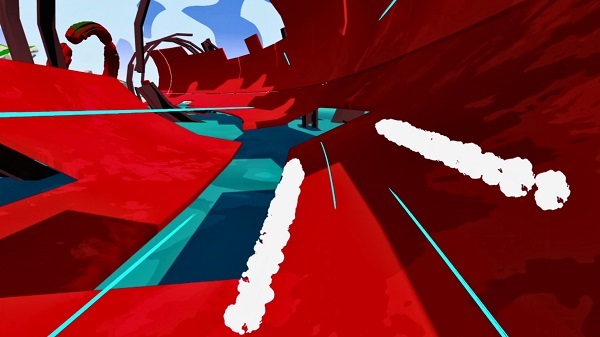
Visually, Aerosurfer adopts a streamlined aesthetic that keeps performance smooth but doesn’t do much to distinguish individual environments. Low-poly vistas and recurring motifs offer moments of scenic calm between runs, but there’s little in the way of atmospheric detail to make the world itself compelling; tracks tend to fade into one another once the novelty wears off. Accompanying audio similarly supports the action without standing out – sound cues are functional in reinforcing movement and feedback, but there’s no memorable score or dynamic sound design to elevate the mood or pace.
Ultimately, Aerosurfer excels as a focused, short-session VR title that rewards precision and persistence, yet it also illustrates the limitations of that design philosophy when pushed too far. For players curious about clean movement systems and self-competition, it delivers satisfying moments of flow and control. But the lack of narrative frame, limited visual variety, and shallow long-term progression mean it stops short of broader appeal or staying power beyond quick flights and time trials. In a VR landscape rich with varied flight experiences, Aerosurfer feels both refreshingly pure and a little sparse.
Stellar Cafe review (Quest)
Stellar Cafe arrives on Meta Quest as an ambitious experiment in interactive VR, one that feels less like a traditional game and more like a breakthrough in narrative systems. At its core is a simple, elegant premise: drop into a quirky space-faring café and just talk. There are no dialogue wheels, no menus, no button prompts – your voice is the controller, and AI-driven robots respond to what you say in real time with distinct personalities and goals. This creates an immediacy of interaction that feels fresh and alive from the first moments you sit down to chat, and when it works well, conversations flow with a natural rhythm that can genuinely delight (especially those experiencing VR for the first time). The setting – a cozy, colorful café at the edge of the galaxy – and the cast of eccentric robot characters give the experience a warm, unpredictable charm that rewards curiosity and encourages improvisation.
This voice-first design is the game’s greatest triumph and its most significant challenge. When the conversational AI delivers quick, coherent, and personality-rich replies, the illusion of talking to someone – even if they are a robot – can be magical and emotionally resonant as dialogue branches into unexpected territory. That said, these interactions are not flawless: occasional mishears, factual errors, or abrupt tone shifts can break immersion, and there are moments where the steering toward mission objectives feels more scripted than free-form. Such quirks remind you that you’re interacting with large language models in a novel context rather than fully autonomous characters with deep, handcrafted arcs.
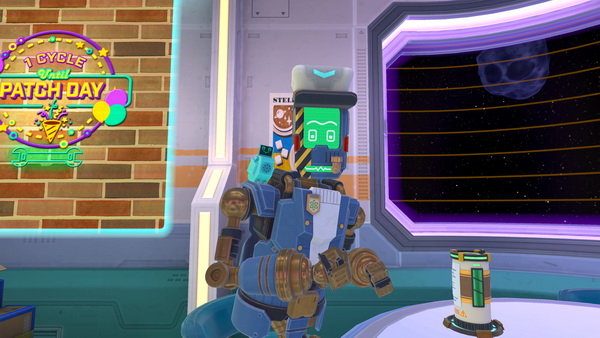
Mechanically, Stellar Cafe leans heavily on its innovative voice system, but hand tracking is an effective complement to this. Grabbing objects, gesturing, sipping drinks, or even playfully tossing items around feels intuitive and grounded thanks to reliable hand-tracking implementation. However, the gameplay loop itself is compact – once you’ve completed the main set of conversational tasks, opportunities for further engagement are limited, and there isn’t much in the way of traditional replay value. The base experience is relatively short; after the core mission resolves, the café’s novelty can fade without additional structured goals or emergent systems to sustain long-term play.
Visually and audibly, the presentation matches the game’s playful tone. The environment is inviting, colorful, and sufficiently detailed to support extended dialogue without visual fatigue, and the robots’ distinct voice personalities help sell their individuality even when the AI stumbles. Yet the reliance on procedural speech generation means voice delivery can veer between impressively natural and oddly mechanical, which sometimes undermines the emotional beats the interactions aim for. Even so, the overall audio and visual design consistently supports the experience rather than detracting from it.
Stellar Cafe feels like a promising glimpse into what conversational VR can become. It’s not a deep, sprawling adventure, but its ability to make you forget you’re playing a “game” and instead feel like you’re genuinely talking – and occasionally laughing – with virtual characters is a remarkable achievement for a first outing. For those curious about where VR and AI might intersect next, it’s a highly recommended experience worth exploring; for players seeking long, goal-driven campaigns or high replayability, its brevity and occasional AI oddities may temper enthusiasm.
Crossings review (Quest)
Crossings positions itself as a visceral, Norse-tinged roguelite where every swing, dodge, and death feels consequential in a world that seems determined to push you back into the soil. The narrative framework isn’t heavy on exposition; instead, it lets the atmospheric design and procedural realm shifts suggest a fragmented afterlife landscape you’re trying to understand and survive. While the story beats are not sprawling, the sense of purpose – to push further into hostile territory run after run – binds the experience together in a way that feels earned rather than artificial.
At the heart of Crossings is its melee combat, which frequently outpaces the sum of its parts. Weapons feel weighty and distinct, with slashes, stabs, and combos that flow from how you physically move in VR, and gesture-based spells add another layer of tactical depth when you pull them off. The blend of physical action and strategic defense gives engagements a rhythm that can feel both tense and rewarding, though balance issues – such as certain weapons trivializing encounters when mastered – temper the challenge at times. Controls generally serve the action well, though some bindings and locomotion choices can feel unintuitive until you settle into them, particularly when sprinting or managing your arsenal mid-run.
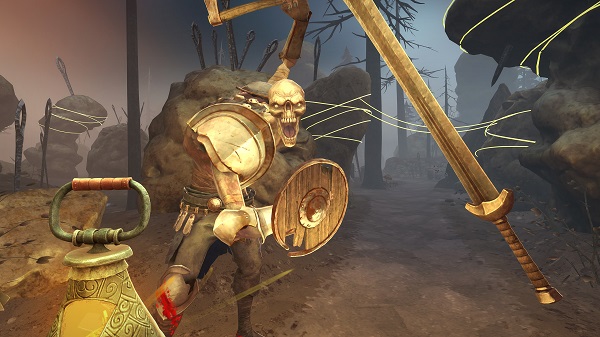
Visually and aurally, Crossings makes good use of the Quest’s capabilities. Environments carry a bleak, moody tone that reinforces the Norse afterlife theme, with lighting and sound design amplifying immersion without becoming overly dramatic. Creatures and terrain look distinct enough to read quickly in combat, and while the graphical fidelity leans toward stylized simplicity rather than photorealism, it never feels underdone for what the game is attempting.
What distinguishes Crossings on Meta Quest is how it balances progression with repetition. Each failure feels meaningful not only because you learn enemy patterns and terrain quirks, but because persistent upgrades give you incremental advantages that shape future runs. This loop keeps the experience feeling fresh despite procedural reuse, though clearer onboarding for mechanics like spellcasting and better orientation through branching paths would strengthen accessibility for new players. As a single-player build of a game with co-op on the horizon, Crossings delivers a compelling taste of what may become a deeper, more layered VR roguelite over time.
Chaos Method review (PSVR2)
Chaos Method on PSVR2 is an unabashedly simple invitation into virtual reality, built around thirteen discrete mini-games that each serve as playful, chaotic introductions to core VR control concepts. There is no overarching narrative or connective tissue holding the collection together, and that’s both its defining strength and its obvious limitation. What emerges is a title that feels less like a fully fleshed game and more like a set of experimental VR sketches – each with its own personality, but none fully developed into a deep or lasting experience.
The design philosophy here prioritizes immediacy and accessibility. Every activity, whether it’s demolishing buildings with tentacle arms or manning dual machine guns against a horde of dinosaurs, drops players directly into action with almost no explanation needed. Controls are intuitive and straightforward, making Chaos Method approachable for newcomers or younger players discovering VR for the first time. This low barrier to entry is complemented by clean, minimalistic visuals that avoid sensory overload and steady technical performance throughout its brisk sessions. The aesthetic and sound design never aspire to spectacle, but they effectively support the game’s rapid-fire rhythm.
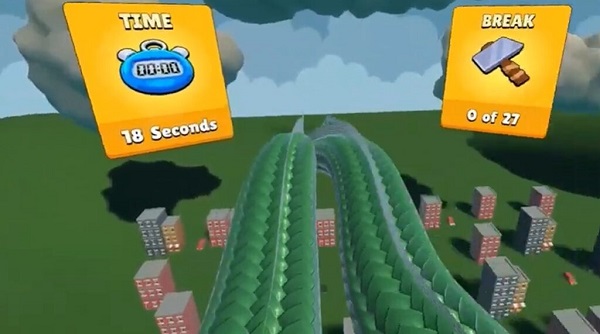
However, this sprint-like pacing also highlights the game’s core weakness: brevity. Most mini-games pass by swiftly, sometimes before a player has the chance to truly engage with or enjoy them, which leaves the overall experience feeling fleeting rather than fulfilling. For seasoned VR veterans accustomed to richer mechanics and extended play loops, there’s little here to sustain long-term interest. Replay value hinges more on personal fondness for individual mini-games or the lure of easily attainable trophies rather than any evolving challenge or progression system.
In the end, Chaos Method is a functional and fun introduction to PSVR2’s capabilities that performs exactly as its premise describes: chaotic, varied, and uncomplicated. Its strength lies in its invitation to play without pretense, making it a solid choice for newcomers or casual sessions. Yet without deeper content, complex mechanics, or incentives for replay beyond the initial novelty, it struggles to leave a memorable impression for more experienced VR players. Chaos Method does what it sets out to do – teach and entertain in short bursts – but ultimately feels like a collection of ideas yearning for fuller expression unless you’re just looking to introduce some friends to VR.
 Press Play Media