
CINESCAPE VR, which we first saw during Gamescom, positions itself as a contemplative puzzle adventure built around cinema as both setting and metaphor, unfolding across the abandoned soundstages of a long-defunct film studio. Developed and published by SUPER AC, the Meta Quest release trades spectacle for curiosity, inviting players to sift through carefully constructed spaces where illusion and reality blur together. From the outset, it frames its experience less as an escape room and more as a slow-burn exploration of authorship, legacy, and identity, with a premise that deliberately withholds clarity in favour of atmosphere.
At the centre of the experience is Cinemorphosis, a mechanic that allows objects to shift between “real” and “prop” states, altering their physical properties in the process. This idea consistently proves to be the game’s strongest asset, giving puzzles a tactile logic that feels grounded in the physicality of VR rather than abstract pattern-solving. Turning an immovable structure into something lightweight or artificial often leads to satisfying moments of spatial re-evaluation, although the system occasionally exposes its own limitations when interactions become less predictable than intended.
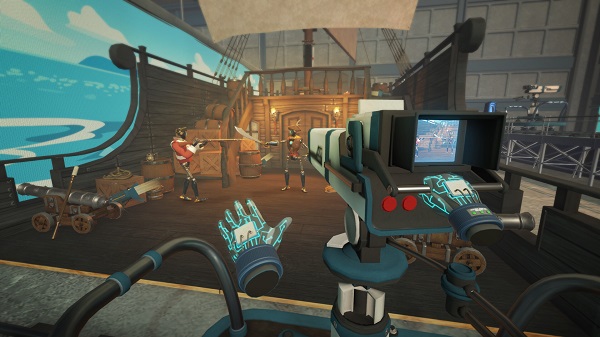
CINESCAPE VR commits fully to hand tracking, eschewing traditional controllers in favour of direct manipulation. When the tracking behaves as expected, the result is impressively immersive, allowing players to grab, rotate, and test objects with a sense of presence that aligns well with the game’s themes of authenticity and fabrication. However, this design choice is also going to be one of its most divisive elements, as inconsistent responsiveness and limited onboarding can make early interactions feel awkward rather than intuitive, particularly for players less accustomed to hand-tracked experiences.
Narratively, the game unfolds through environmental cues and the guidance of P4-TRIC, a robotic assistant whose helpful tone is undercut by an unsettling edge. His commentary adds texture to the exploration, hinting at motivations that are not entirely benign, and reinforces the uneasy feeling that the trials were designed with more personal intent than initially suggested. While some players may find the story’s slow drip-feed of information engaging, others may struggle to connect with a plot that prioritises mood over clear emotional hooks.
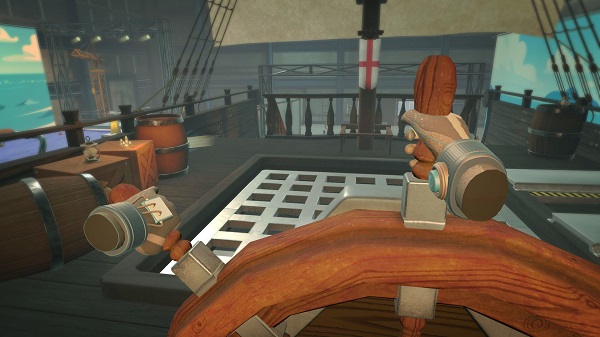
Visually, the studio environments strike a careful balance between theatrical exaggeration and decay. Each space is filled with cinematic nods that reward attentive exploration, and the contrast between polished set dressing and abandoned infrastructure supports the underlying mystery. The presentation is clean rather than flashy, and while it rarely pushes the hardware aggressively, it maintains a level of visual coherence that keeps the illusion intact even during longer puzzle sequences.
The audio design follows a similar philosophy, favouring subtlety over constant stimulation. Ambient soundscapes and restrained musical cues enhance the sense of isolation without overwhelming the player, though the limited variety can make extended sessions feel somewhat subdued. Voice work, particularly from P4-TRIC, does much of the heavy lifting, adding personality and tension even when the broader narrative momentum slows.
As a pure puzzle experience, CINESCAPE VR is unapologetically niche. Its deliberate pacing and lack of action-oriented mechanics will not appeal to those seeking constant adrenaline, but for players willing to engage on its own terms, it offers a thoughtful alternative to more kinetic VR titles. That said, uneven tutorialisation and occasional friction in its core interactions prevent the experience from fully realising the potential of its central ideas.
Ultimately, CINESCAPE VR stands as an ambitious and sometimes uneven exploration of what VR puzzle design can achieve when it leans into physicality and theme rather than spectacle. Its most inventive moments are genuinely compelling, even if they are occasionally undermined by technical rough edges and a narrative that may not resonate universally. For puzzle enthusiasts drawn to atmosphere, experimentation, and cinematic spaces, it offers something distinctive, albeit with clear caveats.
Score: 7.0/10
 Press Play Media