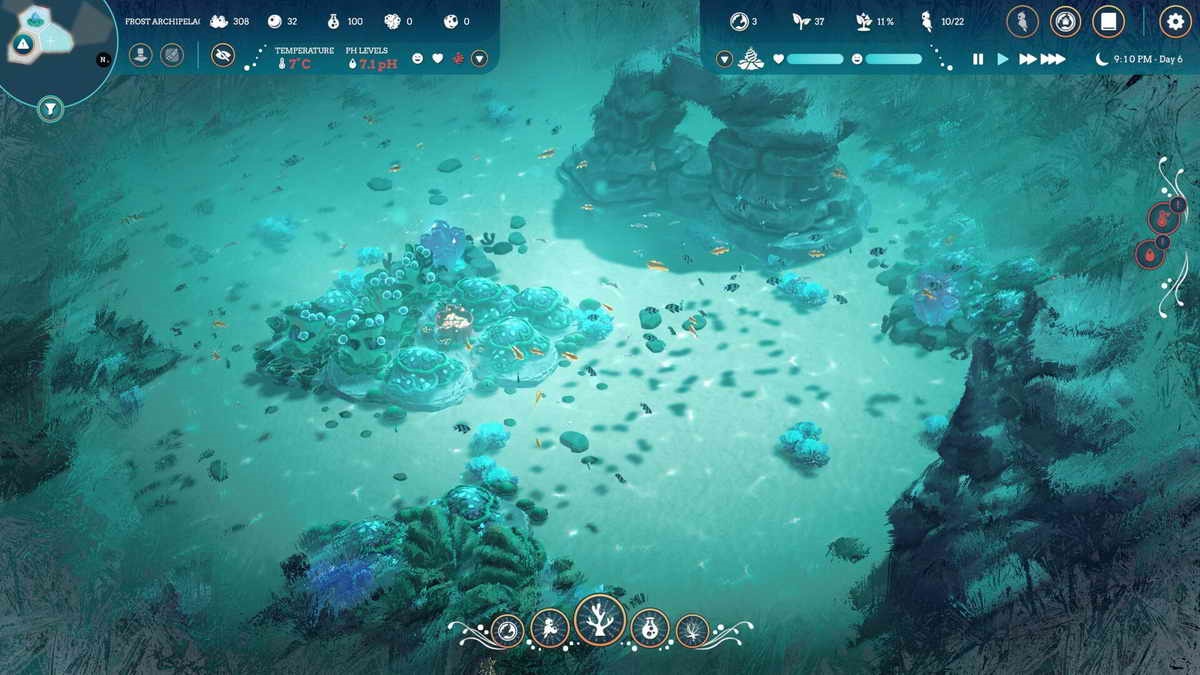
Life Below is a refreshing twist on the city‑building genre set beneath the waves: players shape thriving coral reefs, revive collapsing ecosystems, and grow a living seascape while following a heartfelt narrative by Rhianna Pratchett. In this interview, Game Director Lise Hagen Lie discusses Megapop’s design choices and the team’s approach to blending ecology, gameplay, and myth.
Life Below frames ecosystem restoration as a form of city-building, but one rooted in natural interdependence rather than human control. How did you choose which ecological principles to turn into gameplay?
At first we were a little overwhelmed with all the possibilities for the game – do we include everything from plankton to whales? What elements do we emphasise as ‘part of the reef’ or ocean inhabitants? There are many aspects of reefs we don’t include in Life Below, but we made a conscious effort to discuss different paths and layers of abstraction. We also got great help from the marine biologists who could check our assumptions, and let us know if something was completely off.
With help from them to keep the realism grounded, we looked to games in the genre for inspiration for how to translate this realism into engaging gameplay. Life Below is made to be a fun game, and real life is not necessarily that. This is why we leaned on our take on Magical Realism to bridge between reality and game. We looked at the games we love, our experience with them, and what we’d like to take inspiration from in them. In the end things started to kind of “click” together, and we believe the magic amplifies the realism in a great way.
You worked with marine biologists and incorporated authentic underwater audio, yet the game is also clearly stylised and mythic. How did you balance scientific authenticity with fantasy?
We were always very clear on that Life Below is a game made for players to have fun, not pure edutainment. So a guiding principle for us was that while the foundation was grounded in realism, magic had to come in to bridge the gap between reality and game. For instance a very clear way we have emphasised magic and fun over realism is how we handle water parameters, where the corals themselves can change the water temperature and acidity. As a counterweight to this we also hold to the principle that the game design should be based in nature’s perspective. Life evolves, changes, and lives in symbiosis with the world it’s in. The solutions to hazards, stressful water conditions and development had to come from the ecosystem you’re creating rather than humanity or an outside ‘ex machina’.
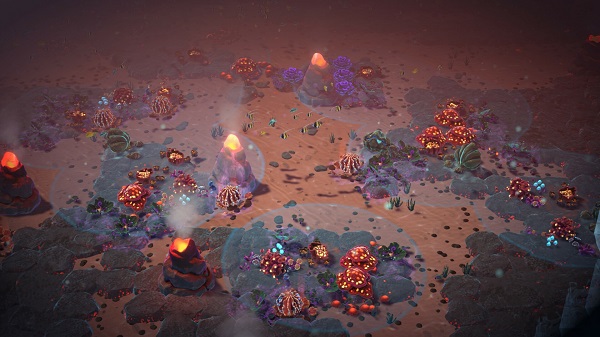
Another way we’ve prioritised fun and fantasy over realism is in the way some things look. We’ve worked to create a world full of life as you build and move forward in the game, but it’s also important that players can understand the actions they do, and the things happening in the reef. For instance in the Oil hazard the player sees an oil cloud and the corals get oiled, needing to be cleaned. In real life, oil would stay on the surface of the water.
An aspect where realism took precedence over fantasy is in our Wildlife Visitor system, where you can call on certain visitors to your reef, who will stay for a while but then leave. These could be for instance dolphins. It would not make sense for big nomadic species like them to stay in one spot like the other wildlife, although it would be cool for them to hang out and live in your reef.
Was encouraging patience and stewardship a deliberate design goal? How did it affect pacing?
I think a lot came naturally from the theme and context of the game, and that reefs inherently are beautiful places! Stewardship was definitely something we were conscious of from the beginning. We wanted to see if we could ‘flip’ the traditional take in city builders where it’s all about human survival, which meant games like Terra Nil were big inspirations.
How did you design wildlife to be both functional and authentic?
We tried to make sure our wildlife has personality through animations, mechanics and interaction with the player. As a player you can watch them swim around, read about the real species in the collection book, and solve their wishes through quests. Some more advanced wildlife directly impacts your reef through gameplay, like seahorses help you move resources where they are needed. On top of that we wanted to make sure it was important for players to have a diverse reef with many different species, which is why we have the biodiversity resource. You can gain biodiversity by getting more wildlife to your reef, but you gain more of
that resource by getting new species. The resource is spent on new structures, solutions to hazards, and unlocking new areas. If your wildlife for any reason chooses to leave or at worst die, you can get into biodiversity debt which would stress your reef. This way we show them that every species is an important part of the reef.
How did you portray environmental threats without being preachy?
We made the choice very early that there would be no humans in the game, and this was one of the big reasons for that. We wanted to show how these hazards could be felt by nature from nature’s perspective. They would not know what an oil spill is, or what garbage is made of, or how invasive species arrive in new areas, but it does feel the effect of that. Our goal in this aspect is to show consequence, so that people might get interested and hopefully care about the why. This way we avoid pointing fingers but encourage curiosity and engagement.
When did the narrative come into the project, and how did it shape the mechanics?
We had a vision for the game to be narrative very early in development, and some things have not been changed since the very beginning until now. One of the first concepts we made for Life Below was of Thalassa. As luck would have it, one of our team members had previously worked with Rhianna Pratchett, and when we asked if she was interested in working with us on Life Below we realised she is also a diver and has a lot of interest in the ocean. In fact, when we showed her the first version of our announcement trailer she pointed out we’d mistakenly included a freshwater fish in it! Immediately she found a great path for the characters we’d defined, and made impactful suggestions like the addition of Pontus, our guiding character. This process happened a while before alpha completion, so it was an important part for us to define our progression.
What do you hope players take away after playing?
First of all, I, of course, hope they have a fun and engaging experience. Then, I hope players feel a connection to the reefs they might not have had before, the ocean is huge! But we know relatively little about it. I hope that spending some time in this wonderful world makes people feel like the bar for understanding and exploration is lowered.
 Press Play Media