As publishers continue to breathe new life into smaller titles and overlooked gems through fresh ports, this latest wave of releases highlights just how varied that second chance can be. From bite-sized retro-inspired platforming collections finding a home on Switch, to culturally rooted horror making its console debut on PS5, and cozy, physics-driven creativity stepping into virtual reality on PSVR2, each of these games brings something distinct to new audiences. Some benefit greatly from their transition, while others reveal the growing pains that can come with new hardware and control schemes, but together they paint a compelling picture of how ports can both preserve experiences and reshape them.
Toree’s 3D Platformer Collection review (Switch)
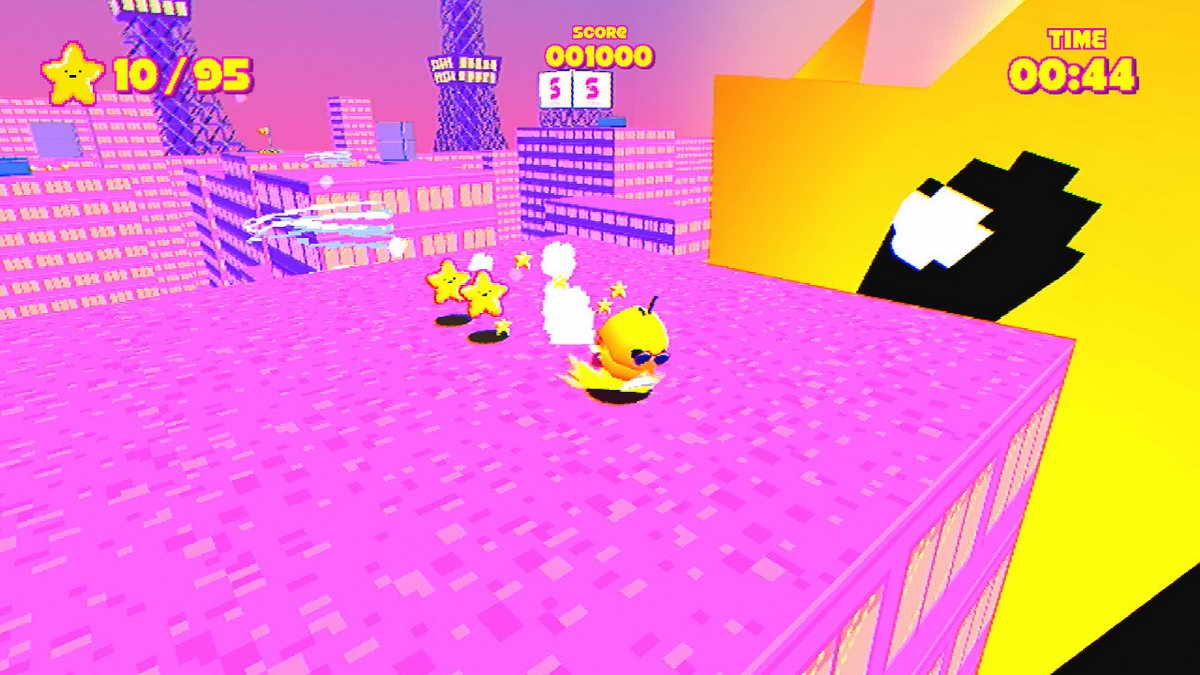
At face value, Toree’s 3D Platformer Collection is a nostalgic love letter to late-90s 3D platformers, steeped in low-poly charm and playful ambition. You’re essentially getting four distinct experiences packaged together, ranging from tight, speed-focused runs to loose, exploratory collectathons that wear their influences on their sleeves. While the narrative is almost nonexistent – the games lean into premise over plot – this suits the throwback ethos the collection wears proudly.
The Toree games themselves are arguably the high point of the set. They deliver swift, uncomplicated platforming where momentum and timing matter, and there’s a satisfying rhythm to sprinting through their colourful courses and chasing time attack ranks that extend replay value without overstaying their welcome. Controls are generally responsive, and the simplicity of movement works in its favor, though quirks such as camera rigidity and minor UI oddities occasionally interrupt flow. The time attack additions across all titles are a smart, lightweight way to add structure to games that otherwise wrap up quickly.
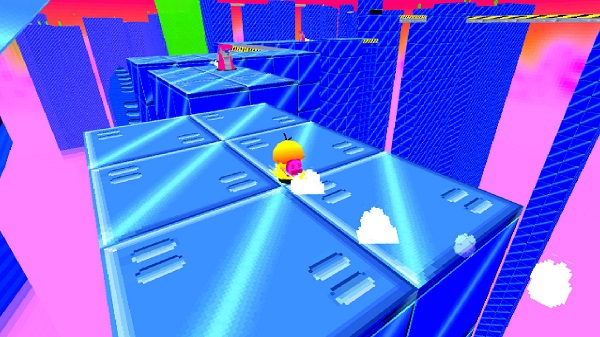
Contrast comes in the form of Macbat 64 and Regina & Mac, which diverge from the straight dash-and-jump formula. Macbat 64 captures that pocket-sized collectathon feel with approachable objectives and charming character work, offering small but engaging worlds where collectibles and light puzzles give you something slightly deeper to chew on. On the flip side, Regina & Mac is the most ambitious of the quartet – sprawling, open, and clearly inspired by classics – but its execution feels rough around the edges. Simplistic visuals and unclear interactions occasionally turn precision platforming into frustration, and camera and control issues here feel more pronounced.
Visually and sonically, the collection leans into its retro roots with enthusiasm. The blocky, colourful aesthetics and upbeat music largely evoke a deliberate throwback, though there are moments where the primitive graphics compound clarity problems in platforming segments. Some segments beg for clearer design cues and polish, but there’s a consistent personality across all four games that makes them more than just nostalgic pastiches. For players with a soft spot for classic 3D platforming – especially on the go – this collection delivers bursts of joy, even if not every element lands perfectly.
Overall: Toree’s 3D Platformer Collection isn’t a flawless anthology, but its varied experiences and earnest design make it a worthwhile pick for fans of old-school platformers on the Switch. With highlights like the Toree games and Macbat 64 balanced against the rougher edges of Regina & Mac, it’s a scrapbook of ideas that at its best reminds you why this genre captured imaginations in the first place.
Apartment No 129 review (PS5)
Apartment No 129 arrives on PS5 with an intriguing cultural premise: a horror tale steeped in Turkish urban legend and real-world folklore that immediately sets it apart from its peers. The narrative, built around a modern content creator driven into an abandoned building to untangle the mystery of two girls’ deaths in 2009, carries a slow-burn tension that occasionally pays dividends. The setting – a labyrinth of dim hallways and claustrophobic rooms – feels genuinely oppressive, and the scattered notes and documents through the environment give a sense of place and backstory that pushes you forward, if you’re willing to engage with it. However, the storytelling is uneven; the live-action sequences stitched into the game come off as awkward and underwritten, and some of the purportedly “real facts” feel more like marketing than substance, which blunts the emotional punch the developers clearly aimed for.
Mechanically, Apartment No 129 feels like a game with good ideas that aren’t fully realized. At its core it’s classic first-person exploration – reading notes, solving simple puzzles, and occasionally fending off hostile entities – but the execution rarely feels satisfying. Controls on PS5 are clumsy by default, with overly sensitive camera settings and unintuitive button mapping that force you into menus before you can settle into the experience. Combat, while present, is infrequent and lacks feedback; weapons feel weightless and encounters often devolve into frustration rather than fear. These issues are compounded by odd design choices, like inconsistent resource usage and cumbersome puzzle interactions, all of which dilute immersion.
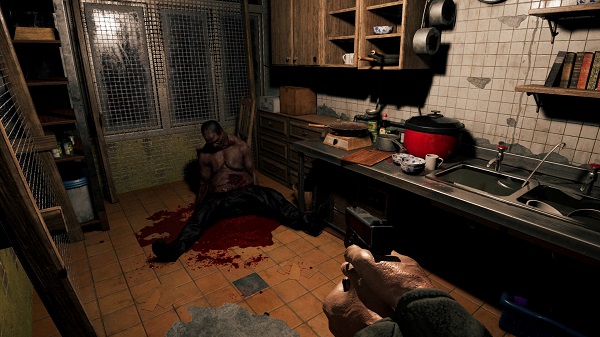
Visually and sonically, the game does a competent job of setting an eerie mood. The environments are appropriately grim and the lighting – especially when your only source is a narrow torch beam – amplifies the unease. Sound design also leans into silence and ambient dread, using quiet moments punctuated by sudden, unsettling noises to build tension. That said, frequent load screens and occasional missing animations or effect inconsistencies pull you out of the atmosphere at times, and the repetition in set dressing makes the apartments themselves feel too homogeneous over the course of a playthrough.
Ultimately, Apartment No 129 is a horror experience with distinct personality and cultural flavor but also clear rough edges. Its strengths lie in its setting, narrative ambition, and a creeping sense of dread that can genuinely get under your skin if you’re patient and willing to look past technical and design flaws. However, awkward controls, uninspired combat, and a narrative that sometimes substitutes exposition for engagement hold it back from being more than a niche curiosity. For players who value atmospheric storytelling and thematic novelty over polished mechanics, there’s something here worth exploring; for others, the experience may be too frustrating to recommend unreservedly.
Umami Grove review (PSVR2)
Umami Grove on PSVR2 feels like a cozy experiment in playful VR design – a curious blend of physics-driven cooking, exploration, and light problem-solving that leans into tactile engagement as its core appeal. From the moment you spawn into its vibrant, seasonal world, the game invites you to use your hands rather than menus: apples hang from branches that must be reached, ingredients hide under foliage, and every object feels like it’s meant to be picked up, tossed, or manipulated in some way. That open-ended physicality is delightful when it works, giving you a genuine sense of presence and agency, but the same physics systems that make sticking a knife into a mushroom satisfying also introduce moments of unpredictability where simple tasks feel fiddly or frustrating.
The narrative thread in Umami Grove doesn’t aim for epic storytelling, and that’s part of its charm. The cast of oddball NPCs you meet across the map provide goals and quirky interactions, and your pursuit of the titular golden acorns gives structure to the otherwise relaxed pace. There’s no pressure to race through objectives; instead, you’re encouraged to explore at your own pace, whether that means helping creatures back to bed, completing side challenges, or simply wandering to see what lies beyond the next turn. That laissez-faire design may not satisfy players seeking tight, directed progression, but it suits the game’s cozy ethos and often results in unexpectedly funny or joyful moments born from your own experimentation.
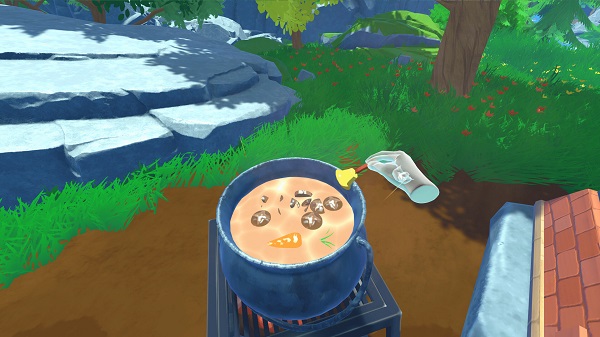
On PSVR2 specifically, Umami Grove’s aesthetic and sensory presentation are a mixed bag. The color palette pops in many areas and the world feels warm and inviting, aided by a pleasant soundtrack and charming character designs that help sell the game’s whimsical tone. However, the port’s technical side doesn’t always match the visual ambition: distant aliasing and the occasional drop below the target frame rate can surface in busier scenes, and some textures read flatter than expected given the headset’s capabilities. These issues don’t break the experience, but they do temper some of the immersion that the concept otherwise promises.
Gameplay around cooking and traversal remains the real heart of the experience. Physically gathering ingredients and preparing meals – whether chopping, boiling, or frying – is satisfying in its tactile simplicity, and the controls are intuitive enough that even VR newcomers should get comfortable quickly. Climbing feels weighty and responsive when it matters, and the little mini-games tucked into the world, from drumming to snowboarding, keep things varied in the mid-game. Yet because so much hinges on physics, there are times when the interactions verge on awkward – a spatula that doesn’t quite catch that onion, or a pan that slips at the wrong moment – and these brief hitches underscore how central solid implementation is to this kind of title.
In the end, Umami Grove on PSVR2 is a relaxed, charming VR experience that won’t win over everyone but rewards players who value atmosphere and creative play over tight mechanical loops. Its blend of cooking, exploration, and playful chaos rarely coalesces into something truly groundbreaking, but the whimsical world, hands-on interactions, and forgiving pace make it an enjoyable way to spend a few hours in VR – especially if you’re after something on the cozy side rather than the competitive or intense.
 Press Play Media