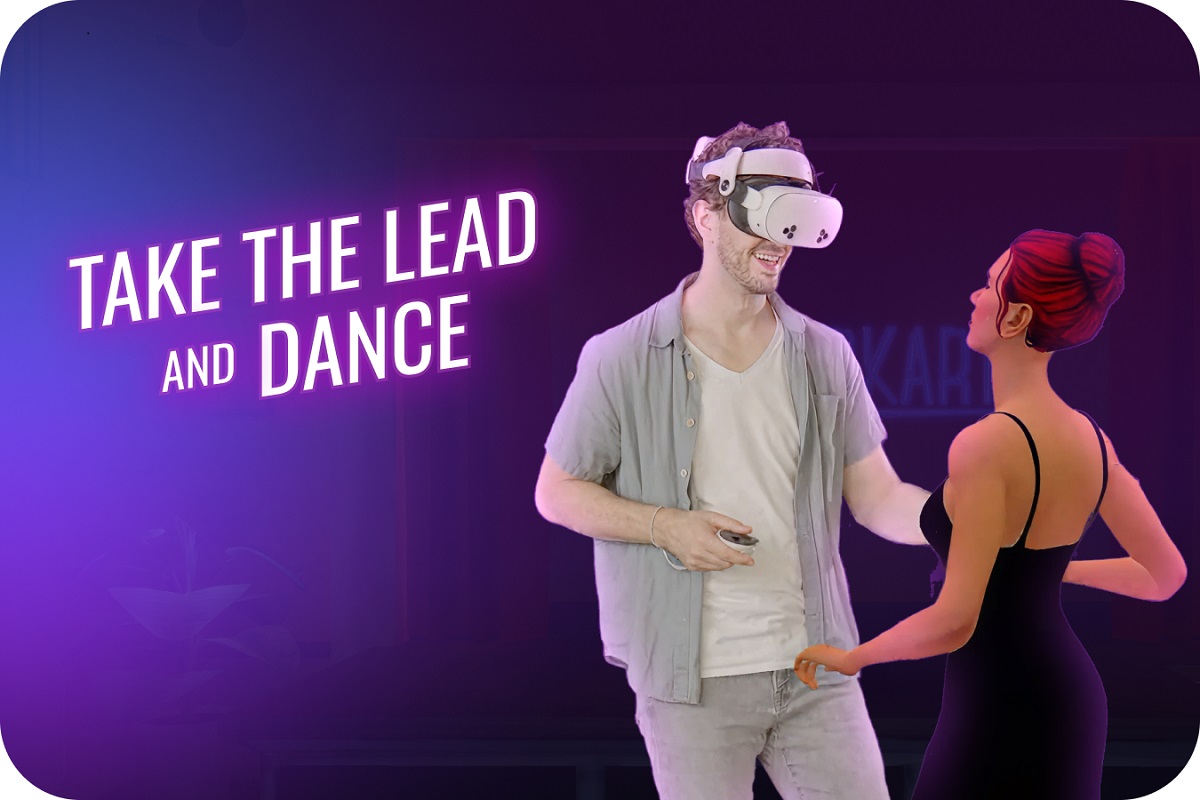
Patrick Ascolese, founder of Seattle‑based Dark Arts Software, turned a wedding‑floor epiphany and years of award‑winning game and XR experience into Trip the Light, a Meta Quest Early Access VR partner‑dance game that teaches salsa, swing, and tango through guided lessons and a patient, AI‑driven virtual partner (Vironica) modeled on a real collaborator; designed for accessibility on consumer Quest hardware without foot trackers, the title uses synthesized chest‑direction tracking, mixed‑reality passthrough, and community‑led development via Kickstarter and Early Access so players can both learn to dance and help shape the game – now, here’s our conversation with Ascolese.
What was the original spark for Trip The Light and how did that idea evolve into a partner‑dance VR experience?
My wife and I learned swing, salsa, and tango together. A little over three years ago, at a wedding, we took the floor together and had a blast. The joy of moving with confidence and grace across a dance floor, arm in arm with a skilled partner, carried us through the night. I had the thought, “This should be a game!” (A natural conclusion for someone who has worked for years in award-winning game design, and XR software and hardware). The core vision of what would become Trip the Light arose quickly from that single thought.
Why did you choose Early Access on Meta Quest and what is the feedback you’re hoping early players will give you?
The development of Trip the Light has always been collaborative. After the spark of an idea struck me, I did more than seek out developers and designers; I joined up with professional dancers and choreographers, musicians, and many more. My team and I see early access as a way to continue the strategy that has served the game so well. We see it as a chance to widen the circle and bring in more voices, more feedback, and more perspectives to this critical new phase of the game’s development.
When we say, “people make games,” and “come dance with us,” we mean those sentiments with all our hearts. Our early access players are more than customers; they are partners.

How closely do the in‑game steps and partner mechanics map to real partner‑dance technique, and can players reasonably transfer those skills to a real dance floor?
This game’s development has been driven by dancers and musicians from the beginning. There is no adaptation without some transformation. Virtual Reality will always be, well, virtual. However, music transcends mediums, and rhythm is rhythm whether you move to it at the club or in your living room. Trip the Light alone won’t give you the full dance education you might get from a flesh-and-blood, professional dance instructor or group class, but it will get you moving and help you find the beat and gain a footing in dance (pun intended). It will show you the same steps and movements an instructor would show you; in some cases, the instruction is aided by the immersive magic that only VR and AR offer. The game’s lessons are as close as the medium allows, and can give any beginner the start they need to take those intimidating first steps onto the dance floor in order to develop their technique, style, skills, and confidence.
For complete novices who find dancing intimidating, what specific design choices did you make to reduce anxiety and encourage steady progress?
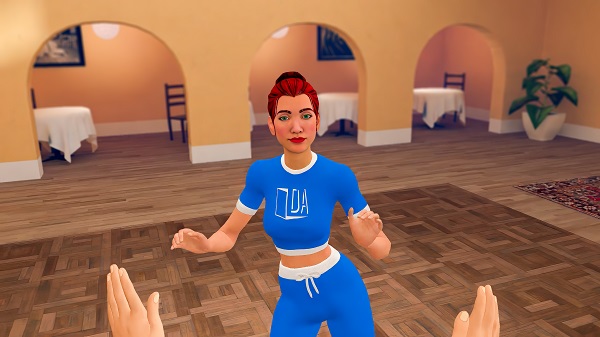
We think one of the key charms of Trip the Light comes from the game’s virtual partners. Vironica, the lady you see on all of our cover art, is not just some NPC. She’s modeled on V, a real person, and one of the earliest supporters and collaborators in the game’s development. Vironica does more than simply look like her. Vironica’s movements and bearing, and the nuances of her personality, all draw from the real woman because we want a new player to feel like there is someone there with them as they take those first unsteady steps – someone compassionate, knowledgeable, and non-judgmental. Partner dance is inherently physical and, for lack of a better term, intimate. We’ve heard over and over that anxiety about dancing hand in hand and face to face with someone is a common reason for people not to take the first step. Like anything, it takes experience to overcome a fear. We’ve worked hard to design and simulate a realistic partner experience so people can become comfortable with the physical closeness of partner dancing before experiencing it with a real person. XR is the only technology capable of simulating this faithfully.
Trip the Light strikes a careful balance. We want new players to, as the old cliché goes, “dance like no one is watching,” but we want them to do so while also feeling like they are not alone. If the smiles we always see on the faces of our first-time players are any indication, we think we strike the right balance.
What technical challenges did you face tracking footwork and partner positioning on Quest hardware, and how did you solve them?
Contrary to many people’s intuition, it turns out you do not need to track the player’s footwork to provide a compelling and realistic simulation. This is fortunate for us as foot tracking is not readily available on modern headsets. Sure, we could ask people to strap trackers or controllers to their feet, but we want the game to be accessible and affordable on popular consumer hardware.
The Quest and other modern headsets are very accurate with respect to spatial positioning, and we strive to clearly teach players the proper footwork so that they learn the steps correctly. Just like in real dance, proper footwork really matters as a person progresses and learns to string together more complex moves and routines; not taking the time to learn will just lead to things being clumsy and forced. Proper footwork is essential if their goal is to move to a real dance floor; otherwise, they will end up stepping on their partner’s feet and tripping over their own.
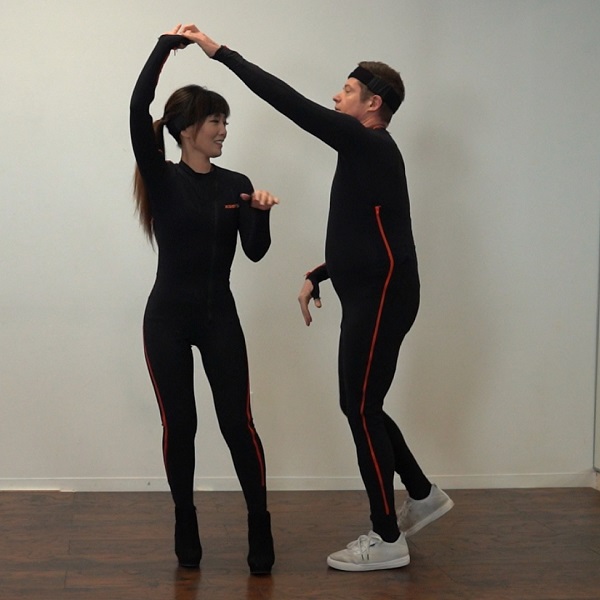
Partner positioning is quite a challenge. One thing the headsets do not offer is the facing direction of the player’s chest, which, depending on the current hold, is quite important in determining where the partner should be standing and facing with respect to the player. We did a lot of work and experimentation to synthesize reliable “tracking” for the chest location of the player, and we developed some cool techniques to test the reliability of our chest direction against real-world players.
In short, we found the best approach was to presume that the player was doing the dance moves correctly (or at least trying to). By limiting the partner’s behaviors to ‘real’ dance moves and not solving the general problem of two people physically interacting, we are able to make the dance simulation look and feel really good.
How do you balance accessibility and depth so experienced dancers can express nuance while the game’s systems remain fair and fun?
Trip the Light offers several modes from our “101” learning mode through the energetic Rhythm Challenge. The newest of the new dancer, any novice or wallflower, can start with our learning mode and see the most basic steps demonstrated and take their time picking them up.
However, the best answer to your question comes in the form of our Partner Dance mode.
When the time comes to step onto the dance floor for real, you don’t get any glowing footprints on the ground; all you get is the music, the floor, and your partner…so that is what we provide, well, that and a bit more. Once the player has taken their lessons and learned the basics, we encourage them to step into Partner Dance. In this mode, they get the music, they get the floor, and they get a partner who is patient, responsive, encouraging, and knowledgeable, who helps them learn and practice and be creative. Everything in that mode, from the partner to the lighting, to some really sparkly particle effects, all work together to encourage progress and reward successes even in the most open-ended, creative environment. In Partner Dance, the player gets to choose their own level of difficulty, and the game supports them along the way.
During Early Access, how will you prioritize new dance styles, music, and social features, and what can players expect next?
We have big plans, and even this early in the process, we feel we have demonstrated that we have the chops to make them happen. In a very short period, we have already improved the user interface, and added new songs and features. We did this while squashing bugs and polishing existing features. More importantly, we have listened. We listen to player feedback, and we have already started to integrate player comments and reviews into our strategies, increasing the priority of some already planned features and laying the groundwork to integrate new ones based on the desires of our earliest adopters.
Short answer as to what players can expect next: all of the above. There will be new dances, new songs, and new layers to the existing modes and features. There may even be things we have not yet thought up as the game grows, but we will do it all while being responsive and accountable to our Kickstarter backers and our early access players.
Trip the Light is just starting to take shape. We can hear the music, and we are moving along with the beat. We have our plans and our roadmaps and our hopes and our ambitions, but this dance is just beginning.
 Press Play Media