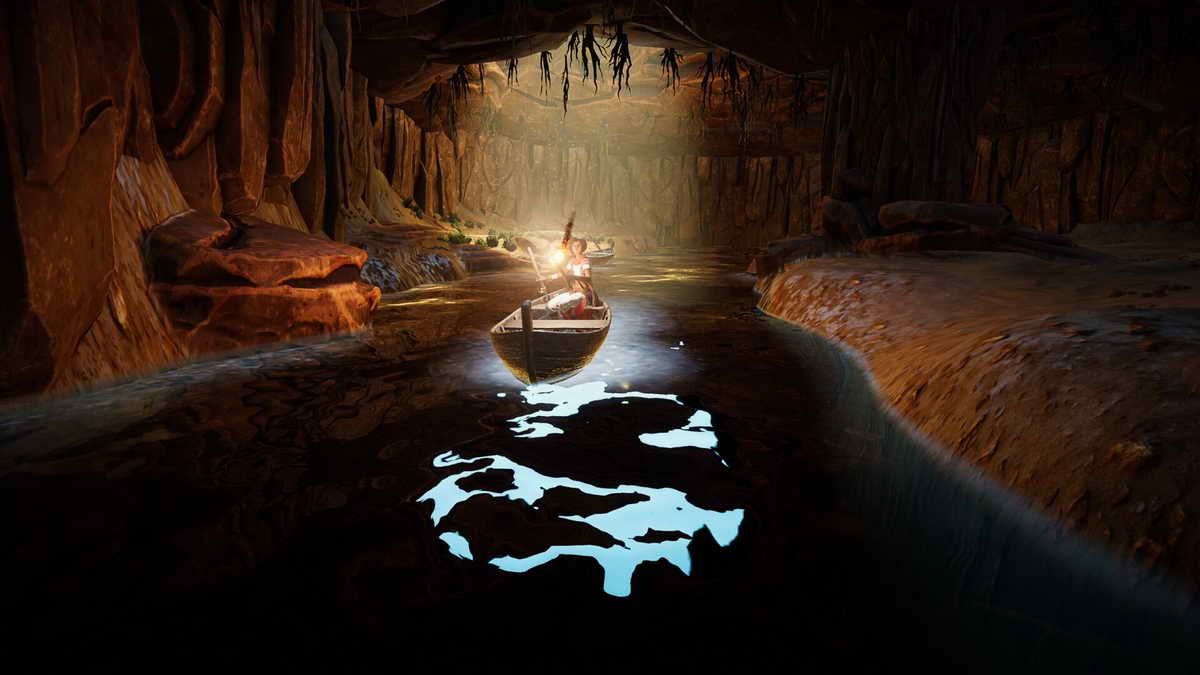
Blowfish Studios and developer Drakkar Dev deliver an unusual blend of fantasy and science fiction with Mirage 7, a third-person adventure built around mythic storytelling and puzzle-driven exploration. Set in a harsh desert world inspired by Middle Eastern folklore, the game follows Nadira and her loyal pet lizard Jiji as they search for a legendary oasis where the Lost Princess Taishma might grant Nadira’s impossible wish: bringing her sister back to life. The narrative opens with a mysterious sci-fi prologue involving a crashed reconnaissance drone and a hidden military installation, hinting at a deeper connection between the technological and mythical strands that shape the story.
That duality gives Mirage 7 a distinctive premise, though the game’s storytelling doesn’t always capitalize on its intriguing setup. Nadira herself is an appealing protagonist whose determination carries the adventure forward, and the desert setting evokes a sense of lonely pilgrimage across a mythic landscape. Yet the plot rarely delivers major surprises, functioning more as a framework for the journey rather than a narrative full of twists. Collectible lore entries and environmental storytelling add texture to the world, but the central story beats tend to be predictable, which can make the adventure feel more like a sequence of tasks than a gripping saga.
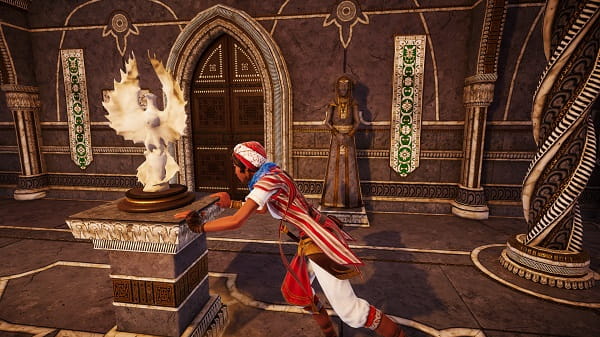
Gameplay leans heavily toward exploration and environmental puzzles rather than combat, and this is where Mirage 7 generally finds its rhythm. As Nadira travels through dunes, ruins, and temples, players gather items to craft simple tools and solve environmental challenges. Jiji plays an important supporting role here, squeezing through narrow spaces and using special vision abilities that highlight interactive objects and hidden symbols used in puzzle solving. This mechanic encourages careful observation and makes exploration more engaging, especially in the game’s larger puzzle areas where multiple mechanics come together.
Puzzle design ranges from straightforward environmental interactions to more elaborate temple sequences, some of which require locating specific items or deciphering visual clues scattered across the environment. At its best, this structure creates satisfying moments of discovery, particularly when puzzles interlock across larger areas. However, the game occasionally stretches these ideas too thin, introducing fetch-style objectives or scavenger hunts that slow the pacing and feel like busiwork. The solutions can also feel a little opaque at times, forcing players to experiment with trial and error rather than clear logic.
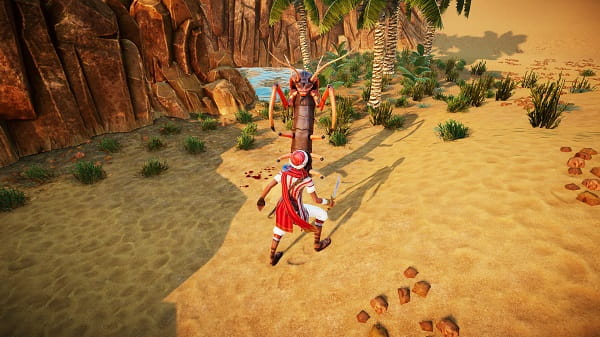
Combat, by contrast, is clearly the weaker side of the experience. Nadira can fight enemies with a dagger or a sling, but encounters often feel stiff and repetitive. Enemy behavior is simple, typically revolving around waiting for an opening to strike and then retreating to avoid damage. Camera behavior and lock-on targeting can also make fights feel awkward, especially when facing multiple enemies at once. While ranged attacks with the sling offer some relief, the overall system lacks the responsiveness and variety seen in modern action adventures.
Visually, Mirage 7 adopts a stylized presentation that emphasizes atmosphere over technical spectacle. The desert landscapes and temple interiors convey a strong sense of place, and the art direction captures the mysticism of its Arabian Nights-inspired setting. Audio design supports that mood as well, with ambient music and environmental sounds helping to sell the sense of isolation across the desert. Still, the game occasionally feels dated in its presentation, with stiff animations and fairly simple environmental detail reinforcing the sense that this is a modestly scaled production.
Despite its rough edges, Mirage 7 manages to carve out a niche for itself as a puzzle-focused adventure with an unusual thematic blend. Players looking for fast-paced action may find its combat underwhelming, but those willing to embrace its slower, exploration-driven structure will find a thoughtful if somewhat uneven journey. Drakkar Dev’s game ultimately succeeds more through its atmosphere and puzzle design than its mechanics, offering a distinctive desert tale that feels a little old-fashioned but still worth experiencing for fans of narrative-leaning adventure games.
Score: 7.0/10
 Press Play Media