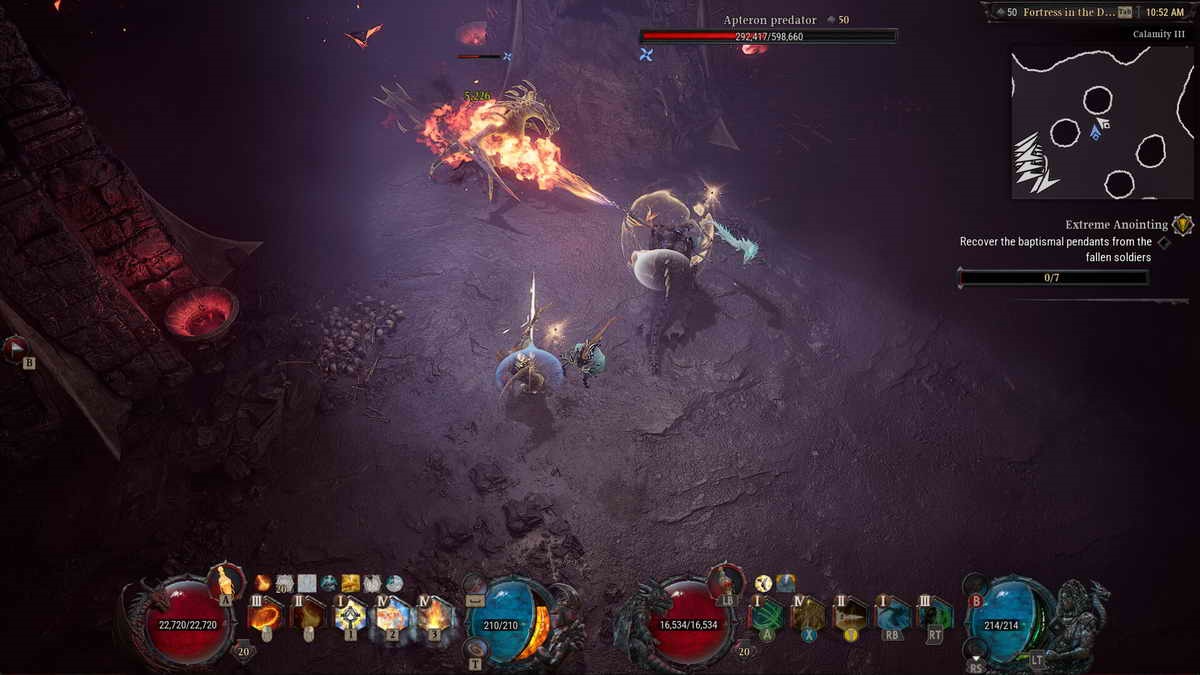
Dragonkin: The Banished sees developer Eko Software return to the isometric action RPG genre after previous outings like Warhammer: Chaosbane, this time crafting an original fantasy setting where dragon blood has corrupted the land and monstrous creatures threaten what remains of humanity. As one of a small group of powerful hunters, your task is to push back against this spreading corruption and eventually take down the Dragon Lords responsible. The setup is familiar territory for the fantasy genre, but the game tries to add a bit more flavor through its council of leaders and political tensions within humanity’s last stronghold. Unfortunately, while the surrounding worldbuilding occasionally hints at something more substantial, the player character remains largely silent and detached from these developments, making it difficult to feel truly invested and immersed in the story unfolding around you.
Once combat begins, Dragonkin settles into a gameplay loop that will be instantly recognizable to anyone who has spent time with games like Diablo or Path of Exile. You carve your way through groups of enemies, juggle cooldown-based abilities, dodge large attacks and chase ever-better loot to refine your build. It’s a structure that works well enough here, and the steady stream of upgrades provides that familiar “one more run/objective” temptation that action RPG fans know all too well. At the same time, the combat often lacks the punch and responsiveness that defines the genre’s heavy hitters. Attacks connect and enemies fall, but the moment-to-moment fighting can feel slightly weightless, as though the action never quite reaches the satisfying intensity it’s aiming for.
Where Dragonkin does attempt to distinguish itself is in its character progression systems. The centerpiece here is the Ancestral Grid, a modular skill system that allows players to slot abilities and modifiers together in a puzzle-like layout to enhance their effectiveness. In theory this opens the door to a wide range of builds, especially when combined with the game’s Wyrmling companions that add elemental effects and additional bonuses to combat. The system has clear potential and can be fun to experiment with, but the available fragments and combinations initially feel limited, making the process of creating truly distinctive builds less exciting than expected during the early stages of the game.
The structure surrounding these mechanics also tries to add a layer of progression beyond the battlefield. Between missions, players return to Montescail, the last bastion of humanity and a hub city that evolves over time as new facilities and residents arrive. It’s a neat idea that reinforces the sense that the player’s actions are helping rebuild a shattered world. In practice, however, the city can feel larger than necessary, with certain areas offering little meaningful interaction beyond basic services. The result is a hub that looks impressive but sometimes feels more like a place you fast-travel through rather than truly inhabit.
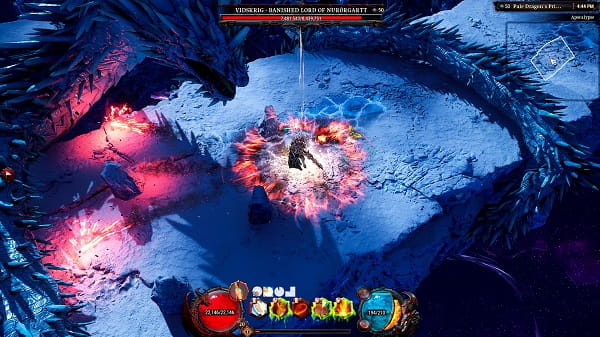
Visually, Dragonkin: The Banished delivers a solid if unspectacular presentation. The environments vary from jungles and frozen landscapes to ruined settlements, helping to break up the monotony often associated with dungeon-crawling ARPGs. Enemy designs and spell effects are serviceable, though they rarely leave a lasting impression, and the overall presentation doesn’t quite match the visual polish of the genre’s biggest productions. The audio follows a similar pattern: functional and occasionally atmospheric, but prone to repetition during extended combat sessions.
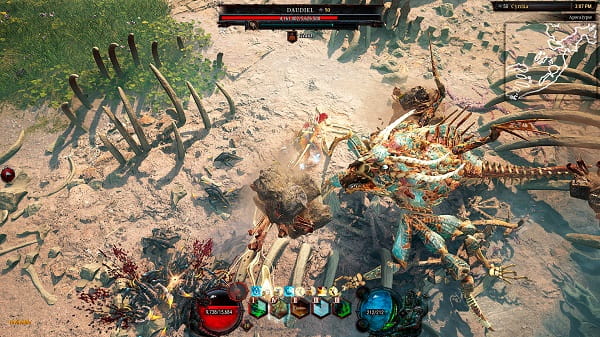
Controls on the PlayStation 5 generally translate the PC-style action RPG formula well to a controller, with abilities mapped comfortably across the face buttons and triggers. Movement and skill usage feel intuitive after a short adjustment period, although some players may still sense that same lack of tactile impact during combat that affects the gameplay more broadly. Difficulty balancing can also be inconsistent, with certain encounters feeling almost trivial before suddenly spiking into chaotic situations where enemy numbers overwhelm the player.
Taken as a whole, Dragonkin: The Banished lands somewhere between a promising new IP and a reminder of just how competitive the action RPG genre has become. Its modular progression systems and companion mechanics give it a few interesting ideas to play with, and the core loop of hunting monsters and refining builds remains entertaining in bursts. At the same time, uneven combat feedback, pacing issues and a narrative that struggles to make the player feel involved keep it from fully realizing its potential. For fans of the genre looking for another world to explore, Dragonkin offers enough to justify a visit – but it may not dethrone the established giants anytime soon.
Score: 7.1/10
 Press Play Media