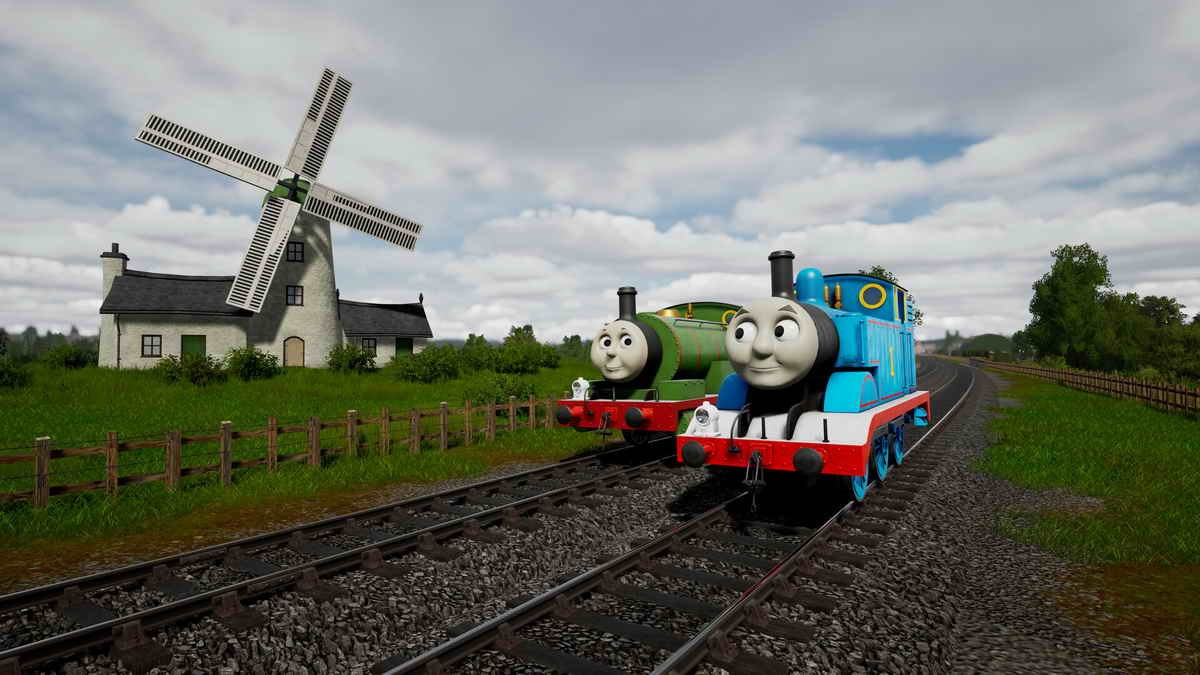
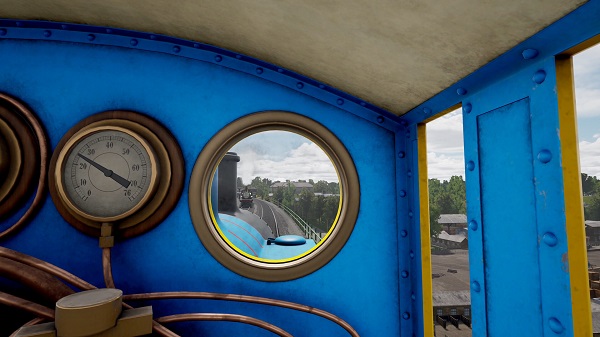
Thomas & Friends: Wonders of Sodor arrives as a collaboration between a beloved children’s franchise and simulation specialist Dovetail Games, leveraging technology typically reserved for more serious rail experiences to recreate the Island of Sodor in interactive form. Built on the foundation of Train Sim World, the game attempts to balance authenticity with accessibility, framing its experience through a first-person perspective that places players directly in the cab of its iconic engines. The result is a title that clearly prioritizes nostalgia and approachability, though it occasionally struggles to reconcile its simulation roots with its younger target audience.
The game’s narrative framework is structured around a collection of short, self-contained stories inspired by both classic Railway Series tales and newly written scenarios. These vignettes are presented with full narration, lending them a storybook quality that aligns well with the franchise’s heritage. While this approach successfully captures the tone and charm of Thomas & Friends, the storytelling itself remains fairly lightweight, often serving more as a contextual wrapper for gameplay than a compelling narrative driver. For younger players or longtime fans, the familiarity is likely to resonate, but those seeking deeper engagement may find the episodic structure somewhat limited.
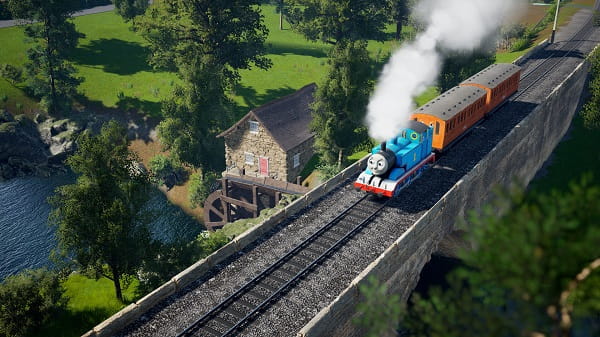
Gameplay is split across several modes, including story missions, a timetable system, mini-games, and a free roam option, all of which aim to provide variety within the relatively simple core mechanics. Driving trains is intentionally streamlined, with forgiving controls and minimal complexity, making it easy for newcomers to grasp. However, this accessibility comes at the cost of depth, as interactions rarely evolve beyond basic speed management and stopping at designated points. The inclusion of tasks like shunting challenges and collectible hunting adds some diversity, but these elements can feel repetitive over time, especially for older players accustomed to Dovetail’s more demanding simulation systems.
The control scheme reflects this design philosophy, offering a responsive and straightforward interface that prioritizes ease of use over realism. While this ensures that younger audiences can engage without frustration, it also reinforces the sense that the underlying Train Sim World framework has been significantly pared back. Moments that could have benefited from more interactive systems – such as managing complex rail operations – are simplified to the point where they lose much of their potential appeal for sim enthusiasts. Still, for its intended audience, this approach keeps the experience approachable and largely frustration-free.
Visually, Wonders of Sodor is one of the game’s strongest aspects, with a detailed and vibrant recreation of the island that captures its iconic locations with impressive fidelity. Landmarks like Tidmouth Sheds and Knapford Station are brought to life with a level of care that reflects Dovetail’s simulation pedigree, even if the overall presentation leans toward a softer, more stylized and colorful aesthetic. There are occasional technical limitations, such as stiffness in animations or a lack of environmental dynamism, but the world itself remains inviting and instantly recognizable.
Audio design further reinforces this sense of authenticity, with familiar character voices and narration playing a central role in delivering the experience. The inclusion of a well-known narrator (Mark Moraghan) helps ground the game in its television roots, while ambient railway sounds and engine effects add a layer of immersion. That said, the repetition of voice lines and limited variety in sound design can become noticeable during longer play sessions, slightly diminishing the overall impact.
Pacing is ultimately where the game’s design shows its most significant limitations. The short, segmented nature of its stories and the simplicity of its mechanics make it well-suited for brief sessions, but less effective as a sustained experience. Free roam offers some creative freedom, yet lacks the systemic depth needed to maintain long-term sandbox-like engagement. This positions Wonders of Sodor as a title best enjoyed in small bursts, particularly by its younger audience or those primarily interested in revisiting the world rather than mastering its systems – or, ideally, by a family playing together.
In the end, Thomas & Friends: Wonders of Sodor succeeds in delivering a faithful and visually appealing adaptation of its source material, anchored by accessible gameplay and a strong sense of nostalgia. However, its simplified mechanics and limited depth mean that it struggles to maintain engagement beyond its core demographic. For children and dedicated fans, it offers a charming and approachable gateway into interactive rail experiences, but for others, being a standalone release, it may feel like a missed opportunity to more fully leverage the simulation framework it is built upon.
Score: 7.5/10
 Press Play Media