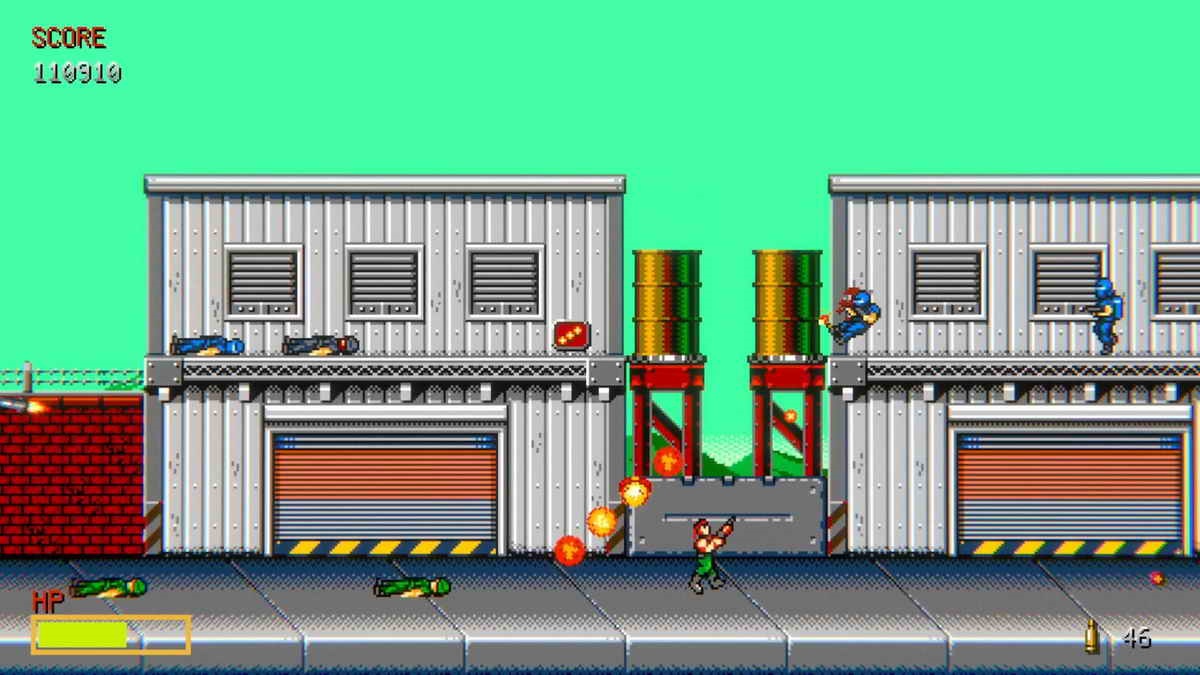
Machine Gun Fury arrives on PlayStation 5 as a deliberate throwback to the era when arcade cabinets thrived on immediacy, spectacle, and punishing difficulty curves. Developed by Reset Games and published by ESDigital Games, it positions itself squarely within the lineage of classic run-and-gun shooters, evoking titles that prioritized reflexes over nuance. Its premise is intentionally barebones, following a trio of heavily armed soldiers as they confront a cartoonishly oppressive threat across a series of global hotspots. While the narrative framing is little more than connective tissue, it aligns with the game’s broader philosophy: strip away modern conventions and deliver pure, uninterrupted action. That simplicity works in its favor thematically, though it also leaves the experience feeling somewhat devoid of personality beyond its nostalgic surface.
Gameplay forms the core of Machine Gun Fury’s appeal, and at a glance it captures the chaos and immediacy of its inspirations. Across eight stages, players alternate between top-down shooting, side-scrolling segments, and vehicle-based sequences, creating a sense of variety that keeps the pacing from stagnating. The top-down sections in particular stand out as the strongest component, successfully channeling the frantic energy of arcade classics with dense enemy waves and destructible environments that reward aggressive play. Weapon pickups and limited ammunition introduce a light layer of resource management, encouraging more deliberate shooting than the genre traditionally demands. However, this variety is a double-edged sword, as not all gameplay styles are equally refined, and transitions between them can feel uneven.
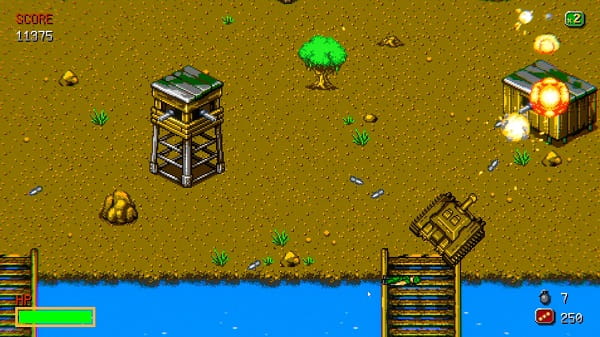
The most persistent issue lies in the game’s control scheme, which struggles to support the speed and complexity of the action. Unlike games that allow for independent aiming, Machine Gun Fury restricts shooting direction to the character’s facing, creating friction in situations where enemies approach from multiple angles. This limitation becomes particularly problematic during more chaotic encounters, where precision and responsiveness are critical. The absence of dual-stick aiming further compounds the issue, making movement and targeting feel unnecessarily rigid. While the controls are simple and easy to grasp on a basic level, they lack the flexibility needed to sustain the game’s more demanding scenarios, leading to frustration that feels rooted in design rather than player error.
Level design follows a similarly uneven trajectory. Shorter stages benefit from the game’s fast pace, delivering quick bursts of action that align well with its arcade sensibilities. Longer stages, however, expose structural shortcomings, particularly the lack of checkpoints. Being forced to restart extended sections after a late-stage failure undermines the sense of momentum and can quickly turn challenge into repetition. Side-scrolling levels are another weak point, as their platforming elements feel underdeveloped and poorly adapted to the control scheme, resulting in awkward jumps and avoidable deaths. In contrast, the vehicle segments provide a refreshing shift in tempo, even if they lack the depth needed to stand alongside the stronger top-down encounters.
Visually, Machine Gun Fury embraces its retro identity with 8-bit-inspired pixel art enhanced by modern effects. Explosions, screen shake, and layered backgrounds add a sense of scale and impact that elevates the presentation beyond a straightforward homage. The result is a game that looks convincingly old-school while still benefiting from contemporary polish. That said, visual clarity can occasionally suffer during more chaotic firefights, where the abundance of effects and enemies makes it harder to track incoming threats. The overall aesthetic succeeds in capturing the spirit of the era it draws from, even if it doesn’t consistently translate into readability during intense moments.
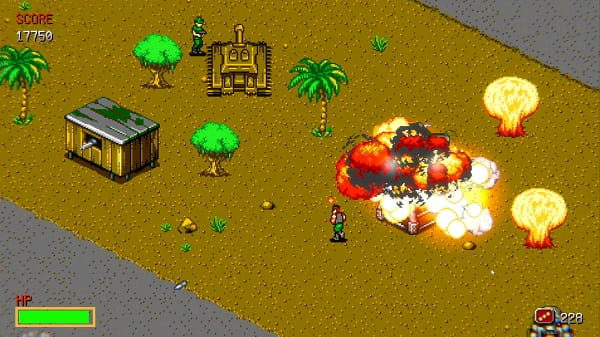
Audio design complements the visuals with a soundtrack that leans heavily into retro influences, delivering energetic, chiptune-style tracks that reinforce the arcade atmosphere. The music does a solid job of maintaining momentum, particularly during extended combat sequences, while sound effects emphasize the constant barrage of gunfire and explosions. There’s a satisfying punch to the audio feedback, though it occasionally borders on overwhelming, especially when layered with the game’s already chaotic visual presentation. Still, as part of the overall sensory package, it contributes meaningfully to the game’s nostalgic appeal.
Ultimately, Machine Gun Fury is a game defined by its ambition to revive a classic formula and the friction that arises from its execution. It succeeds in capturing the look, feel, and relentless pacing of old-school run-and-gun shooters, particularly in its strongest top-down segments. However, inconsistent design decisions – most notably in its control limitations, uneven level quality, and unforgiving structure – prevent it from fully realizing that vision. Its short length and limited replay incentives further complicate its value proposition, even at a budget price point. For players with a deep affection for retro arcade experiences, there’s a measure of enjoyment to be found here, but it remains a flawed homage rather than a definitive modern revival of the genre.
Score: 6.5/10
 Press Play Media