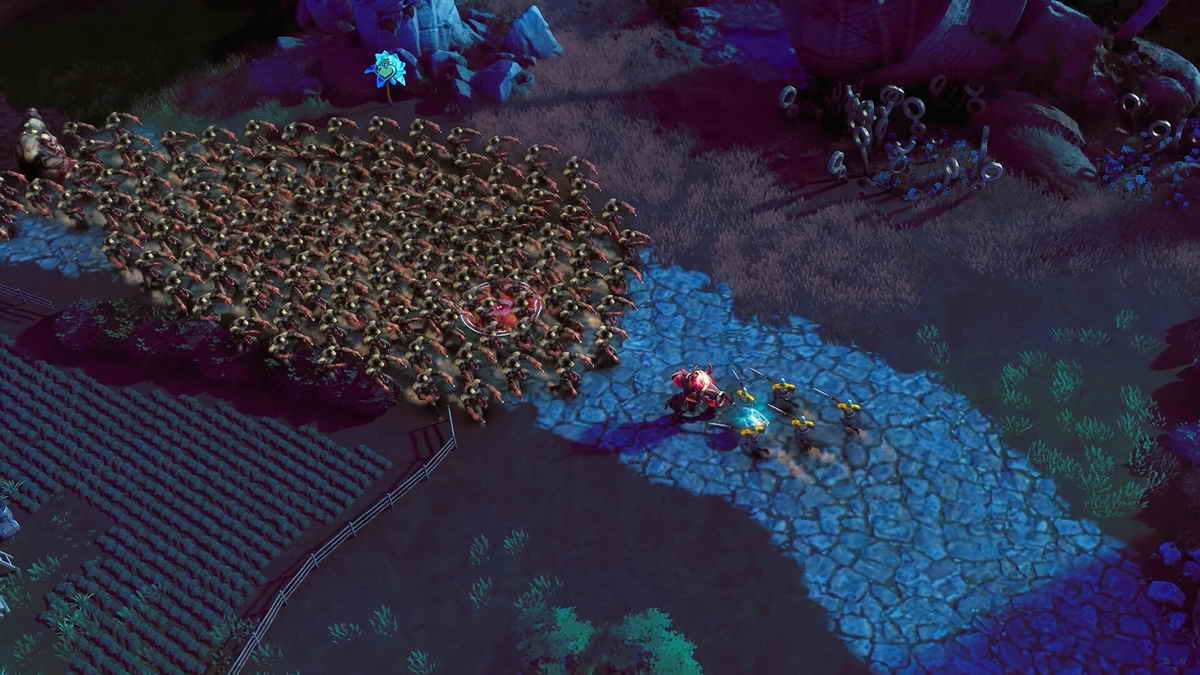
When we first saw EverSiege: Untold Ages during its earlier preview phase, it already hinted at an ambitious blend of genres, combining real-time strategy, roguelite progression, and hands-on hero control. Now, in its full PC release from Tindalos Interactive and Dear Villagers, that hybrid design has taken shape into something that feels both familiar and refreshingly experimental. The core premise revolves around defending and rebuilding Bastion while pushing back against relentless enemy forces, but the real hook lies in how it transforms defense into an aggressive, evolving campaign where each run reshapes both the battlefield and the player’s approach.
At its foundation, EverSiege is a game about pressure and decision-making. Each run places players in a procedurally generated map where daytime preparation gives way to increasingly punishing nighttime assaults. Resource gathering, base construction, and exploration all compete for attention, forcing constant prioritization. Gold income, troop deployment, and defensive structures like towers and gates all intertwine with hero progression, creating a layered gameplay loop that rewards efficiency and foresight. That loop proves compelling, especially as players begin to understand how early economic decisions ripple into late-game survivability.
What elevates the experience is its “hero-driven” approach. Instead of acting purely as an overseer, players directly control a wargear – a customizable hero defined by weapon choice and elemental essence. This combination system offers significant build diversity, with dozens of spell evolutions and synergies that can dramatically alter playstyles. Whether focusing on ranged damage scaling, area-of-effect crowd control, or survivability through resurrection mechanics, the game encourages experimentation. Over time, meta progression systems unlock new upgrades and enhancements, making each subsequent run feel like part of a broader arc rather than an isolated attempt.
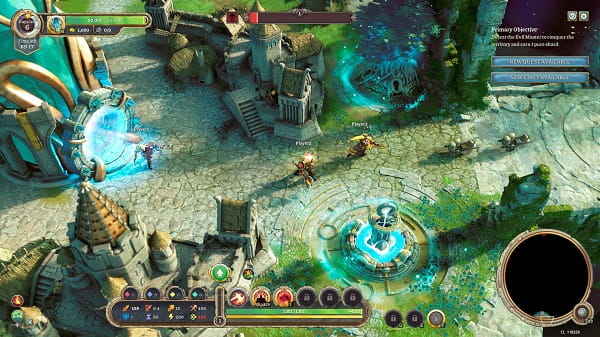
However, that same depth can also become a point of friction. The game’s difficulty curve is steep at first, with enemy waves escalating rapidly if early optimization falters. Managing health as a resource, maintaining defensive layers, and juggling multiple objectives simultaneously can feel overwhelming, particularly for newcomers. Combat itself, while responsive in principle, occasionally suffers from unclear enemy telegraphing and moments where positioning feels less precise than it should, which can lead to frustrating losses that feel only partially within the player’s control.
Structurally, the blend of RTS, roguelite, and action elements is one of EverSiege’s biggest strengths. It draws inspiration from classic custom map design philosophies while layering in modern progression systems and procedural variability. Each run introduces new map layouts, objectives, and enemy configurations, ensuring that repetition rarely feels stale. There’s a tangible sense of growth not just in stats, but in player knowledge – understanding optimal build paths, timing, and map routing becomes just as important as raw upgrades.
That said, technical and systemic shortcomings hold the experience back from fully realizing its potential. Small bugs and interface limitations surface, alongside issues with targeting clarity and control flexibility. More notably, multiplayer integration feels underdeveloped, with progression systems that fail to properly support cooperative play. This significantly undermines what could have been a major pillar of the game, especially given how well its mechanics lend themselves to coordinated strategies.
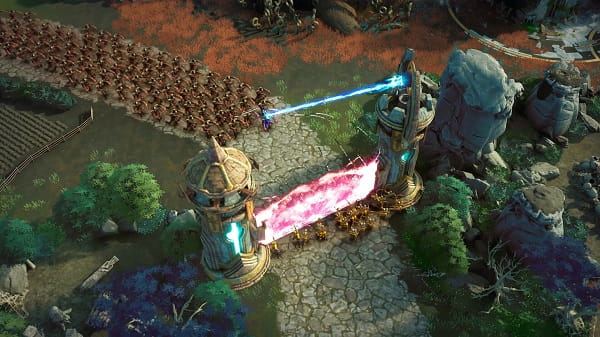
Visually, EverSiege opts for a functional rather than flashy presentation. The art direction is clear and readable, which is essential in a game where situational awareness is critical, but it rarely impresses on a technical level. Effects and animations communicate gameplay information effectively, though they can become visually noisy during larger encounters. The audio design follows a similar pattern – serviceable and supportive, but not particularly memorable, with its main role being to reinforce the escalating tension of incoming waves.
In the end, EverSiege: Untold Ages succeeds most where it matters: its core gameplay loop is engaging, strategic, and highly replayable. It builds on the promise we saw in our earlier preview by delivering a dense and rewarding systems-driven experience, even if it arrives with notable rough edges. For solo players willing to invest time into mastering its mechanics, there’s a lot to appreciate here. Those looking for a polished cooperative experience, however, may want to wait and see how post-launch support addresses its current shortcomings.
Score: 7.4/10
 Press Play Media