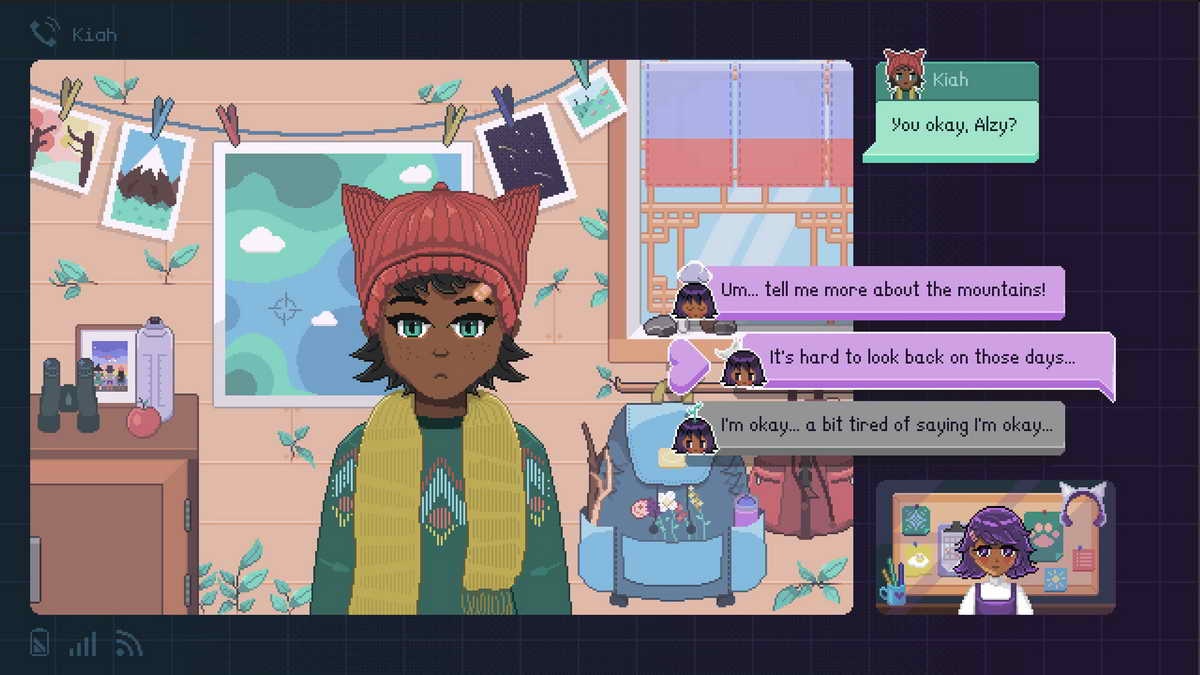
Fishbowl, developed by imissmyfriends.studio and published by Wholesome Games, positions itself as an introspective slice-of-life narrative that leans heavily into themes of grief, early adulthood, and emotional isolation. Set over the course of a month, the game follows Alo as she adjusts to a new job and a new city while processing the recent loss of her grandmother. It’s a premise that immediately distinguishes itself through its grounded, personal stakes, though its deliberate pacing and subdued storytelling won’t resonate equally with every player. The game’s strength lies in its authenticity, but that same restraint can occasionally make its narrative feel uneventful or overly drawn out.
The storytelling unfolds through a mix of daily routines, conversations, and memory fragments, with Alo’s interactions forming the emotional backbone of the experience. Dialogue exchanges – whether with coworkers, friends, or family – feel naturalistic and often understated, capturing the awkward rhythms of real-life communication. However, this grounded approach can sometimes come at the expense of narrative momentum, as the game rarely builds toward dramatic peaks. Instead, it opts for a quiet, reflective tone that emphasizes gradual emotional shifts over overt plot developments. For some, this will result in a deeply relatable journey; for others, it risks feeling meandering.
Gameplay in Fishbowl is intentionally low-intensity, centering around everyday tasks such as working from home, organizing belongings, and engaging in conversations. The most mechanically involved aspect comes through Alo’s job as a video editor, represented via a matching-style minigame that adds a layer of interactivity to an otherwise narrative-driven experience. While this mechanic provides a welcome break from the slower pacing, it doesn’t evolve significantly over time, which can lead to repetition. Still, the simplicity of the gameplay aligns with the game’s broader design philosophy, reinforcing its focus on mood and character rather than challenge.
Controls on PlayStation 5 are straightforward and largely unobtrusive, supporting the game’s relaxed structure. Navigation through Alo’s apartment and interface-driven interactions feel intuitive, though the limited range of actions can make the experience feel somewhat static over longer sessions. The game rarely demands precision or quick reflexes, which suits its contemplative tone, but it also means that player agency is somewhat restricted. Choices do influence the narrative direction, yet their impact often feels subtle rather than transformative, reinforcing the idea of shaping a life through small, cumulative decisions rather than major turning points.
Visually, Fishbowl adopts a soft, cozy aesthetic that complements its themes. The art direction leans into warm color palettes and intimate interior spaces, effectively conveying the sense of isolation within Alo’s apartment while still maintaining a comforting atmosphere. Character expressions and environmental details help communicate emotional nuance, though the limited variety in locations can occasionally make the visual experience feel confined. This is thematically appropriate, but it does contribute to a sense of repetition over time.
The audio design plays a crucial role in reinforcing the game’s emotional tone. A gentle, ambient soundtrack underscores the quieter moments, while subtle sound effects bring Alo’s daily routines to life. Voice acting is used sparingly, allowing text-based dialogue to carry much of the narrative weight, which works well for immersion but may not fully satisfy players who prefer more dynamic presentation. The overall soundscape succeeds in creating a reflective mood, though it rarely shifts in intensity, mirroring the game’s consistently subdued pacing.
Ultimately, Fishbowl is a deeply personal and introspective experience that prioritizes emotional authenticity over traditional gameplay engagement. Its portrayal of grief and early adulthood is handled with care, offering moments of genuine resonance for those willing to meet it on its own terms. At the same time, its slow pacing, limited mechanical depth, and understated narrative progression may leave some players wanting more structure or variety. It’s a game that feels less like a conventional story and more like inhabiting a moment in someone’s life – quiet, imperfect, and deeply human. And it’s all the more memorable for it.
Score: 8.2/10
 Press Play Media