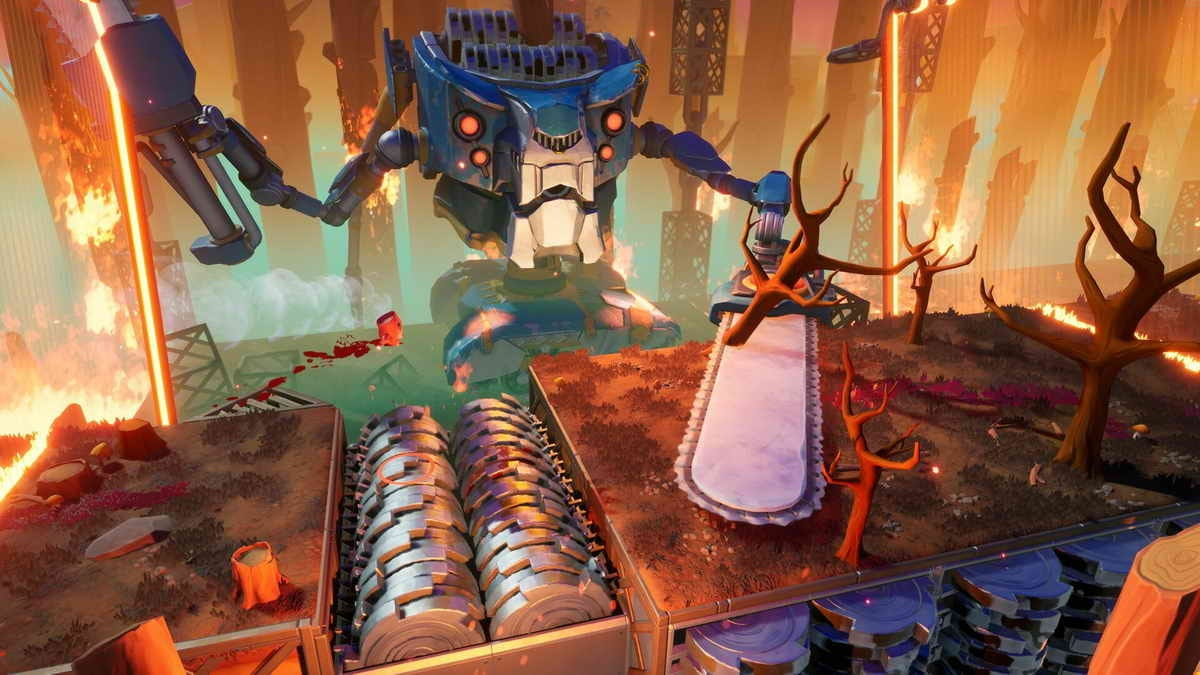
Super Meat Boy 3D represents a bold but risky evolution for a franchise that built its identity on razor-sharp 2D precision. Developed by Sluggerfly in collaboration with Team Meat and published by Headup, this PlayStation 5 iteration attempts to translate the series’ famously punishing platforming into a fully three-dimensional space. The premise remains deliberately absurd and lightweight, centering on Meat Boy’s relentless quest to rescue Bandage Girl from a grotesque antagonist, but narrative has never been the draw here. Instead, the focus is squarely on mechanical execution – and it’s in that transition to 3D where the game finds both its most compelling strengths and a few slightly frustrating shortcomings.
Core gameplay still revolves around tight, reflex-driven platforming where momentum, timing, and spatial awareness are everything. In its best moments, Super Meat Boy 3D successfully channels the same addictive loop that made the original so enduring: rapid retries, short levels, and the satisfaction of shaving seconds off a near-perfect run. The addition of depth introduces new traversal challenges, requiring players to think not just laterally but spatially, and this can elevate the experience when level design fully embraces the added dimension. However, that same shift also exposes cracks, as the increased complexity can make movement feel less readable and deaths occasionally feel less deserved than in its 2D predecessor.
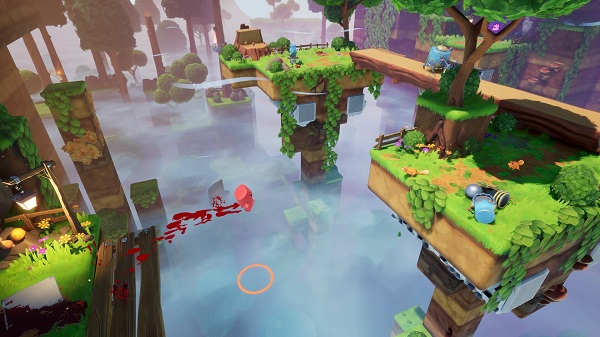
Controls are responsive in a technical sense, but they demand a higher degree of player adaptation due to the 3D perspective. Precision remains the cornerstone, yet judging distances and angles isn’t always intuitive, especially in later levels where hazards stack aggressively. While seasoned players may eventually acclimate, there’s a recurring sense that the game is fighting against its own design ambitions. Camera behavior, in particular, can be a point of contention, sometimes obscuring things or making already demanding sequences feel unfair. This slightly undermines the otherwise meticulous design philosophy that defined earlier entries.
Level design oscillates between inspired and overly punishing. When the game leans into clear visual language and well-structured obstacle placement, it delivers exhilarating sequences that reward mastery and persistence. But as difficulty ramps up, the line between “challenging” and “chaotic” begins to blur. Some stages rely heavily on memorization or trial-and-error rather than skillful execution, which can erode the sense of fairness the series is known for. The inclusion of tougher “Dark World”-style content amplifies this divide, catering to hardcore players while potentially alienating others.
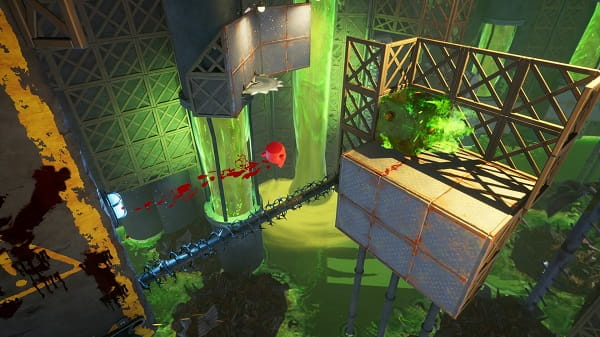
Visually, the transition to 3D is functional and rarely uneven. The environments are varied, ranging from industrial hazards to organic, decaying landscapes, and they often succeed in conveying a grimly playful tone consistent with the franchise. Yet the overall presentation lacks the distinct clarity and charm of the original’s 2D aesthetic, sometimes making it harder to parse environmental hazards at a glance. Performance on PS5 is generally stable, which is crucial for a game so dependent on timing, but visual readability occasionally takes a hit due to environmental clutter and perspective shifts.
Audio design continues the series’ tradition of energetic, irreverent soundscapes. The soundtrack complements the fast-paced gameplay well, reinforcing the intensity of each run while maintaining a slightly chaotic edge that matches the on-screen action. Sound effects remain punchy and effective, clearly signaling jumps, impacts, and hazards. However, the audio rarely stands out as a defining feature, instead serving as a solid but secondary layer to the gameplay experience.
Ultimately, Super Meat Boy 3D is a fascinating but imperfect reinvention. It captures the spirit of its predecessor in bursts, delivering moments of genuine exhilaration when its systems align, but it struggles to consistently translate the purity of 2D precision into a 3D framework for its entire runtime. For fans willing to adapt to its quirks, there’s a rewarding challenge to be found, but it lacks the elegance and immediate readability that made the original a genre benchmark. This is a sequel that proves the concept works – but also highlights just how difficult it is to get right.
Score: 7.8/10
 Press Play Media