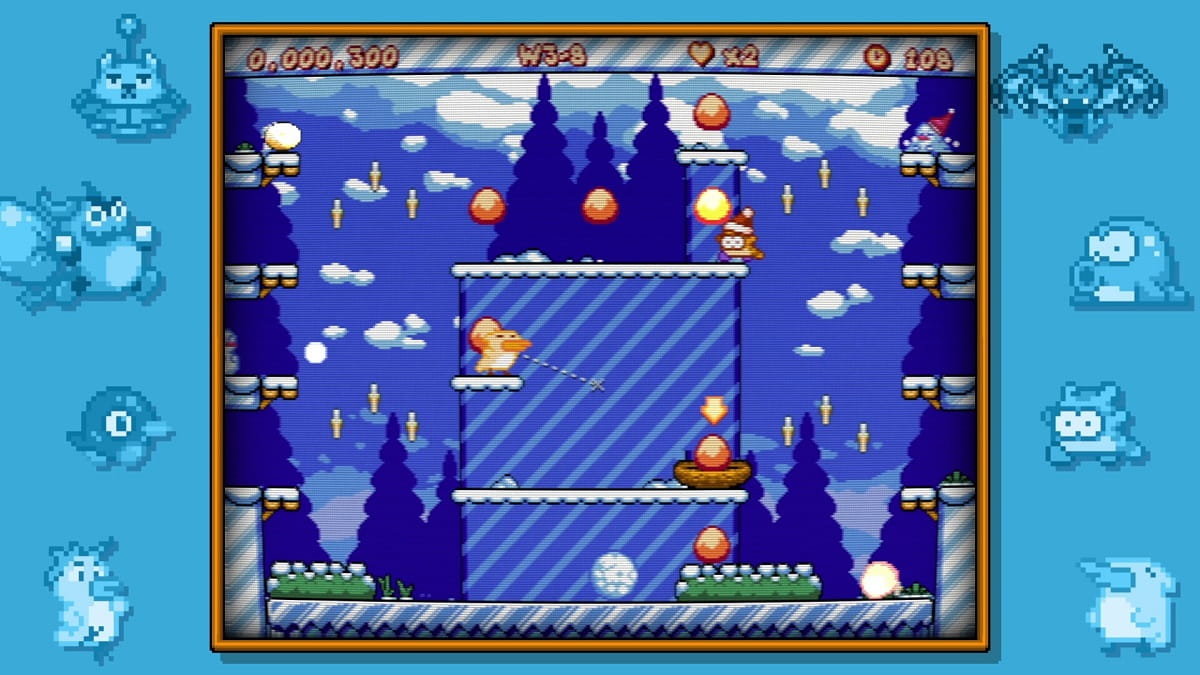
Go! Go! Mister Chickums arrives on PlayStation 5 as a deliberately old-school platformer, drawing heavily from the single-screen arcade design philosophy that defined much of the 1980s (think Donkey Kong, Bubble Bobble, etc). Developed and published by com8com1 Software, it frames its premise with a simple, almost cartoonishly playful setup: a determined chicken sets out to recover stolen eggs from a mischievous antagonist. It’s a narrative that exists largely as a functional excuse to propel the action forward, but in doing so it captures the immediacy and clarity that its inspirations relied on. That simplicity works in its favor early on, though it also means there’s little in the way of evolving stakes or narrative payoff as the experience progresses.
The core gameplay loop is built around navigating compact, single-screen levels filled with platforms, hazards, and patrolling enemies, all while racing against a ticking clock. Each stage is effectively a contained puzzle of movement and timing, requiring players to collect eggs efficiently while avoiding or outmaneuvering threats. There’s an undeniable purity to this design, and at its best it channels the “just one more try” (or quarter) energy that defined arcade classics. However, that same rigidity can occasionally work against it, as repetition begins to creep in over extended sessions, particularly when level concepts start to blur together.
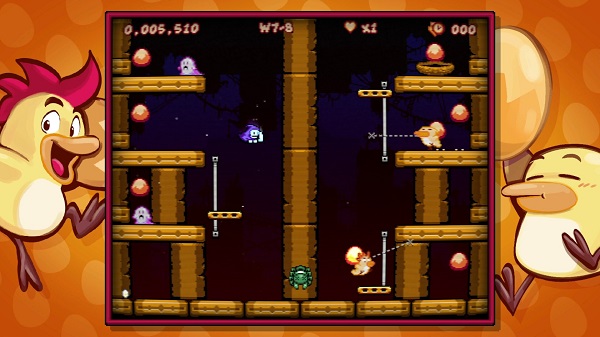
What helps sustain engagement is the gradual introduction of new enemy behaviors and environmental twists, which force players to adapt their approach rather than simply relying on muscle memory. Some enemies demand precise timing to bypass, while others require more strategic positioning, lending the game a light tactical layer beneath its reflex-driven surface. Even so, difficulty spikes can feel uneven, with certain stages leaning more toward trial-and-error than skill-based mastery until you get past their difficulty curve, a balance that may frustrate players expecting a smoother difficulty curve.
Controls are, for the most part, responsive and well-suited to the demands of tight platforming. Movement feels snappy, jumps are predictable, and the game rarely punishes players for input ambiguity. This is crucial in a title so dependent on precision, and it ensures that failures are generally attributable to player error rather than mechanical shortcomings. That said, the increasing pace and density of later levels can expose how little margin for error the game allows, occasionally making success feel more like survival than controlled execution.
Visually, Go! Go! Mister Chickums leans into a colorful, retro-inspired aesthetic that complements its arcade sensibilities. Character designs are charming in a simple, exaggerated way, and the bright, readable environments ensure that gameplay clarity is never compromised. While the presentation is cohesive, it also lacks variety over time, with repeated visual motifs reinforcing the sense of sameness that emerges across its 100 levels. The soundtrack, meanwhile, proves to be a stronger asset, delivering upbeat, energetic compositions that align well with the game’s pace, even if the loops can become noticeable during longer play sessions.
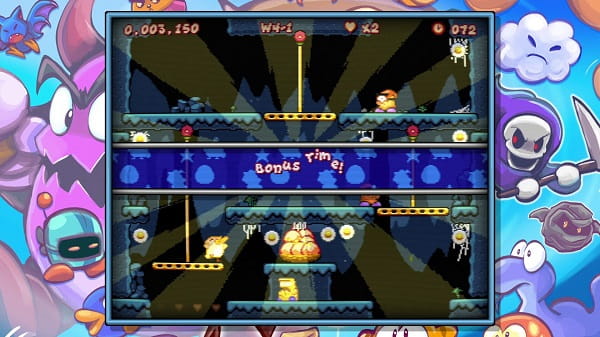
One of the more notable inclusions is local co-op, which allows a second player to join in as a supporting character. This addition injects a welcome layer of chaos and coordination into the experience, transforming what is otherwise a solitary, precision-focused game into something more dynamic and social. It doesn’t fundamentally alter the structure, but it does provide an alternative way to engage with the content, particularly for players looking to share the challenge with someone else.
Ultimately, Go! Go! Mister Chickums succeeds in capturing the essence of classic arcade platforming, delivering a tightly constructed experience that prioritizes immediacy and mechanical clarity. Its strengths lie in its focused design and accessible pick-up-and-play structure, but those same qualities also limit its long-term appeal, as repetition and uneven difficulty begin to surface. For players with a strong affinity for retro-inspired challenges, there’s a satisfying core to uncover here, with its commitment to classic arcade design as its greatest strength.
Score: 8.1/10
 Press Play Media