Virtual reality continues to offer new experiences, and the latest wave of releases highlights just how broad – and occasionally fragmented – those can be. From experimental mixed reality concepts that quite literally map gameplay onto your living space, to physics-driven brawlers that lean into chaotic immersion, and even educational experiences that blur the line between game and virtual tourism, there’s a clear sense that developers are still actively defining what VR can and should be. This roundup brings together three recent Quest titles that each approach that question from a very different angle, showcasing both the creative ambition driving the medium forward and the growing pains that come with it.
Xploit ZERO review (Quest)
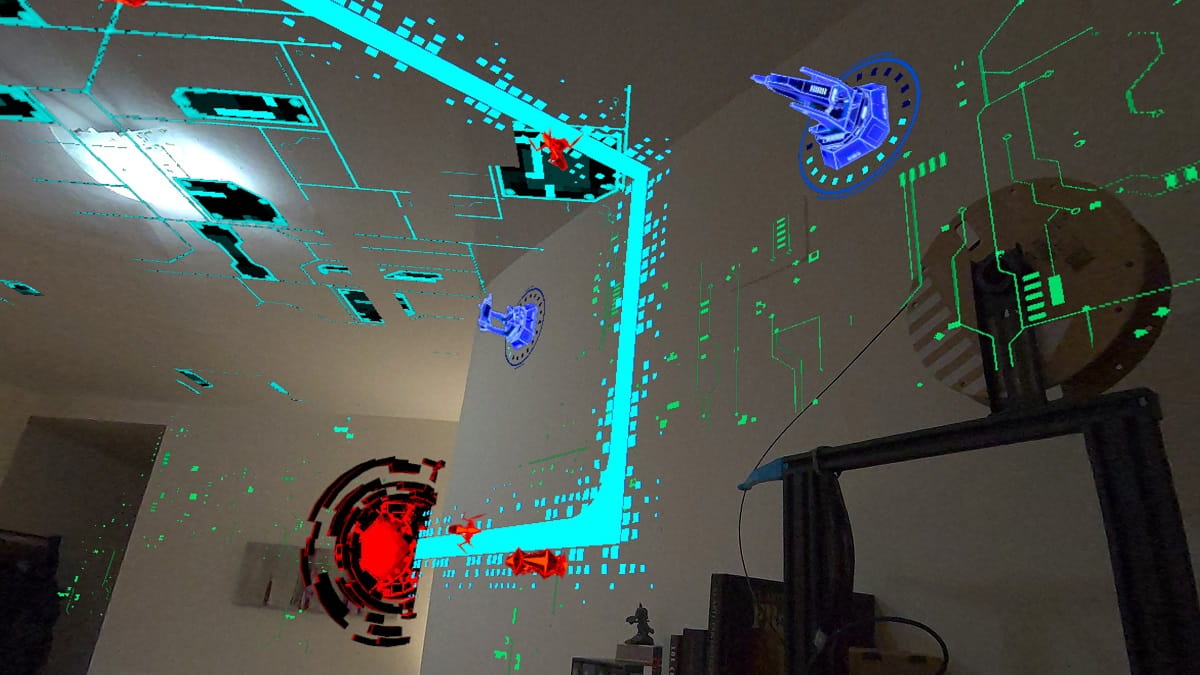
Xploit ZERO is a unique mixed reality tower defense experience that fully commits to the idea of turning your living space into a battlefield, and it’s in that spatial integration where the game immediately distinguishes itself. Rather than relying on a traditional grid or abstract map, the action unfolds across your actual room, with enemy paths dynamically stretching over floors, walls, and ceilings. This gives the premise a tangible immediacy that elevates it beyond a simple gimmick, even if its narrative framing – centered around defending a central hub from digital incursions – remains functional rather than deeply developed.
That physicality carries directly into the gameplay loop, which is far more active than most tower defense titles. Placing turrets is only part of the equation, as you’re constantly moving to collect resources, reposition yourself for better angles, and manually intercept incoming threats that can instantly dismantle your defenses. The result is a hybrid of strategic planning and reflex-driven multitasking that feels fresh, though it can also become overwhelming surprisingly quickly as multiple systems demand attention at once. The reliance on your real-world play space adds another variable – larger rooms allow for more manageable enemy paths, while tighter areas can make the experience feel cramped and significantly more punishing and overwhelming.
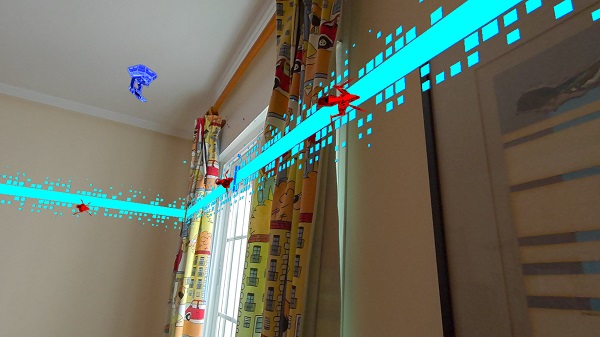
Controls lean heavily into hand tracking and physical interaction, and while this reinforces immersion, it also introduces occasional friction when precision is required under pressure. Swatting away incoming projectiles or grabbing falling resources works well in principle, but the intensity of later waves can expose small inconsistencies in responsiveness. Where the game truly excels, however, is in its audio design. Spatial cues play a critical role in awareness, guiding your attention toward threats and resources outside your immediate field of view, and this creates a strong sense of presence that compensates for visuals that, while stylistically cohesive with their neon-infused aesthetic, remain relatively modest in technical ambition outside of the impressive use of mixed reality.
As an Early Access release, Xploit ZERO already demonstrates a solid mechanical foundation and a compelling use of mixed reality that feels more fully realized than many comparable experiments. At the same time, its content offering and turret variety still leave room to grow, and the demanding physical requirements mean it won’t be equally accessible in all environments. For players with the space to accommodate it, though, this is an engaging and often intense reinterpretation of tower defense that thrives on its ability to blur the line between game space and living space, even if it hasn’t yet fully capitalized on all of its potential.
TaVRn’s Takedown – Naheulbeuk review (Quest)
TaVRn’s Takedown – Naheulbeuk is a chaotic, physics-driven VR brawler, but it quickly becomes clear that it aims for more than just mindless tavern violence. Set within the absurd Naheulbeuk universe we’ve seen before, the game leans heavily on humor and personality, supported by a surprisingly strong introduction and voice work that helps establish its tone early on. While the narrative never becomes the main driver, it adds just enough context and charm to elevate the experience beyond a simple sandbox of bar fights, even if the premise ultimately remains fairly lightweight.
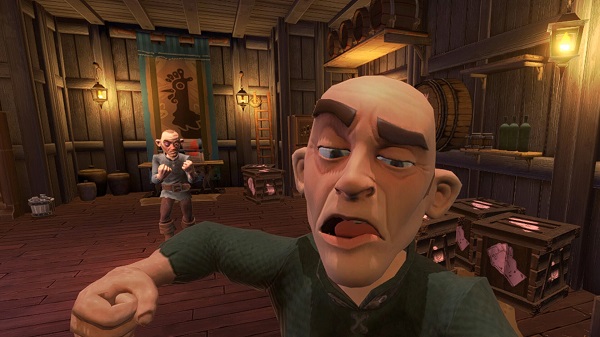
Combat is where the game finds its footing, delivering punchy, tactile interactions that make full use of VR’s physicality. Swinging stools, hurling mugs, and landing exaggerated uppercuts all feel impactful, with enemies reacting in satisfyingly over-the-top ways that reinforce the game’s cartoon logic. Compared to other VR brawlers, there’s a noticeable emphasis on responsiveness and weight, avoiding the floatiness that can sometimes plague the genre. At the same time, the chaos is intentionally unstructured, which makes for great moment-to-moment fun but can occasionally feel shallow once the novelty begins to wear off.
What helps sustain engagement is the layer of progression and variability woven into each run. Power-ups and equippable gear introduce meaningful tweaks to gameplay, from altering cooldowns to boosting weapon effectiveness, while more outlandish modifiers inject unpredictability into fights. The system encourages experimentation, and with multiple unlockable abilities and upgrade slots, there’s a decent sense of build customization. Even so, the overall content offering feels somewhat limited, with sessions that can feel a bit short-lived once players have sampled the available variety.
Visually, the game adopts a stylized, cartoony aesthetic that aligns well with its comedic tone, even if it won’t appeal to everyone. The presentation is polished for a Quest title, with smooth performance and consistent animation helping to maintain immersion. Audio plays a strong supporting role, particularly through its voice acting, though some control quirks – such as slow turning speeds – can occasionally disrupt the flow of play. Ultimately, TaVRn’s Takedown thrives as a chaotic, accessible VR brawler with more depth than expected, even if its longevity doesn’t quite match its initial burst of energy.
Ludwig II – Virtual: Neuschwanstein (Quest)
Ludwig II – Virtual: Neuschwanstein is less as a traditional game and more of an interactive historical experience, inviting players to step inside one of Germany’s most iconic castles and explore the life and ambitions of its enigmatic creator. That framing largely defines what works and what doesn’t. When it leans into its strengths – recreating spaces and presenting them in an accessible, immersive format – it can genuinely feel like a virtual field trip, offering a convincing sense of place even for those who have never visited the real location. At the same time, expectations of a more dynamic or narrative-driven experience may go unmet, as the structure is closer to a guided educational tool than an evolving VR adventure or hands-on experience.
The core interaction revolves around exploration and information discovery, though the degree of agency varies depending on the scene. Some environments allow for free movement through detailed 3D reconstructions, while others feel more constrained, resembling curated viewpoints or staged presentations rather than fully explorable spaces. This inconsistency can create a disconnect, especially for users expecting seamless navigation throughout. Still, where interactivity is present, it works well enough to support the experience’s educational ambitions. The amount of content, however, feels somewhat limited, with roughly an hour of material currently available, leaving a sense that the experience could benefit from further expansion over time.
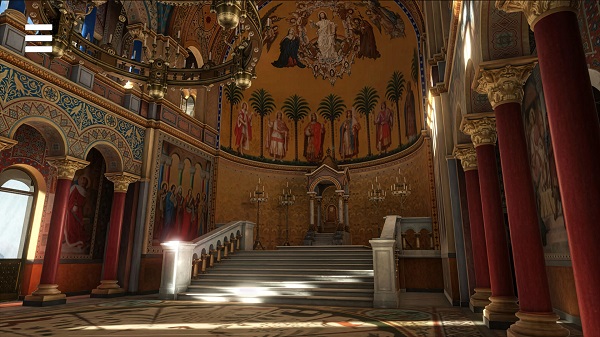
Visually, the experience is often impressive, with high-resolution textures and carefully recreated interiors that convey a strong sense of authenticity. Performance is also a notable strength, which helps sustain immersion. However, not all visual elements are equally convincing, with some scenes or assets lacking the same level of polish, and certain stylistic choices – such as the integration of AI-assisted imagery – may not resonate with everyone. The audio component, including narration, supports the educational tone but can come across as somewhat utilitarian rather than engaging. Taken as a whole, Ludwig II – Virtual: Neuschwanstein succeeds as a visually solid and technically stable virtual tour, but its limited interactivity and uneven presentation mean it will primarily appeal to those specifically interested in history and architecture rather than players looking for a more game-like VR experience.
 Press Play Media