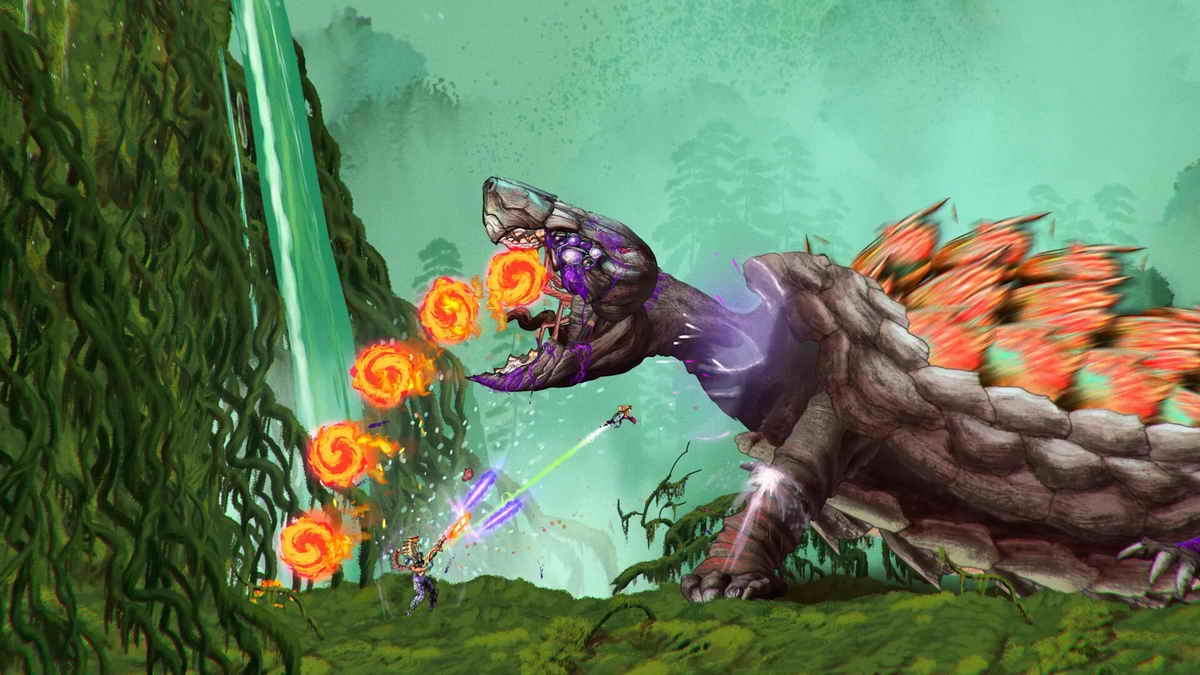
ChainStaff, developed and published by Mommy’s Best Games, brings a strikingly unconventional action concept to PlayStation 5 – one that fuses arcade immediacy with a mechanical hook that feels both elegant and demanding. Set against a backdrop of alien infestation and grotesque biological mutation, the game leans into a surreal, almost heavy metal album-inspired tone, where the protagonist’s fusion with a parasitic entity becomes both narrative driver and gameplay enabler. While the premise is intentionally pulpy, it establishes a consistent thematic throughline that supports the game’s emphasis on risk-reward decision making, particularly when it comes to how players deal with stranded survivors and their own moral trajectory.
At the center of everything is the ChainStaff itself – a multi-purpose weapon that defines the entire experience. With a single-button input system, the game manages to extract surprising depth from contextual actions, allowing players to attack, defend, grapple, and reposition depending on timing and spatial awareness. This streamlined control scheme is remarkable for its ingenuity, though it also introduces a learning curve that can feel unintuitive early on, especially when precision is required under pressure. Mastery becomes less about memorizing inputs and more about understanding situational application, which creates a satisfying skill ceiling but can alienate players expecting more traditional twin-stick responsiveness.
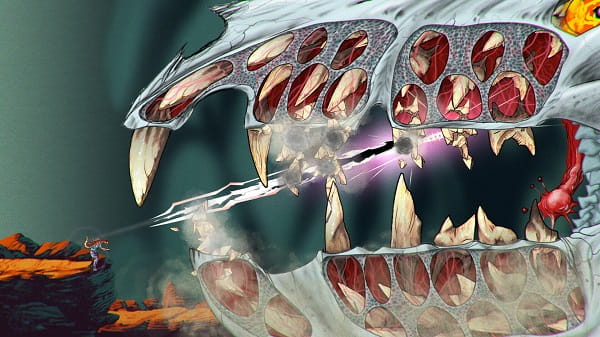
Combat encounters reinforce this design philosophy, throwing increasingly erratic and often overwhelming enemy patterns at the player. The mutated creatures range from erratic swarms to massive screen-filling bosses, each demanding careful positioning and efficient use of the ChainStaff’s defensive and mobility options. However, difficulty spikes and occasionally chaotic visual feedback can make encounters feel unfair, particularly when deaths occur in rapid succession without clear readability. While the game insists that every death is avoidable, the margin for error can be razor-thin, reinforcing its arcade lineage but also testing player patience.
Beyond combat, ChainStaff introduces a moral decision system that ties directly into progression. Players can choose to rescue stranded soldiers or harvest them for upgrades, a mechanic that adds a layer of strategic tension to exploration. This system is conceptually compelling, encouraging multiple playthroughs to uncover different outcomes, but its execution can feel somewhat binary in practice, with choices occasionally lacking the nuanced consequences one might expect from such a grim premise. Still, it adds a welcome layer of agency that complements the otherwise action-focused structure.
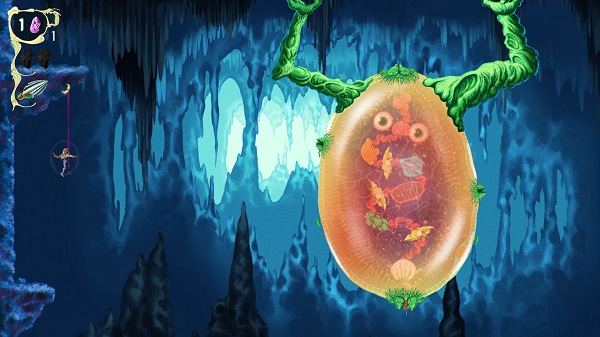
Visually, the game stands out with its hand-drawn aesthetic, heavily inspired by 70s and 80s rock and sci-fi art. The environments are richly textured and surreal, shifting from misty crags to alien-infested landscapes that feel both organic and otherworldly. This distinctive art direction is one of the game’s strongest assets, though the same visual density can sometimes work against gameplay clarity, particularly during hectic encounters where foreground and background elements blur together. It’s a case where style occasionally compromises function, even if the overall presentation remains memorable.
The audio design reinforces the game’s identity, driven by a hard-hitting soundtrack that blends metal riffs with synth interludes. The music injects energy into combat and exploration alike, maintaining a consistent momentum that aligns well with the game’s pacing. However, the intensity of the soundtrack can occasionally feel overwhelming during extended sessions, especially when paired with the already demanding gameplay loop. Still, it succeeds in establishing a strong audiovisual cohesion that few indie titles attempt at this scale.
Ultimately, ChainStaff is a game built around a single, brilliant idea – and it largely succeeds on the strength of that idea alone. Its commitment to a one-button, multi-function system results in gameplay that feels fresh and mechanically distinct, even if it comes with accessibility trade-offs and occasional frustration. Combined with its bold art direction and relentless pacing, it carves out a unique space within the action genre. For players willing to embrace its quirks and endure its difficulty spikes, ChainStaff offers a rewarding, if sometimes punishing, experience that lingers long after its final encounter.
Score: 8.0/10
 Press Play Media