With games like Another World and Heart of Darkness, Éric Chahi has been responsible for several iconic games over the past three decades. His most recent title, Paper Beast, recently received a PSVR2 version in Paper Beast – Enhanced Edition (which is also playable without VR). We caught up with him to find out more.
The PSVR2 version of Paper Beast features several enhancements. Can you share some specific examples of how the game leverages the headset’s capabilities?
We took advantage of the HDR capability of the PSVR2 headset, as its color range is much more vibrant than that of other headsets, with very subtle hue. So the light and color of each level in the game have been tuned precisely for this hardware.
Did you make any changes based on player and/or critical feedback?
Yes, many people wanted a continuous/free move option on the PSVR version, but unfortunately it was not possible for us to do it due to technical limitations of the PS4. The good news is that the PS5 version now has this long-awaited feature – it is possible to move freely in the landscape, making the interaction with creatures and the world more immersive than before. Another thing that we wanted to do was the light shaft effect. You know – these rays of light in the atmosphere when looking at a bright light source, which we included. We also extended the sandbox and the terrain is now bigger. Players can populate the world with many more creatures and entities, and plants grow and get bigger over each generation.

Paper Beast has a very striking and unique visual design. What can you tell us about the design process behind that?
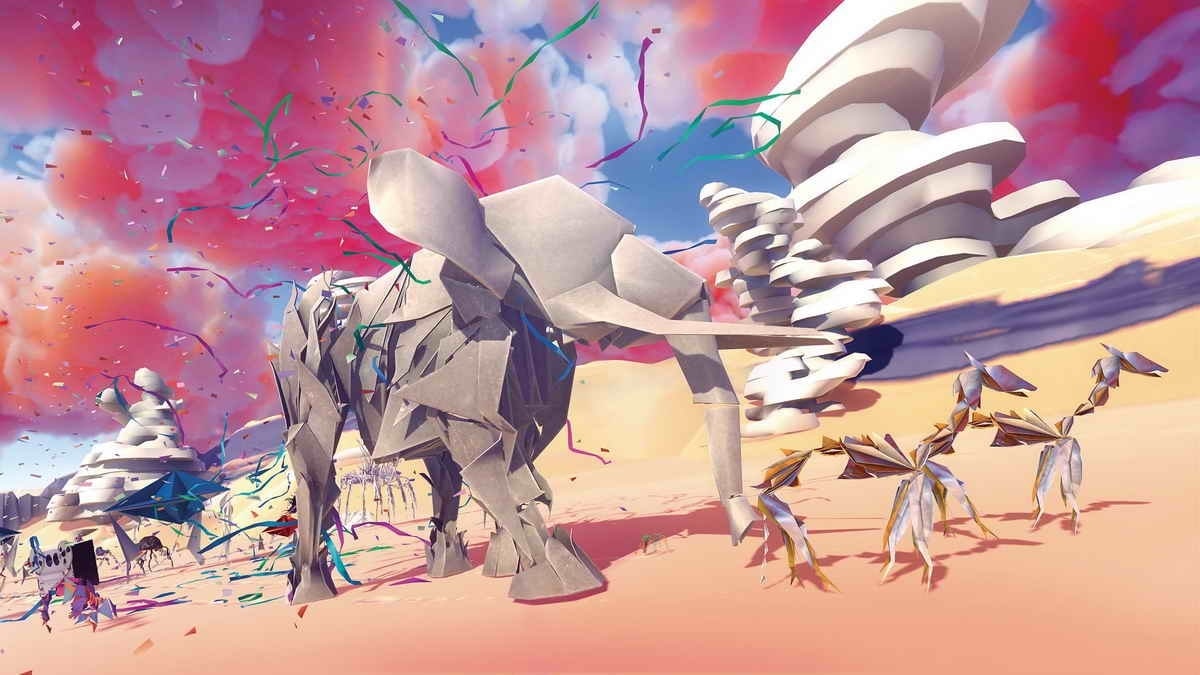
We decided to use paper origami creatures for both aesthetic and technical reasons. The advantage is that it demands fewer polygons to draw. It matches the physical structure of simulated bodies very well, and each part of a creature is a separate piece of origami. This way everything articulates well when it is in motion, and I want to point out that all creature motion is generated in real time by an algorithm. That’s why it was important to have something very modular for Paper Beast, so we had low poly meshes, and in contrast very high resolution textures. This last point is very important as a player can look at an animal very closely and see a lot of details that makes it very believable while being surrealistic at the same time. That was a good match. In the same way, all skies were super detailed. It was pre-rendered in Houdini, taking advantage of radiosity rendering that takes days to be calculated. These skyboxes that we created also illuminate all the models in the scene, giving everything a visual juice and consistency.
Can you elaborate on the enhancements made for the PS5/PSVR2 version?
The visual improvement is huge compared to the PS4 version. The lighting is better, with more light, a very soft hue and sharper shadows. One of the coolest features is the addition of animated textures on sand and water. Now players can see things flowing even at the level of sand grains. The audio of the original version was already so high that it needed no improvements, and I consider Paper Beast’s sound design as a pure masterpiece. I had the chance to work with an audio team that provided the best audio I’ve ever I had on any of the games I’ve created.

You were previously responsible for classics like Future Wars, Another World and Heart of Darkness. How does Paper Beast fit into your overall design philosophy?
It shares some common roots with Another World in that there’s no dialog and a world you don’t know but have to explore, and also with From Dust when you look at the terrain simulation. The narration is implicit, given by the world events and the player experience. It follows partly an improvisational creation process like Another World where the narrative and level has been created progressively and chronologically. On the other hand, it is also a departure, as it has a much more surrealistic universe than all previous titles. Another big difference is the use of simulation aspects to express meaning in the game – especially life simulation. This binds together living beings in a crazy universe with a tempest of paper, giant letters falling from a breach in the sky, becoming liquid and flooding the land. And because it is mainly a VR title, it totally changes the way in which players interact with and feel the space of the world.
Technology has evolved significantly since your earlier works. How has the advancement in technology influenced your approach to game development?
Yes, I’ve always been attracted by new tech. Every time I tried to bring a different way to use the technology, but it also has a cost. Often it demands a lot of research and optimization, and Paper Beast was a bit extreme in this sense, as it uses a massive amount of simulation for the terrain as well as the creatures. All of this in VR as well, which add another layer of complexity. For the future I want to be a bit less driven by technology, just to remove a layer technical stress, haha! Game creation is already tough enough by itself.
 Press Play Media