
Clock Tower: Rewind brings the suspense of one of the earliest survival-horror games to a new generation, capturing both the nostalgia and eerie simplicity that defined the original. First released in Japan in 1995, Clock Tower stands out as a classic in atmospheric horror, and this version’s updates make it accessible for both newcomers and longtime fans. The story centers on Jennifer, a teenage orphan navigating the unsettling Barrows family manor while trying to avoid the notorious Scissorman. With his oversized shears and slow, menacing pursuit, Scissorman remains one of the most iconic horror figures in gaming, and his presence is just as unnerving in this remake as it was in the original.
The game’s standout new feature is its Rewind mode, which introduces a few much-needed quality-of-life updates. The ability to save states, a newly animated intro, and the addition of a vocal theme song by Mary Elizabeth McGlynn give Clock Tower an updated flair without compromising the integrity of its 16-bit roots. Motion comics and an art gallery enhance the storytelling experience and offer behind-the-scenes glimpses that fans of horror gaming history will appreciate as well. These additions make Clock Tower accessible for modern players while staying true to its vintage horror aesthetic, while for those seeking a more authentic experience, there’s the Original mode. This presents the game in its untouched form, keeping the mechanics and challenges as they were in 1995, ensuring an experience that reflects the game’s original pacing and design.
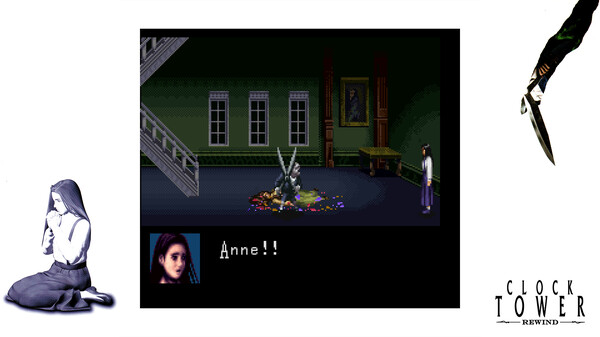
Gameplay remains simple yet effectively unnerving. The point-and-click mechanics task players with searching for clues and solving light puzzles, which sound straightforward but gain intensity under the threat of Scissorman. His presence drives tension, with the randomization of his appearances ensuring that players are never quite sure when they’re safe. Some may find this simplicity a bit outdated compared to modern survival horror mechanics, but the limited actions contribute to the feeling of vulnerability, a hallmark of Clock Tower’s scare tactics. The inclusion of multiple endings and random elements adds a surprising level of replayability, encouraging players to dive back in and explore different paths and outcomes, each with varying degrees of jump scares and psychological tension.
The game’s visual and audio updates succeed in heightening the atmosphere without detracting from its retro style. The 2D pixel art holds up well, with detailed animations that bring Jennifer and her horrifying surroundings to life. The audio design is particularly effective; the creaking floorboards, sudden loud noises, and Scissorman’s chilling snips create an atmosphere of dread that permeates the entire experience. While the game may lack the graphical polish of current gen horror titles, it makes up for it in atmospheric design and suspense, showcasing how effective minimalist horror can be. However, some may find the lack of modern visuals limiting, as the game’s reliance on pixel art could feel outdated for players unfamiliar with vintage games like Clock Tower.

Ultimately, though it may feel basic to some, Clock Tower: Rewind is a faithful recreation that preserves the original’s suspenseful horror. It successfully modernizes elements that enhance accessibility while respecting the simplicity that made it so groundbreaking. Scissorman’s relentless pursuit and the oppressive atmosphere in the Barrows manor maintain the sense of terror that cemented Clock Tower as a horror classic. For fans of survival-horror and gaming history, this is both a tribute to and a revival of an iconic, genre-defining title. The minimalist approach to horror here shows that a game doesn’t need complex graphics or mechanics to leave a lasting, haunting impact.
Score: 7.0/10
 Press Play Media