
No fewer than four (!) recent console posts are included in today’s port roundup, as we check out Copycat, Knight’s Night!, Ratshaker and Kvark on PlayStation and Xbox.
Copycat review (PS5)
Now available on PlayStation 5 following its earlier PC release, Copycat stands out as a heartfelt narrative-driven indie game that blends feline perspective with deeply human (and relatable) emotion. You play as Dawn, a stray cat who’s used to fending for herself until she’s unexpectedly adopted by Olive, an elderly woman mourning the loss of her previous pet. What follows is a slowly building emotional bond between two wounded souls – until illness and an unexpected impostor turn the story in a new, melancholic direction.
Gameplay-wise, Copycat is minimalist and contemplative. It prioritizes storytelling over challenge and gameplay mechanics, with light interaction and exploration that let players absorb the atmosphere and emotional beats at their own pace. While some might find the pacing a little too relaxed, others will appreciate the meditative quality it brings. The game focuses on internal growth and personal discovery more than puzzle-solving or platforming.

Visually, the game adopts a soft, hand-drawn style that reinforces its gentle but somber tone. The environments – ranging from cozy interiors to stark urban alleys – are simple but effective. The real strength lies in the audio, particularly the nuanced voice acting and the subtle, moving soundtrack that supports the emotional highs and lows of Dawn’s journey.
While some mechanical hiccups – like the occasional awkward transition or camera angle – detract slightly from the experience, they don’t overshadow what Copycat accomplishes at its emotional core. It’s a brief but moving tale about identity, loss, and what it means to find and lose a home. For players open to a slow-paced narrative wrapped in an animal’s point of view, this is a touching story worth exploring.
Knight’s Night! review (PS5)
Now available on PlayStation 5 after its original PC debut, Knight’s Night! delivers a minimalist but challenging retro-style platformer that leans heavily into its 1-bit aesthetic. Taking on the role of a lone knight on a mission to storm a dark wizard’s castle, you’ll work through a series of compact, carefully constructed levels filled with hazards and secrets. There’s no elaborate storytelling here – the premise is kept deliberately simple, which suits the game’s throwback style, though it may feel a bit too barebones for some players.
Where the game shines is in its level design and mechanics. Despite the visual simplicity, each level is handcrafted with attention to layout, encouraging players to not only survive the traps and enemies but also explore thoroughly for hidden collectibles. Unlocking new abilities as you go keeps the platforming from becoming stale, and there’s a rewarding sense of progression as you gradually master the movement and environmental challenges. That said, Knight’s Night! can be unforgiving at times, and a lack of mid-level checkpoints may lead to some frustrating deaths and repetition.
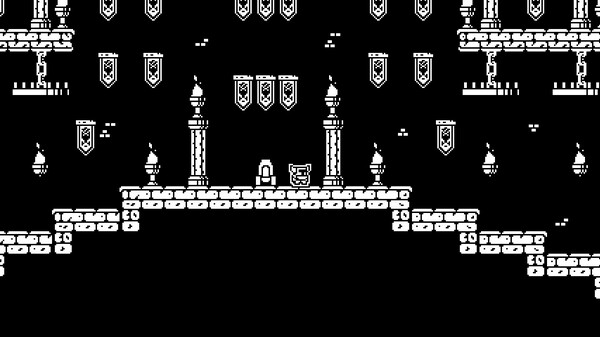
Visually, the game is unapologetically committed to its 1-bit black-and-white style, which gives it a distinct charm but also makes some gameplay elements harder to distinguish at times. The environments rely on sharp contrasts between light and shadow to evoke a brooding, night-time atmosphere, and while this look won’t be for everyone, it’s impressively consistent. Sound design is similarly retro, with minimalistic effects and looping chiptune music that reinforce the game’s retro identity.
Ultimately, Knight’s Night! is a short but solid experience for fans of classic precision platformers. It won’t win over players looking for narrative depth or visual spectacle, but its tight controls, clever level layouts, and commitment to old-school design make it a compelling option for genre enthusiasts – especially those who don’t mind a few spikes in difficulty along the way.
Ratshaker review (PS5)
Ratshaker, developed by Sunscorched Studios, initially presents itself as a quirky, low-budget indie game where players shake a cartoonish rat using the PlayStation 5’s DualSense controller. However, this seemingly simplistic and almost silly premise quickly evolves into a surreal and unsettling experience. The game begins with players engaging in the titular rat-shaking mechanic, which fills a meter necessary for progression. This mechanic, while humorous at first, soon reveals deeper layers as the rat begins to speak, offering cryptic and disturbing commentary that hints at a more profound narrative.
As players advance, the game transitions from its initial absurdity into a psychological horror experience. The environment becomes increasingly eerie, with the once simple setting giving way to a haunting atmosphere filled with unsettling imagery and sound design. The rat’s dialogue grows more intense, challenging players’ perceptions and adding to the game’s disturbing ambiance.

The DualSense controller’s features enhance the immersive experience, making the act of shaking the rat feel more tangible and, at times, disconcerting. The game’s short runtime, approximately 30 minutes to an hour, is packed with moments that leave a lasting impression, prompting players to reflect on the underlying themes presented.
While Ratshaker’s gameplay mechanics are minimalistic, the game’s strength lies in its ability to subvert expectations and deliver a thought-provoking narrative. It’s a unique title that challenges players to look beyond its bizarre premise and engage with the deeper story it tells. For those seeking an unconventional gaming experience that blends dark humor with psychological horror, Ratshaker offers a memorable journey into the surreal – with a price tag to mimic its short runtime.
Kvark review (Xbox)
Kvark arrives on Xbox (and PlayStation) after an earlier PC release and delivers a throwback to late 90s first-person shooters – gritty, atmospheric, and laced with darkly comedic satire. Developed by Latest Past Studio and published by Perun Creative, the game leans heavily into its Eastern European dystopian tone, pairing bleak industrial environments with propaganda-laced absurdity. From the moment you step into the halls of a radiation-soaked facility supposedly brimming with order and safety, the oppressive worldbuilding is felt not just through its narrative setup but also in its grimy, minimalist presentation.
The comparison to games like Half-Life and S.T.A.L.K.E.R is impossible to avoid, especially in how Kvark blends scripted environmental storytelling with puzzle-solving and retro-styled shooting. Combat is deliberately paced, often placing you in claustrophobic spaces where every shot counts. Enemies are visually distinct if not particularly clever, and the arsenal, while not expansive, feels punchy and tactile. However, the AI can be inconsistent, which slightly dulls the impact of the more intense firefights. That said, the game balances exploration and combat well, with occasional detours for keycard-hunting or physics-based challenges that feel rewarding despite their familiarity.
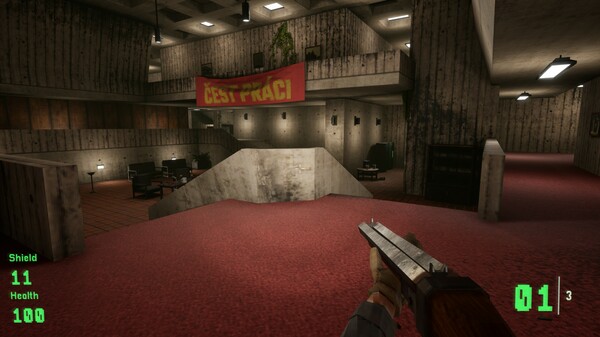
Visually, Kvark embraces a lo-fi aesthetic that contributes to the eerie tone, with heavy use of shadows, muted colors, and crumbling industrial assets that reflect the setting’s dangerous decay. The environments are well-realized even if some areas start to feel a bit repetitive over time. The ambient audio design, filled with mechanical hums and unsettling silence, further supports the tension – though voice acting and occasional lines of dark humor inject welcome contrast.
Kvark might not revolutionize the genre, but for fans of classic PC shooters who enjoy oppressive sci-fi settings and a dash of subversive humor, it hits the mark. Its mix of atmosphere, solid gunplay, and puzzle-solving recalls a very specific era in gaming, and while it doesn’t always shake off its inspirations or low-budget limitations, it’s an intriguing and memorable descent into a dystopian rabbit hole and a good reminder of why some classic shooters are so beloved. And sometimes, that’s more than good enough.
 Press Play Media